Draw Nyquist Plot By Hand: Learn How to Determine Stability

  • Thread starter Thread starter Bypass
  • Start date Start date
  • Tags Tags
    hand Plot
Click For Summary
To draw a Nyquist plot for stability analysis, substitute s with jω in the transfer function and calculate the complex value of the denominator at various ω values. Key points to plot include ω = 0, where the plot approaches infinity, and ω = infinity, where it approaches zero. The imaginary intercept is identified as 1.25, while the real intercept requires careful evaluation, potentially leading to zero. A systematic approach involves testing values like ω = 1, 2, 3, and refining based on the distance between points to ensure accuracy. This method helps determine how many times the Nyquist plot encircles the -1 point, which is crucial for assessing system stability.
Bypass
Messages
2
Reaction score
0
I am trying to understand how to draw nyquist plot.
Lets say the transfer function is
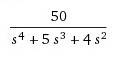
G1Dqr.jpg

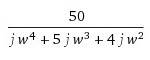
Subbing in jω for s,

Z1S5b.jpg
***Note: should be (jw)^4 , (jw)^3, (jw)^2

Then separating the Real and Imaginary part,
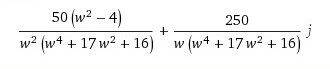
yvAZD.jpg

So when
w = 0, in the nyquist plot it is infinity
w = infinity, it is 0
Imaginary intercept is 1.25
For real intercept I am not sure. Since imaginary part is 0 only when w is infinity, i plug in infinity for w in real part. Would the real intercept be infinity or 0? It would be infinity/infinity but numerator is lower order than higher order so would it be 0 instead?

In any case, how am i supposed to plot the rough nyquist plot or at least be able to determine the stability using these 4 points?

In Matlab the Nyquist plot comes out like this
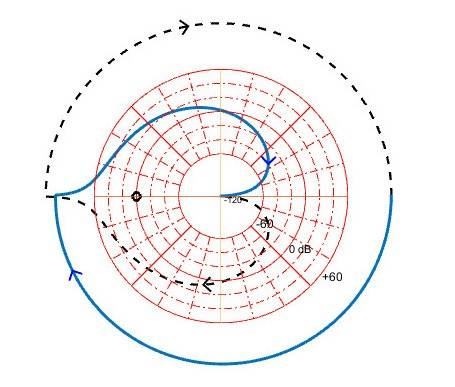
eB4Zn.jpg
 

Attachments

  • G1Dqr.jpg
    G1Dqr.jpg
    1.4 KB · Views: 467
Last edited:
Engineering news on Phys.org
Sorry, I cannot see what you are doing. You have:

G1Dqr.jpg

Substituting s with jω, you should get:

50 / ( ( jω )4 + 5( jω )3 + 4( jω )2 ) =

50 / ( ω4 - j5ω3 - 4ω2 )

Now, choose a ω and calculate the complex value of the denominator. Do the division and plot the result.

Example: ω=1 → point = ( -4.412 + j7.353 )
 
Last edited:
Hesch said:
Sorry, I cannot see what you are doing. You have:

G1Dqr.jpg

Substituting s with jω, you should get:

50 / ( ( jω )4 + 5( jω )3 + 4( jω )2 ) =

50 / ( ω4 - j5ω3 - 4ω2 )

Now, choose a ω and calculate the complex value of the denominator. Do the division and plot the result.

Example: ω=1 → point = ( -4.412 + j7.353 )

Sorry about that, just a typo. But it is not possible to plug in every single point that encircles the RHP of S-Plane to see how many times the nyquist plot encircles -1 to determine the stability. So my question is what are some key points that I need to plot so I can determine stability of a closed loop system.
 
Try ω = 1, 2, 3, 4 . . . .

If distances are to small then continue: . . . . 8, 16, 32

If distance is to large between ω=2 and ω=3, then try ω=2.5. It's a "cut and try" process.
 
Had my central air system checked when it sortta wasn't working. I guess I hadn't replaced the filter. Guy suggested I might want to get a UV filter accessory. He said it would "kill bugs and particulates". I know UV can kill the former, not sure how he thinks it's gonna murder the latter. Now I'm finding out there's more than one type of UV filter: one for the air flow and one for the coil. He was suggesting we might get one for the air flow, but now we'll have to change the bulb...

Similar threads

  • · Replies 1 ·
Replies
1
Views
3K
  • · Replies 3 ·
Replies
3
Views
2K
  • · Replies 1 ·
Replies
1
Views
2K
  • · Replies 2 ·
Replies
2
Views
6K
Replies
2
Views
2K
  • · Replies 14 ·
Replies
14
Views
9K
  • · Replies 3 ·
Replies
3
Views
5K
Replies
1
Views
2K
  • · Replies 3 ·
Replies
3
Views
2K
Replies
7
Views
4K