Drawback of dimensional analysis - motion in a resistive medium

Click For Summary
SUMMARY

The forum discussion centers on the limitations of dimensional analysis in understanding motion in a resistive medium, particularly when a particle with initial velocity \(v_0\) travels through a medium where the resistive force is proportional to the square of its velocity. Participants highlight that while dimensional analysis suggests a finite distance, the mathematical solution indicates that the distance traveled approaches infinity over time due to the logarithmic nature of the solution. The conversation emphasizes that in real-world scenarios, static friction eventually halts motion, contrasting with the theoretical model where velocity asymptotically approaches zero without ever reaching it.

PREREQUISITES
  • Understanding of basic physics concepts, including motion and forces.
  • Familiarity with differential equations, specifically \(dv/dt = -kv^2\).
  • Knowledge of dimensional analysis and its applications in physics.
  • Basic grasp of friction types, including static and kinetic friction.
NEXT STEPS
  • Explore the implications of resistive forces in fluid dynamics.
  • Study the mathematical solutions of differential equations related to motion, particularly logarithmic solutions.
  • Investigate the role of static and kinetic friction in real-world applications.
  • Learn about the limitations of dimensional analysis in predicting physical behavior.
USEFUL FOR

Physics students, educators, and researchers interested in the complexities of motion in resistive media, as well as those examining the limitations of dimensional analysis in physical models.

brotherbobby
Messages
756
Reaction score
170
TL;DR
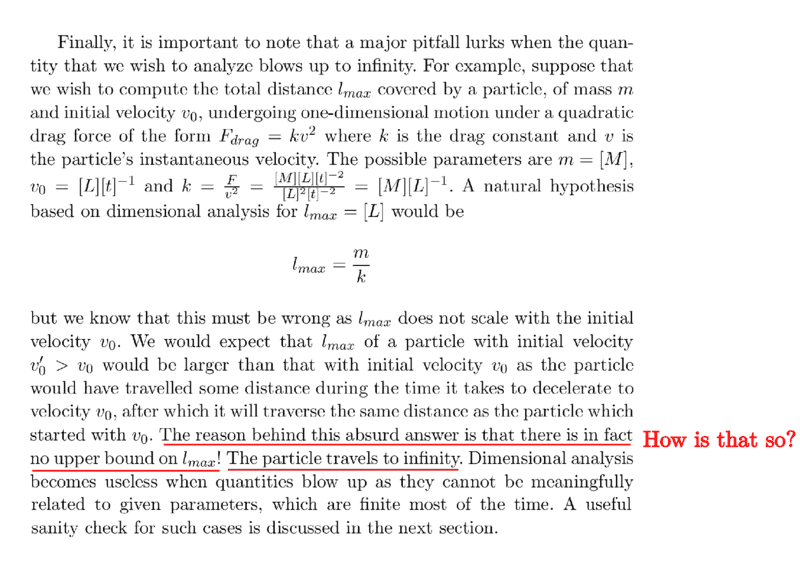
The author of a problem book on introductory mechanics discusses, in his first chapter, some of the drawbacks of dimensional analysis. Among others, he mentions the case of the distance travelled by a particle with some initial velocity in a resistive medium. I copy and paste the portion of the text below.

I hope someone can explain to me the meaning of the sentence I underline. I fail to see how ##l_{max}##, the total distance covered by the particle, can be indefinitely large.
Statement from the text : I copy and paste the portion of the text that am struggling to understand and underline in red the claim the author makes which I can't believe to be true.
1686683568219.png


Doubt : As you can read in the first line of the paragraph and in the one I underlined, the author believes that ##l_{max}## "blows up to infinity". But isn't it the case that a particle travelling with some initial velocity ##v_0## would come to a stop in a resistive medium after covering a finite distance?

A hint or help would be appreciated. Thank you for your time.
 
Physics news on Phys.org
Solving dv/dt = -v2 gives Δt ~ (1/vfinal)-1 which gives Δx ~ ln(1+Δt).
 
Last edited:
Thank you @Frabjous . Writing ##F = m\frac{dv}{dt} = -kv^2\Rightarrow \frac{dv}{dt}=-\frac{k}{m}v^2##, which, upon solving first for ##v## and then for ##x## gives what you wrote : ##\boxed{\Delta x = \frac{1}{\alpha}\ln\left(1+\frac{\alpha}{\beta}\Delta t\right)}##, where ##\Delta x## is the total distance travelled by the particle for a time ##t## and the constants ##\alpha = \frac{k}{m}## and ##\beta = \frac{1}{v_0}##, ##v_0## being the initial velocity.

So the conclusion is that for a length of time ##\Delta t## large enough, the distance travelled ##\Delta x## goes up indefinitely?

Also, doesn't it violate intuition? Don't you expect the particle to come to rest at some stage?
 
brotherbobby said:
doesn't it violate intuition? Don't you expect the particle to come to rest at some stage?

I too was taken aback for a few seconds. But in fact, this intuition is based on the fact that in the real world, there is always some static friction that kicks in below a certain velocity, bringing the object to a dead stop. In a situation without static friction the velocity only approaches zero without ever becoming actually zero.
 
yes @Swamp Thing , but there is one point that I failed to consider. The resistive force varies as a square of the velocity. Hence the smaller the velocity, the less the resistance. In high school physics, we speak of static friction (##\mu_S##) which has some maximum value and kinetic friction (##\mu_K##) which is lower than static friction and acts for as long as the body moves. Both these frictions have constant values. In fact, we don't talk of a velocity-dependent kinetic friction ##\mu_K(v)##. I am not sure frictional coefficients vary with velocity for moving bodies when both surfaces are solid. But surely they do when bodies move in fluids.

Here, as you said, the velocity will fall, which will make the frictional force fall, which in turn will make the velocity fall but less so. With the velocity never becoming zero, it is conceivable that the particle keeps moving for good.

I plot below the distance-time graph for the function ##x(t) = 0.5\ln (1+0.5t)##. I don't know if the coefficients are realistic. Upon zooming and going as far along the time axis as I could, I found that the distance covered doesn't end in a horizontal line.

1686749113757.png
 
ln(infinity)=infinity

If memory serves, there is a closed form solution for F=a+bv^2
 
I'm not really sure the author makes a very clear point. We usually use dimensional analysis to how things will scale in the physical constants. You can actually see from the full solution in post #3 that it does scale like dimensional analysis suggests, but there is an additional logarithmic factor. I think the author of the book simply asks too much of dimensional analysis.
 
brotherbobby said:
In high school physics, we speak of static friction (##\mu_S##) which has some maximum value and kinetic friction (##\mu_K##) which is lower than static friction and acts for as long as the body moves. Both these frictions have constant values.
Static friction doesn't have to be constant, the constant coefficient just tells you its maximal value, as you wrote.

The transition between sliding (kinetic friction) and grip (static friction) is complex. When you consider the macroscopic deformation of an object, static friction can be a function of that deformation and raises briefly to stop the object within the distance given by the limits of deformability, then goes to back zero once the deformation ceases.
 
Haborix said:
I'm not really sure the author makes a very clear point. We usually use dimensional analysis to how things will scale in the physical constants. You can actually see from the full solution in post #3 that it does scale like dimensional analysis suggests, but there is an additional logarithmic factor. I think the author of the book simply asks too much of dimensional analysis.
The author is showing where dimensional analysis fails. This is one example in that it cannot predict the factor under logarithmic (or exponential/trigonometric) expressions.
 
  • #10
It even does that in this case, dimensional analysis would give you a time scale ##\beta/\alpha##, using post #3 notation. The author already goes off the tracks by putting an equal sign between ##\ell_{max}## and the constants of equivalent dimension. I'd ignore this section of the book and maybe the whole book if it is full of this kind of thing.
 

Similar threads

  • · Replies 2 ·
Replies
2
Views
314
  • · Replies 20 ·
Replies
20
Views
1K
  • · Replies 1 ·
Replies
1
Views
3K