Drum rotation, lateral loads and point of pull

Click For Summary
SUMMARY

The discussion focuses on optimizing the design of a cable and drum system for water control in rice farming, specifically addressing the impact of winch height on lateral loads and leverage. The user employs a 24" water-tight rotary union and dual spool winch setup, with concerns about the angle of pull and its effect on the pedestal's stability. Key insights include that winch location does not influence the turning force but does affect bearing loads, and that guiding cables closer to the pedestal reduces lateral bending forces. The user is considering implementing cable guides and tensioning mechanisms to enhance system performance.

PREREQUISITES
  • Understanding of cable mechanics and tension forces
  • Familiarity with rotary unions and their applications
  • Knowledge of lateral load dynamics in mechanical systems
  • Experience with winch systems and their configurations
NEXT STEPS
  • Research optimal cable guide designs for reducing lateral loads
  • Explore the mechanics of tensioning systems for winch applications
  • Investigate the effects of winch height on mechanical stability
  • Learn about the use of idler pulleys in cable systems to balance forces
USEFUL FOR

Farmers, mechanical engineers, and designers involved in agricultural water management systems, particularly those working with cable-driven mechanisms and rotary unions.

Powderbullet
Messages
3
Reaction score
1
TL;DR
Using a winch cable to rotate a drum
I farm and have built water control devices for my rice operation that use a cable and drum setup. The moving part is a 24"water tight rotary union that we rotate with a cable that originates in a dual spool winch above the center line of rotation for the drum. The winch cables secure to the bottom of the drum by wrapping each side. So it is like a continuous loop back to the winch but the cables anchor beneath to the drum. My question has to do with angle of pull and lateral loads.

In the attached drawing you can see that example 1 (which only shows one side of the dual spool setup) puts the winch high above the drum. The point of pull is near the outside edge of the drum at the 9:00 position which means the lever is the greatest it can be and the lateral loads on the winch pedestal are a greater concern. Example 2 puts the winch lower, which moves the point of pull closer to center line and thereby reduces leverage but it also reduces the lateral load issue on the pedestal by allowing it to be shorter and thereby less likely to bend to the load. Is the angle of pull a key component or are the only 2 issues leverage and lateral loads?

I am thinking of putting a cable guide straight down the pedestal leg from the winch, which would allow me to set the guide / point of pull height above the drum anywhere I wanted it regardless of the height of the actual winch. So I am trying optimize the placement of the guide / point of pull for a 24" drum. Thanks for any suggestions!
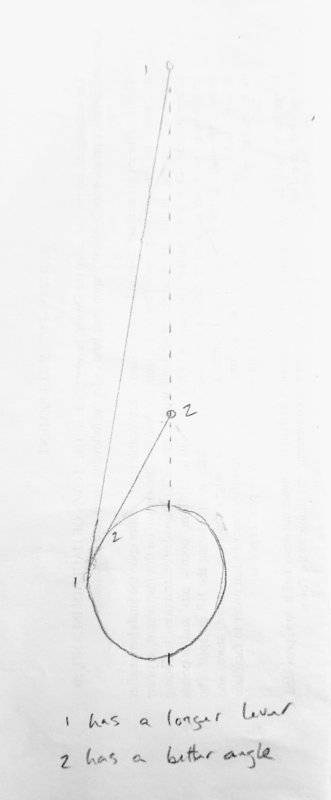
Winch positioning options.jpg
 
Engineering news on Phys.org
I assume that the center of rotation is the center of the circle you drew. Considering only turning the 24" drum, it does not matter where the winch is mounted. The location of the winch does affect the bearing loads on the 24" drum. You can pull up, sideways, or downward, and it will turn the drum exactly the same. The bearing loads will differ.

So put the winch where you want, but keep in mind that shorter cables are usually better because they are stiffer and so have better control.
 
As I understand it, the drum remains in position but rotates on it's axis to control water flow, possibly through the drum. I do not know how the drum is held in position, if it is.

A drum could be rotated by applying equal forces in opposite directions on either side of the drum. There would then be no side forces on the drum being rotated. There will be a force on a winch pulling one or more cables in the same direction. But a winch could be mounted with two cables so the side forces canceled by using idler pulleys.

The common mountings of the drum, pedestal and winch will be important. We really need a picture of the existing system, or a much better sketch, before we can analyse the situation with any confidence.
 
Thanks. Maybe the attachments will help. My concern is lateral / side loading of the pedestal more than bearing loads on the drum itself. I have assumed that there would be an optimal height above the center line of a 24" drum to either mount the winch or a cable guide, but that is just intuition. The cables attach to tabs at the bottom of the drum and the winch spools one cable in while spooling the other one out. Sometimes the winch is much higher above the drum than in the attached image. The box top in the image attaches to a water tight rotary union and the entire apparatus is attached to a drain pipe that goes through the levee to a ditch.

ar2_1489168903608.jpg
 
As @jrmichler pointed out you can place your winch where you want. The forces are the same.

Keep the wires close to the pedestal to reduce the pedestal side force. The pedestal only counters the tension in the wires, so minimise that. Wire tension arises from the sum of three things.

1. Pretension in the wire must be countered by the pedestal structure twice, permanently. By also clamping the wire at the winch drum, it may be possible to operate with a slightly slack wire to eliminate that component of the tension.

2. For a fixed diameter drum, the worst case tension in the one wire pulling to rotate the drum will also be countered by the pedestal structure, but only when moving the drum against friction.

3. Asymmetric buoyancy of the rotated box may also provide a tension in the wire, so long as the box remains in that position.
 
To reduce lateral bending forces on the column, the wires should be moved closer to the column. You might consider moving the column to one side of the drum rather than rising from the axis of the drum. One wire would then be vertical, and very close to the column. The other wire from the opposite side of the drum would pass through a captive pulley on the column, before heading up close to the first wire, to the winch at the top.
 
Ok this helps. Thanks. What I learned:

- winch location does not affect turning force in the drum but does affect bearing loads.
- lateral loads on the pedestal increase exponentially with pedestal height so guiding the cable straight down the pedestal part of the distance to the drum will reduce side bending force on the pedestal.
- longer cables will develop more slack over time.
- rather than guiding both cables to the center we could position the pedestal over the lifting cable (which requires more force) and guide the off side cable back to the pedestal. The drum only rotates 90 degrees when installed so one side is always the lifting side.

We also plan to build some sort of tensioning into guide(s). The cable not being pulled always has some slack, even when new, because we must allow for possible overwrap of cable in the spool. The slack is unsightly but has never caused an issue with function. We are looking at either garage door type torsion spring cable guides or roller guides that spring toward each other.

We would change to a curved rack and worm gear drive but have concerns about ice.

Thanks again for the suggestions.
 
  • Like
Likes anorlunda

Similar threads

  • · Replies 17 ·
Replies
17
Views
4K
  • · Replies 17 ·
Replies
17
Views
15K
Replies
9
Views
2K
  • · Replies 12 ·
Replies
12
Views
5K
  • · Replies 6 ·
Replies
6
Views
2K
  • · Replies 9 ·
Replies
9
Views
8K
  • · Replies 15 ·
Replies
15
Views
3K
Replies
3
Views
2K
  • · Replies 1 ·
Replies
1
Views
2K
  • · Replies 5 ·
Replies
5
Views
2K