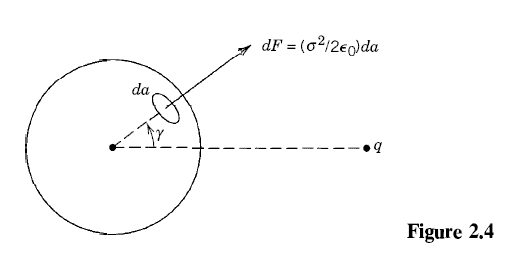
[E&M] Question on the Image charge method of a grounding sphere

Click For Summary
SUMMARY

The discussion centers on the Image Charge Method as applied to a grounding sphere, referencing Jackson's work. The potential for both the real charge and the image charge is established, leading to the calculation of the electric field and force on the real charge. Key equations include the electric field outside the surface as E = σ/ε₀ and the force per unit area derived from the Maxwell stress tensor, which states that dF = (σ²)/(2ε₀). The conversation highlights the complexities of defining the electric field at the surface of the sphere and suggests using the Heaviside step function for practical calculations.

PREREQUISITES
  • Understanding of electrostatics and electric fields
  • Familiarity with the Image Charge Method
  • Knowledge of Maxwell's equations and stress tensor
  • Basic calculus for integrating Coulomb's law
NEXT STEPS
  • Study Jackson's "Classical Electrodynamics" for deeper insights into the Image Charge Method
  • Learn about the Heaviside step function and its applications in electromagnetism
  • Explore the derivation of the Maxwell stress tensor and its implications in electrostatics
  • Investigate the mathematical conventions used in defining electric fields at boundaries
USEFUL FOR

Physicists, electrical engineers, and students studying electromagnetism, particularly those interested in electrostatic problems and the application of the Image Charge Method.

Shell_E
Messages
3
Reaction score
1
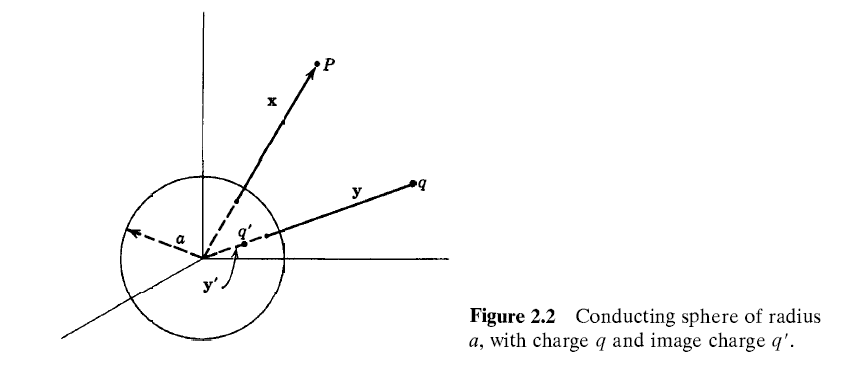
So I was reading Jackson's discussion on Image charge method of a grounding sphere.
1569989299202.png

He first assumed an image charge q inside Sphere with radius a, so the potential for real change and image charge is
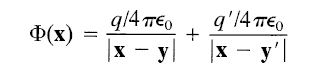
1569988859382.png
.
The by set potential equal to 0 at x=a, he solved q' and y'
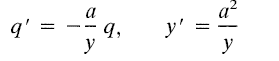
1569988905756.png

Then he can get potential, thus get E field, also can get force on real charge q.
Then he figured out surface charge density by:
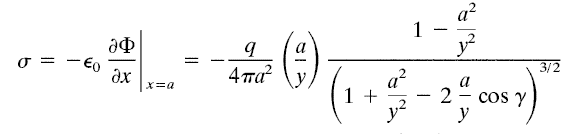
1569988929636.png

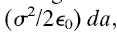
Then he mentioned that the force on unit area da is just :
1569989038794.png

1569989064843.png

So this is the part I don't get, I understand that σ *da = dq is the charge on area da, but what is the rest part? I don't really get why dF = dq * (σ /2ε ), is that indicate the E field at da is (σ /2ε )? if so, how do we get this?

Thank you!
 
  • Like
Likes   Reactions: Delta2
Physics news on Phys.org
Hi.

1. Say on thin volume surface surrounding da on conductor sphere,
##E=\frac{\sigma}{\epsilon_0}## outside surface and ##E=0## inside surface.

2. Maxwell stress tensor says force per unit area on outside surface is ##\frac{\epsilon_0}{2} E^2=\frac{\sigma^2}{2\epsilon_0}##

3. 1, 2 and ##dF=\sigma da E## tempt us to regard

Shell_E said:
E field at da is (σ /2ε )?
value of which is exact average of outside field and inside field mentioned in 1.

I do not think electric field at the exact point of sphere charge be defined neither physically nor mathematically.
 
Hi.
Further to post #2 I found texts around Fig.I.5 in Introduction of Jackson Third edition is helpful showing microscopic and macroscopic view of plate charge. It says about plate condenser but applies to our sphere.

Though I said electric field working on sphere charge is not defined, we may make use of convention that
E=H_{1/2}(x) \frac{\sigma}{\epsilon_0}
where Heaviside step function_1/2 is 0 for x<0 inside, 1/2 for x=0 on surface and 1 for x>0 outside. As Jackson explained it does not correspond to both macro and micro physics and I take it for practical mathematical convention to meet equation ##dF=\frac{E}{\epsilon_0} \sigma da##.
 

Similar threads

  • · Replies 2 ·
Replies
2
Views
2K
  • · Replies 4 ·
Replies
4
Views
2K
  • · Replies 7 ·
Replies
7
Views
3K
  • · Replies 16 ·
Replies
16
Views
2K
  • · Replies 11 ·
Replies
11
Views
2K
  • · Replies 5 ·
Replies
5
Views
2K
  • · Replies 4 ·
Replies
4
Views
2K
  • · Replies 8 ·
Replies
8
Views
2K
  • · Replies 17 ·
Replies
17
Views
2K
  • · Replies 4 ·
Replies
4
Views
2K