wang0073
- 2
- 0
Hi,
I would like to ask a question on incandescent light.
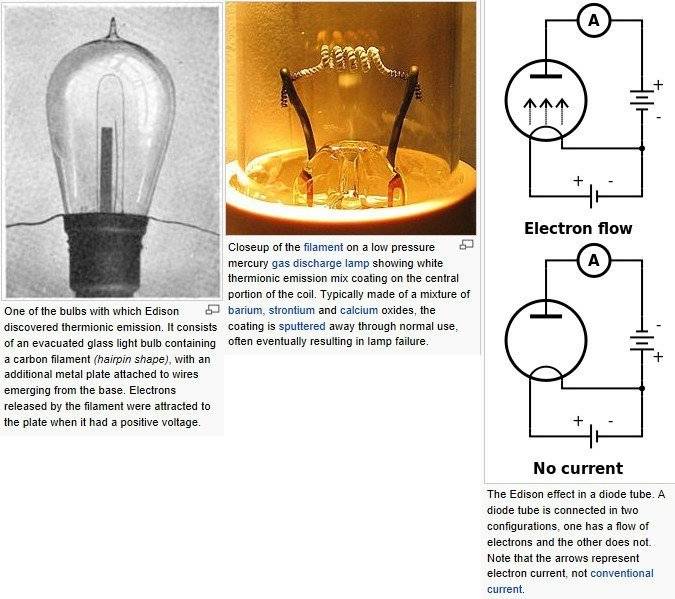
From the Thermionic emission (Edison effect), heated tungsten filament emits electrons that could be collected by an anode (like a foil connected to positive voltage).
The wiki also mentions that in order to facilitate thermionic emission, tungsten is often treated with mixture of barium, strontium and calcium.
Does this emission happen in a normal incandescent lamp? In the bulb which Edison discovered the effect, there is a plate(foil) inserted into the bulb from the base, this is absent in normal bulbs. Does the tungsten filament still emit electron in this case? If it does, where would the emitted electron go? Without an anode collector, will they be suspended in the vacuum (assume a vacuum bulb) space inside the bulb?
This further brings up a question to the energy balance (conservation) question in a vacuum bulb:
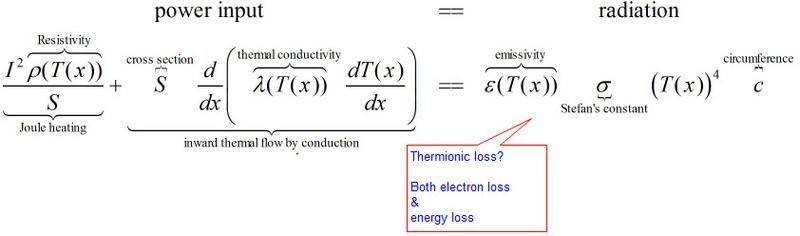
This is the fundamental equation for all tungsten filament temperature calculation when the inside of the bulb is vacuum, and appears in Irving Langmuir’s 1936 http://prola.aps.org/abstract/PR/v50/i1/p68_1 and numerous others.
Do we need to consider the thermionic effects for an ordinary incandescent bulb? How should we modify the equation above?
Wang
I would like to ask a question on incandescent light.
From the Thermionic emission (Edison effect), heated tungsten filament emits electrons that could be collected by an anode (like a foil connected to positive voltage).
The wiki also mentions that in order to facilitate thermionic emission, tungsten is often treated with mixture of barium, strontium and calcium.
Does this emission happen in a normal incandescent lamp? In the bulb which Edison discovered the effect, there is a plate(foil) inserted into the bulb from the base, this is absent in normal bulbs. Does the tungsten filament still emit electron in this case? If it does, where would the emitted electron go? Without an anode collector, will they be suspended in the vacuum (assume a vacuum bulb) space inside the bulb?
This further brings up a question to the energy balance (conservation) question in a vacuum bulb:
This is the fundamental equation for all tungsten filament temperature calculation when the inside of the bulb is vacuum, and appears in Irving Langmuir’s 1936 http://prola.aps.org/abstract/PR/v50/i1/p68_1 and numerous others.
Do we need to consider the thermionic effects for an ordinary incandescent bulb? How should we modify the equation above?
Wang
Attachments


Last edited: