biologynewhan
- 1
- 0
I am preparing my examination on next week.
I face a challenge question on the textbook but it does not provide any answers.
Can someone help me? Two questions distribute 10 marks for each. How can I answer point by point to get all the marks in this questions. Many thanks!
Consider this problem. A train carrying a tank of Chemical X has overturned on a railway bridge. The bridge runs over a river located in a national park (see Figure 1).
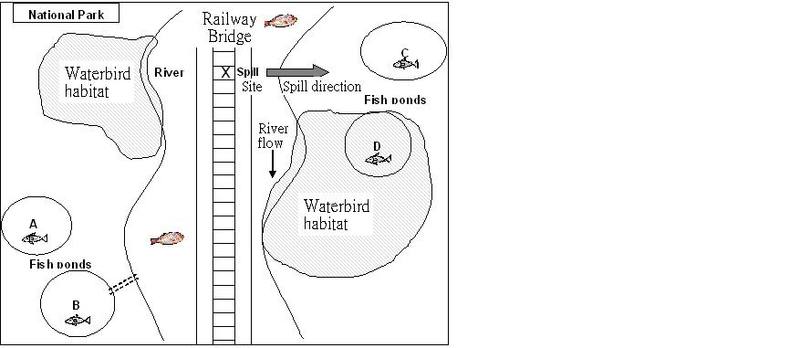
Figure 1 Chemical X spilled into the river and onto the riverbank on the right (grey arrow). The river is surrounded by four small fish ponds (A-D), as well as waterbird habitat (shaded areas). Fish pond B is connected to the river by underground water flow, and the waterbird habitat on the right riverbank includes fish pond D. There are two fish species in the area, one that lives in the river, and one that lives in the fish ponds.
You know that Chemical X is a chlorinated, lipophilic pesticide. You also know that the waterbirds in the area consume primarily fish.
(a) What do you think will be the most likely distribution of Chemical X in this environment? Justify your answer with reasons. 10 Marks
(b) With reference to the diagram above, which habitats and which living organisms do you think would be most at risk? Justify your answer. 10 Marks
I face a challenge question on the textbook but it does not provide any answers.
Can someone help me? Two questions distribute 10 marks for each. How can I answer point by point to get all the marks in this questions. Many thanks!
Consider this problem. A train carrying a tank of Chemical X has overturned on a railway bridge. The bridge runs over a river located in a national park (see Figure 1).
Figure 1 Chemical X spilled into the river and onto the riverbank on the right (grey arrow). The river is surrounded by four small fish ponds (A-D), as well as waterbird habitat (shaded areas). Fish pond B is connected to the river by underground water flow, and the waterbird habitat on the right riverbank includes fish pond D. There are two fish species in the area, one that lives in the river, and one that lives in the fish ponds.
You know that Chemical X is a chlorinated, lipophilic pesticide. You also know that the waterbirds in the area consume primarily fish.
(a) What do you think will be the most likely distribution of Chemical X in this environment? Justify your answer with reasons. 10 Marks
(b) With reference to the diagram above, which habitats and which living organisms do you think would be most at risk? Justify your answer. 10 Marks