closer
- 18
- 0
Consider a frictionless track ABC as shown in Figure P8.23. A block of mass m1 = 8.00 kg is released from A. It makes a head-on elastic collision at B with a block having a mass of m2 = 14.0 kg that is initially at rest. Calculate the maximum height to which m1 rises after the collision.
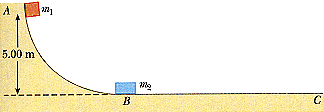
To find the initial velocity of mass 1 right before the collision:
Ug = KE
mgh = .5mv2
gh = .5v2
(9.8)(5) = .5v2
v = 9.9
Find the final velocity of mass 1 right after the collision:
vf1 = (m1-m2/m1+m2)vi1
vf1 = (8-14/8+14)(9.9)
vf1 = -2.7
Find the height at which the mass will reach with the initial velocity 2.7:
Wnet = [tex]\Delta[/tex]KE
KE - Ug = [tex]\Delta[/tex]KE
.5mv2 - mgh = .5mvf2 - .5mvi2
.5vi2- gh = .5vf2 - .5vi2
.5(2.7) - (9.8)h = .5(0)2 - .5(2.7)2
h = .7438
Final answer is incorrect. Any ideas?
To find the initial velocity of mass 1 right before the collision:
Ug = KE
mgh = .5mv2
gh = .5v2
(9.8)(5) = .5v2
v = 9.9
Find the final velocity of mass 1 right after the collision:
vf1 = (m1-m2/m1+m2)vi1
vf1 = (8-14/8+14)(9.9)
vf1 = -2.7
Find the height at which the mass will reach with the initial velocity 2.7:
Wnet = [tex]\Delta[/tex]KE
KE - Ug = [tex]\Delta[/tex]KE
.5mv2 - mgh = .5mvf2 - .5mvi2
.5vi2- gh = .5vf2 - .5vi2
.5(2.7) - (9.8)h = .5(0)2 - .5(2.7)2
h = .7438
Final answer is incorrect. Any ideas?
Last edited: