Elastic collision find max height

Click For Summary
The discussion revolves around solving a physics problem involving an elastic collision between two blocks on a frictionless track. The user initially struggles with calculating the final velocity of the blocks after the collision and understanding the conservation of energy principles. They eventually determine the velocity after the collision and successfully calculate the maximum height reached by the first block as 0.92 meters. A question remains about the equation used for the collision, specifically how it applies when the masses of the blocks are unequal. The conversation highlights the importance of both momentum and energy conservation in elastic collisions.
Aubiefan
Messages
16
Reaction score
0
I am having a lot of difficulty with this problem:
Consider a frictionless track as shown in Figure P6.48. A block of mass m1 = 4.20 kg is released from A. It makes a head on elastic collision at B with a block of mass m2 = 10.5 kg that is initially at rest. Calculate the maximum height to which m1 rises after the collision.
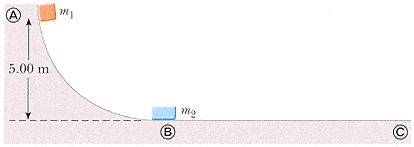
p6-48.gif

My plan was to use (KE+PE)i=(KE+PE)f, somehow.
I know that at the time of release block A has 205.8 J of potential energy, from PE=mgy, but I need the final velocity in order to use the conservation equation.
I found the velocity before the collision using (delta y)=.5(Vyo+Vy)t, and got 9.9m/s for Block A, B is at rest.
Then I tried to figure out the velocity after the collision, using (m1v1+m2v2)i = (m1v1+m2v2)f
I had (4.2 x 9.9)= (m1v1+m2v2)f, so m2v2f=41.58-m1v1, and that is where I seem to be stuck, I can't figure out how to carry on or if I am even right up to this point. Any tips are EXTREMELY appreciated!
 
Physics news on Phys.org
In the case of an elastic collision, except linear momentum, kinetic energy is also conserved. Use that fact, too. After finding the speed of the first mass after the colision, use the fact that the work m1g*h done by gravity equals the change of kinetic energy from the moment after the colision to the moment when v1 equals 0 (i.e. the moment the mass m1 obtains its maximum height h).
 
Last edited:
I don't think I understand what the next step would be, I haven't been able to get as far as finding the velocity right after the collision. The initial PE (mgy) was 205.8 J, so I know that the KE at the bottom (right after collision) must equal that, but how do I tell the difference in that from the KE it had right before the collision, when it was also at 0 elevation? I tried setting it up with the values right before the collision as (.5mv^2 + mgy)i, which is (.5 x 4.2 x 9.9^2 + 0) equal to at where the max height would be, (.5mv^2 + mgy)f, which would be (.5 x 4.2 x 0 + 4.2 x 9.8), and when I solved for y I got 5.00, which isn't right, that was my initial height, I seem to be doing something circular. Can you explain what my next step should be?
Sorry!
 
Nevermind, I just got it, sorry. I used v1i + v1f = v2i + v2f and set v2f equal to (v1i + v1f), since v2i is zero, and solved to get -4.24 m/s for the velocity after collision, then used the KE=PE rule to solve for the height, 0.92 m.
Thanks for the tips!
One question: the equation above, v1i + v1f = v2i + v2f, was given in lecture and appears in the book, but I really don't understand it, how do the masses cancel out of the blocks are inequal?
 
The book claims the answer is that all the magnitudes are the same because "the gravitational force on the penguin is the same". I'm having trouble understanding this. I thought the buoyant force was equal to the weight of the fluid displaced. Weight depends on mass which depends on density. Therefore, due to the differing densities the buoyant force will be different in each case? Is this incorrect?

Similar threads

  • · Replies 4 ·
Replies
4
Views
2K
  • · Replies 10 ·
Replies
10
Views
3K
  • · Replies 5 ·
Replies
5
Views
2K
  • · Replies 16 ·
Replies
16
Views
4K
  • · Replies 4 ·
Replies
4
Views
2K
  • · Replies 4 ·
Replies
4
Views
3K
  • · Replies 6 ·
Replies
6
Views
2K
  • · Replies 12 ·
Replies
12
Views
3K
  • · Replies 7 ·
Replies
7
Views
5K
  • · Replies 6 ·
Replies
6
Views
4K