cks
- 164
- 0
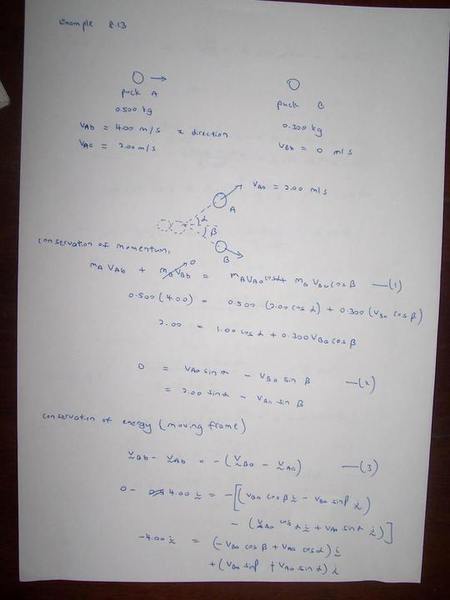
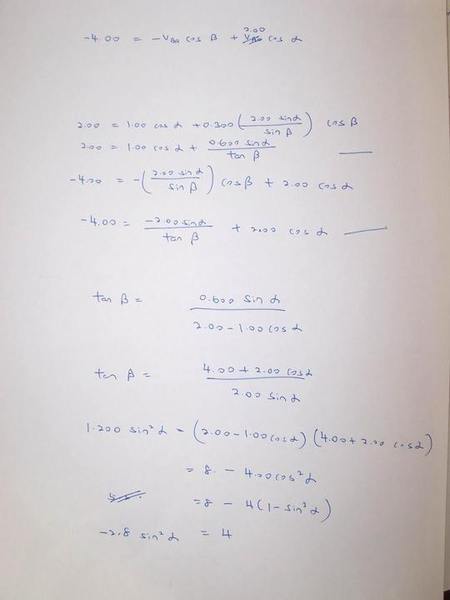
From the pictures(my solutions) I submitted, I know that I can straightly find the magnitude of the velocity of the puck B by using conservation of energy in the lab frame.
However, my gut feelings tell me that answering the question using conservation of energy in the moving frame (puck A) will do.
But I find something awkward when I write down all the equations. Equation (3) which is the conservation of energy in the moving frame give equation that contradicts equation (2) (which is the conservation of momentum in the y-direction) .
Why is this so? I have checked everything and couldn't see anything that are against the law of physics.
Thank you.
An elastic collision of two pucks on a frictionless air-hockey table. Puck A has mass mA=0.500 kg and puck B has mass mB=0.300 kg. Puck A has an initial velocity of 4.00 m/2 in the positive x-direction and a final velocity of 2.00 m/2 in an unknown direction. Puck B is initially at rest. Find the final speed of VB2 of puck B and the angles Alpha and Beta in the figure.
.
However, my gut feelings tell me that answering the question using conservation of energy in the moving frame (puck A) will do.
But I find something awkward when I write down all the equations. Equation (3) which is the conservation of energy in the moving frame give equation that contradicts equation (2) (which is the conservation of momentum in the y-direction) .
Why is this so? I have checked everything and couldn't see anything that are against the law of physics.
Thank you.
An elastic collision of two pucks on a frictionless air-hockey table. Puck A has mass mA=0.500 kg and puck B has mass mB=0.300 kg. Puck A has an initial velocity of 4.00 m/2 in the positive x-direction and a final velocity of 2.00 m/2 in an unknown direction. Puck B is initially at rest. Find the final speed of VB2 of puck B and the angles Alpha and Beta in the figure.
.
Last edited: