Elastic Recovery and Permanent Set

  • Thread starter Thread starter waltonhcky05
  • Start date Start date
  • Tags Tags
    Elastic Set
Click For Summary
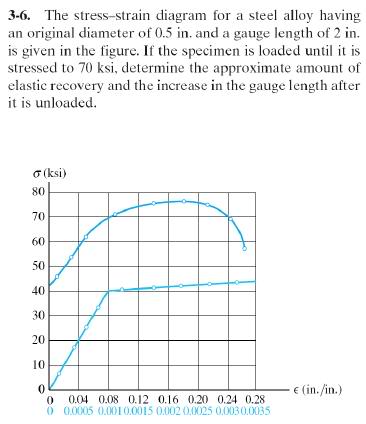
To determine the elastic recovery and permanent elongation of a steel sample under a 70ksi load, it is essential to draw a line with the same slope as the modulus of elasticity on the stress-strain diagram. The confusion arises from identifying which of the two lines on the graph to use for this purpose. The new line should be drawn from the point where the sample is loaded, extending to the x-axis to find the permanent set. The magnified bottom curve provides additional detail that may assist in accurately determining the correct points for drawing the new line. Understanding these elements is crucial for solving the problem effectively.
waltonhcky05
Messages
2
Reaction score
0
I'm given a stress strain diagram for a sample of steel that has an original diameter of 0.5in and a gauge length of 2in. The sample is loaded to 70ksi and the question asks for the amount of elastic recovery and permanent elongation of the sample. The actual graph is shown below...
312.jpg

I know that I would need to draw a line that is of the same slope as modulus of elasticity to find the elastic recovery and permanent set. Where the permanent set is just the x intercept of that new line, but what's confusing me is the two lines shown on the graph and which one I should be using to draw this new line. Also, once I find out which line I should be using, from what point on the curve should I actually draw the new line from?

Thanks for any help!
 
Last edited:
Physics news on Phys.org
Can anyone offer any insight into how to solve this?
 
The bottom curve is showing a magnified version of the top curve in the x-direction. Does this help?
 
The book claims the answer is that all the magnitudes are the same because "the gravitational force on the penguin is the same". I'm having trouble understanding this. I thought the buoyant force was equal to the weight of the fluid displaced. Weight depends on mass which depends on density. Therefore, due to the differing densities the buoyant force will be different in each case? Is this incorrect?

Similar threads

Replies
16
Views
4K
  • · Replies 5 ·
Replies
5
Views
2K
  • · Replies 29 ·
Replies
29
Views
8K
  • · Replies 17 ·
Replies
17
Views
4K
  • · Replies 2 ·
Replies
2
Views
17K
  • · Replies 24 ·
Replies
24
Views
3K
Replies
2
Views
33K
  • · Replies 2 ·
Replies
2
Views
3K
  • · Replies 2 ·
Replies
2
Views
9K
  • · Replies 2 ·
Replies
2
Views
16K