Elastic Recovery and Permanent Set

  • Thread starter Thread starter waltonhcky05
  • Start date Start date
  • Tags Tags
    Elastic Set
Click For Summary
SUMMARY

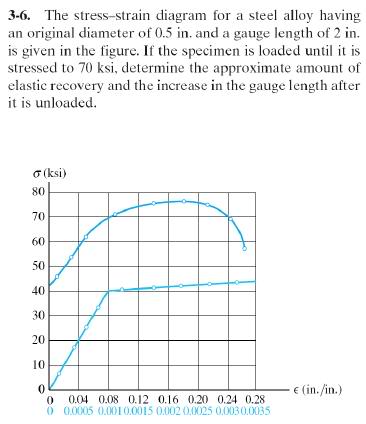
The discussion focuses on calculating elastic recovery and permanent elongation for a steel sample with an original diameter of 0.5 inches and a gauge length of 2 inches, subjected to a load of 70 ksi. To determine these values, one must draw a line with the slope of the modulus of elasticity on the stress-strain diagram. The permanent set is identified as the x-intercept of this new line. Clarification is sought regarding which of the two lines on the graph should be used for this calculation and the appropriate starting point for drawing the new line.

PREREQUISITES
  • Understanding of stress-strain diagrams
  • Knowledge of modulus of elasticity
  • Familiarity with concepts of elastic recovery and permanent set
  • Basic skills in interpreting graphical data
NEXT STEPS
  • Review the principles of stress-strain relationships in materials
  • Study the calculation methods for elastic recovery in steel
  • Learn how to accurately draw and interpret lines on stress-strain diagrams
  • Examine case studies involving permanent set in structural materials
USEFUL FOR

Mechanical engineers, materials scientists, and students studying material properties who are involved in analyzing stress-strain behavior in metals.

waltonhcky05
Messages
2
Reaction score
0
I'm given a stress strain diagram for a sample of steel that has an original diameter of 0.5in and a gauge length of 2in. The sample is loaded to 70ksi and the question asks for the amount of elastic recovery and permanent elongation of the sample. The actual graph is shown below...
312.jpg

I know that I would need to draw a line that is of the same slope as modulus of elasticity to find the elastic recovery and permanent set. Where the permanent set is just the x intercept of that new line, but what's confusing me is the two lines shown on the graph and which one I should be using to draw this new line. Also, once I find out which line I should be using, from what point on the curve should I actually draw the new line from?

Thanks for any help!
 
Last edited:
Physics news on Phys.org
Can anyone offer any insight into how to solve this?
 
The bottom curve is showing a magnified version of the top curve in the x-direction. Does this help?
 

Similar threads

Replies
16
Views
4K
  • · Replies 5 ·
Replies
5
Views
2K
  • · Replies 29 ·
Replies
29
Views
8K
  • · Replies 17 ·
Replies
17
Views
4K
  • · Replies 2 ·
Replies
2
Views
17K
  • · Replies 24 ·
Replies
24
Views
3K
Replies
2
Views
33K
  • · Replies 2 ·
Replies
2
Views
3K
  • · Replies 2 ·
Replies
2
Views
9K
  • · Replies 2 ·
Replies
2
Views
16K