How Does Gauss' Law Apply to Electric Fields in a Hollow Sphere?

Click For Summary
SUMMARY

The discussion focuses on applying Gauss' Law to determine electric fields in a hollow sphere with inner radius R1 and outer radius R2, uniformly charged with total charge Q. Participants clarify that the charge density is calculated as Q divided by the volume of the hollow sphere, specifically Q/{4π/3(R2^3 - R1^3)}. The charge within a radius r is derived from this density, leading to the conclusion that the charge inside radius r is Q times the ratio of the volume within radius r to the total volume of the hollow sphere.

PREREQUISITES
  • Understanding of Gauss' Law and its mathematical formulation
  • Knowledge of electric field concepts and charge density
  • Familiarity with spherical coordinates and volume calculations
  • Basic principles of electrostatics and charge distribution
NEXT STEPS
  • Study the derivation of Gauss' Law in electrostatics
  • Learn about electric field calculations in different geometries
  • Explore charge distribution in hollow and solid spheres
  • Investigate applications of Gauss' Law in real-world scenarios
USEFUL FOR

Students studying electromagnetism, physics educators, and anyone seeking to deepen their understanding of electric fields and Gauss' Law applications in spherical geometries.

underground
Messages
3
Reaction score
0
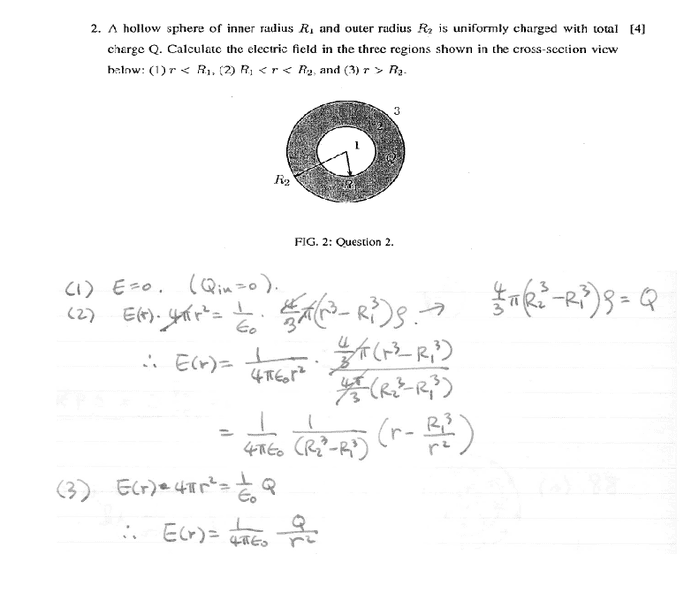
Hey I am currently studying for my final and I am stuck on a question i have the solution but I am not sure what he did, could someone explain

A hollow sphere of the inner radius R1 and outer radius R2 is uniformly charges with total charge Q. Calculate the electruc fiels in the three regions shown in the cross-section view below 1) r<R1, 2) R1 < r <R2, and 3) r >R2
pPKRZ.png


What i don't get is part two, i know he is using gauess law Q inclosed/e = E(r)*A
but i don't know how he got Q and reduced it
 
Physics news on Phys.org
welcome to pf!

hi underground! welcome to pf! :smile:
underground said:
A hollow sphere of the inner radius R1 and outer radius R2 is uniformly charges with total charge Q.

What i don't get is part two, … i don't know how he got Q and reduced it

the total charge is Q, so the charge density is Q/volume = Q/{4π/3(R23 - R13)},

so the charge inside radius r is the density times the volume within radius r, ie 4π/3(r3 - R13) :wink:
 
Thanks for the respond I am getting there but can you explain one thing

I get what your saying but i don't see where the Q overall charge disappeard

P7rGZ.png


This is my logic of the question and the Q which is overall charge remained in the equation
 
suppose R1 was 0 (ie, a solid sphere) …

then the charge within radius r would be Q(r/R2)3, wouldn't it?

this is similar … the charge is Q times (volume/total-volume) :wink:
 
Thanks so much for your help :)
 

Similar threads

Replies
23
Views
4K
Replies
6
Views
1K
  • · Replies 2 ·
Replies
2
Views
1K
  • · Replies 12 ·
Replies
12
Views
7K
  • · Replies 2 ·
Replies
2
Views
2K
Replies
21
Views
4K
  • · Replies 18 ·
Replies
18
Views
4K
  • · Replies 5 ·
Replies
5
Views
6K
  • · Replies 2 ·
Replies
2
Views
2K
  • · Replies 15 ·
Replies
15
Views
2K