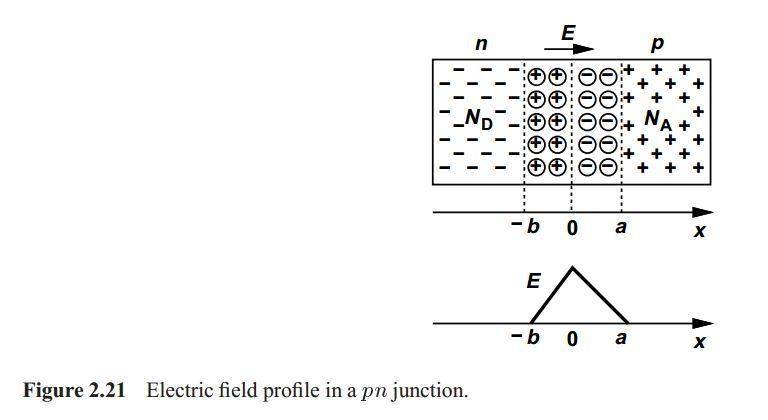
Electric field inside PN junction in equilibrium

Click For Summary

Homework Help Overview

The discussion revolves around understanding the electric field behavior in a PN junction in equilibrium, particularly focusing on the region outside the depletion zone and the transition into it. Participants are exploring the nature of the electric field in relation to positive and negative ions and their contributions to the overall field.

Discussion Character

  • Conceptual clarification, Assumption checking

Approaches and Questions Raised

  • Participants are questioning why the electric field is considered zero in certain regions and discussing the implications of positive and negative ions on the electric field. There are attempts to visualize the situation through analogies involving charged particles moving through the depletion region.

Discussion Status

Some participants have provided insights and analogies to help clarify the behavior of the electric field, while others express confusion and seek further explanation. The discussion is ongoing, with various interpretations being explored without a clear consensus.

Contextual Notes

There are indications of schematic representations being used, and participants are grappling with the nuances of the electric field's behavior near the boundary of the depletion region, including the sharpness of this boundary and the rapid changes in the field strength.

anhnha
Messages
179
Reaction score
1
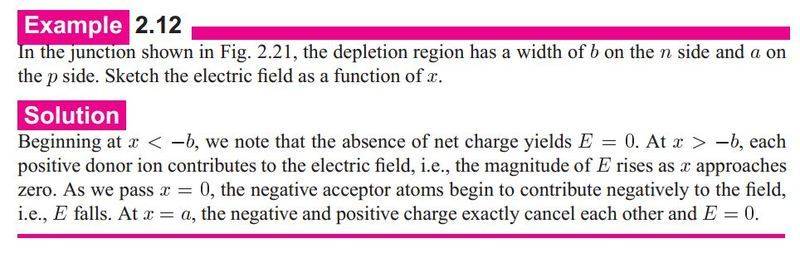
I need help to understand this solution:
attachment.php?attachmentid=59361&stc=1&d=1370665607.jpg

attachment.php?attachmentid=59362&stc=1&d=1370665607.jpg

Why electric field is zero at x < - b?
I think it should be non-zero because the electric field from positive and negative ions don't completely cancel each other.
How can you know E rises as x approaches zero?
 

Attachments

  • PN junction solution.JPG
    PN junction solution.JPG
    38.7 KB · Views: 623
  • PN junction.JPG
    PN junction.JPG
    21.6 KB · Views: 744
Physics news on Phys.org
anhnha said:
Why electric field is zero at x < - b?

I think it should be non-zero because the electric field from positive and negative ions don't completely cancel each other.
It is only a schematic plot. The electric field is not zero just at the boundary of the depletion region. (And the boundary of the depletion region is not sharp, either). But it tends to zero quite fast, as the forces from the positive and negative regions tend to cancel.

anhnha said:
How can you know E rises as x approaches zero?

Imagine you are a positively charged particle. You walk into the depletion region from left, from the n part. When you are inside the depletion region, still in the n part, there are some positive ions both behind you (pushing you forward) and the other positive ions in front of you, pushing you backwards. But all the negative ions on the other side pull you forward. When you are exactly at the interface between the p and n region, (x=0) all the positive ions are behind you, pushing forward and all the negative ions are in front of you, pulling you forward.

ehild
 
  • Like
Likes   Reactions: 1 person
Imagine you are a positively charged particle. You walk into the depletion region from left, from the n part. When you are inside the depletion region, still in the n part, there are some positive ions both behind you (pushing you forward) and the other positive ions in front of you, pushing you backwards. But all the negative ions on the other side pull you forward. When you are exactly at the interface between the p and n region, (x=0) all the positive ions are behind you, pushing forward and all the negative ions are in front of you, pulling you forward.
Thanks, the example is great!
t is only a schematic plot. The electric field is not zero just at the boundary of the depletion region. (And the boundary of the depletion region is not sharp, either). But it tends to zero quite fast, as the forces from the positive and negative regions tend to cancel.

I am not quite understand it. Can you explain it more detail?
 
anhnha said:
Thanks, the example is great!


I am not quite understand it. Can you explain it more detail?

The space charge region around the p-n junction is quite thin, the positive and negative "poles" are close, the electric field is similar to that of a dipole, q and -q charges d distance apart. At far away from the junction, in the line of the dipole at distance x , the electric field is E=kq/(x-d/2)-q(x+d/2)≈2kq/x3.

ehild
 
  • Like
Likes   Reactions: 1 person
Thanks, got it now!
 

Similar threads

Replies
10
Views
2K
  • · Replies 1 ·
Replies
1
Views
1K
  • · Replies 12 ·
Replies
12
Views
1K
Replies
6
Views
2K
  • · Replies 5 ·
Replies
5
Views
3K
  • · Replies 2 ·
Replies
2
Views
3K
Replies
4
Views
4K
  • · Replies 4 ·
Replies
4
Views
2K
Replies
3
Views
2K
  • · Replies 2 ·
Replies
2
Views
2K