Electric field of a charged cube

Click For Summary

Homework Help Overview

The discussion revolves around calculating the electric field of a uniformly charged cube. Participants explore the challenges of applying Gauss's law due to the lack of symmetry and the complexity of integrating the electric field contributions from individual charge elements within the cube.

Discussion Character

  • Exploratory, Assumption checking, Mathematical reasoning

Approaches and Questions Raised

  • Participants discuss using Gauss's law and integration techniques, noting the difficulties in symmetry and complex integrals. There is consideration of superposition principles and comparisons to simpler geometries, such as spheres. Questions arise about the relationship between electric field strength and cube dimensions.

Discussion Status

There is a productive exploration of various approaches, including the use of integrals and the concept of charge density. Some participants suggest alternative methods and analogies, while others express uncertainty about the implications of their findings. Multiple interpretations of the problem are being examined without a clear consensus.

Contextual Notes

Participants mention constraints such as the complexity of integrals and the need for relevant equations. The discussion also touches on the level of understanding required, indicating an undergraduate context.

Moara
Messages
43
Reaction score
5
Homework Statement
The electric field in point A due to the cube with side a and with uniform volumetric charge density is E. What is the electric field at point A when a cube of side a/2 is taken out from the original cube, such as in the picture.
Relevant Equations
E=kq/r^2
Tried to use gauss law but there isn't any usefull symmetry that I have seen. Also tried to integrate the field due to small charges over the whole cube, didn't work too since the integral were too much complicated.
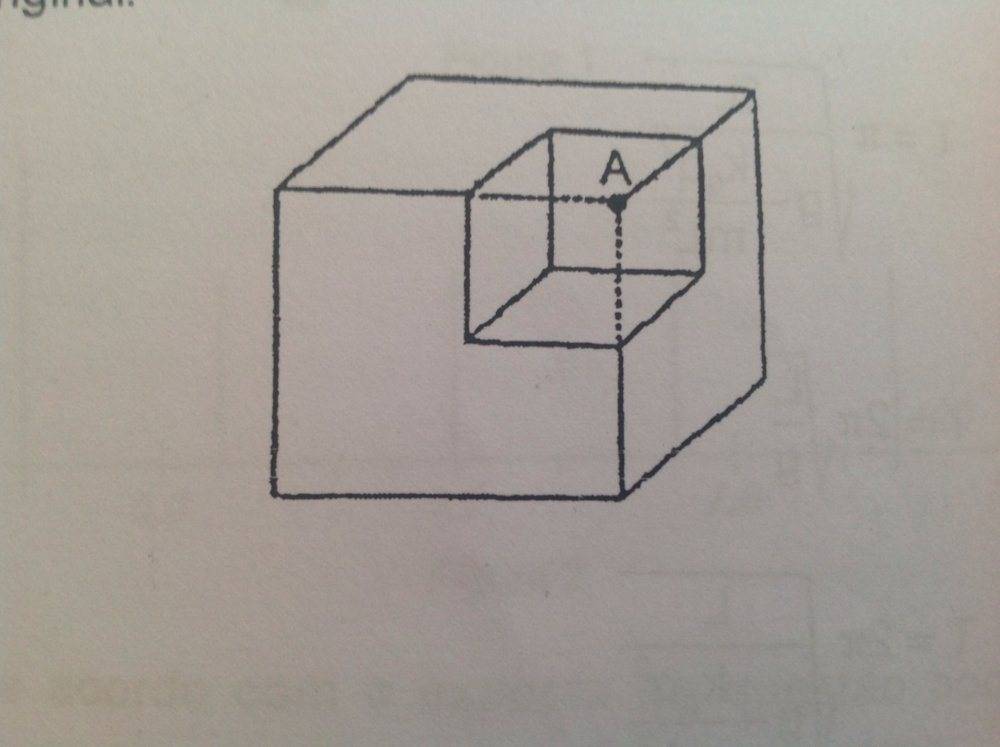
image.jpg
 
Physics news on Phys.org
Hello Moara, ##\qquad## :welcome: ##\qquad## !

I suppose you have other relevant equations available ?
If not, can you do the integral for the full cube with side a ?

Given that the electric field in point A due to the cube with side a and with uniform volumetric charge density is E, would you know the field at point A due to a cube with sides a/2 with the same, but opposite sign charge density ?
 
I have no other relevant equation that could be used and as I sad, the integral of the electric field due to charges dq is very difficult since you need to do it using the components in Cartesian or polar coordinates, the angle and distances vary making the integral very difficult. I think I need to use some superposition principle as you mantioned by calculating the electric field of the cube with opposite charge density and side a/2. I just can't find a relation between the electric field and the dimensions of the cube
 
Something I know is that by symetry the field point in the direction of the line OA where O is the center of the cube
 
Moara said:
I just can't find a relation between the electric field and the dimensions of the cube
I agree about the integral being too complicated :smile: . In addition it's already been 'calculated' and the result is E.
I also agree with your conclusion: we need to find a relationship. Can we use some kind of similarity argument ? Suppose it's not a cube but a sphere with radius a: what happens to E at the surface when we reduce the radius to a/2 ?
 
  • Like
Likes   Reactions: TSny
The field Will reduze by a factor of 2 using the field of a uniformly charged sphere which can be considered a point charge for calculating the field, then just use volume of sphere and that the density remains constant. But can't see how this helps, since not necessarily the field in the vertice is of the form E=kl , where k is constant and l some mesure of the cube which can be its side.
 
Moara said:
The field Will reduze by a factor of 2 using the field of a uniformly charged sphere which can be considered a point charge for calculating the field, then just use volume of sphere and that the density remains constant. But can't see how this helps, since not necessarily the field in the vertice is of the form E=kl , where k is constant and l some mesure of the cube which can be its side.
What about if you think about a charged cube as a lattice of finitely many point charges?

Could you calculate the effect of expanding the cube in terms of the charge density and the electric field at point A?
 
i tried that using the concept of energy density but didnt work
 
Moara said:
i tried that using the concept of energy density but didnt work
What about Coulomb's law?
 
  • Like
Likes   Reactions: Moara
  • #10
Moara said:
The field Will reduze by a factor of 2 using the field of a uniformly charged sphere which can be considered a point charge for calculating the field, then just use volume of sphere and that the density remains constant. But can't see how this helps, since not necessarily the field in the vertice is of the form E=kl , where k is constant and l some mesure of the cube which can be its side.
Correct. Charge reduces by factor of 8, 1/r2 increases by factor of 4. No use is made of the shape of the charge distribution, so the same argument holds for a cube.

If that isn't plausible enough: let's return to the integral (which we don't have to calculate: that's already been done and the result is the given E). But we do look at how it changes when the cube shrinks to half size:

Given $$ E = k \rho \int_0^a \!\! \! \int_0^a\!\! \! \int_0^a {1\over x^2 + y^2 + z^2}\; \mathrm{d}x\; \mathrm{d}y\; \mathrm{d}z $$ we want to know $$k \rho \int_0^{a/2}\!\! \! \int_0^{a/2} \!\! \! \int_0^{a/2} {1\over x^2 + y^2 + z^2}\; \mathrm{d}x \;\mathrm{d}y \;\mathrm{d}z$$
See a factor 1/2 coming up ?

hint: change of variables ##x\rightarrow x'/2## etc.
 
Last edited:
  • Like
  • Skeptical
Likes   Reactions: gleem, Moara and PeroK
  • #11
Now I see, very nice to work with the integral without really getting to some explicit function, got the ideas
 
  • Like
Likes   Reactions: BvU
  • #12
$$ E = k \rho \int_0^a \!\! \! \int_0^a\!\! \! \int_0^a {1\over x^2 + y^2 + z^2}\; \mathrm{d}x\; \mathrm{d}y\; \mathrm{d}z $$

Can further justifications be made for this approach? I see this integral as trying to calculate something about the cube rather than something at a specific point (although in this case the point could be the center). Also E is a vector quantity which isn't indicated in the integral and no assumptions of symmetry are given which would otherwise obviate the need to use vector notation in the integrand.
 
  • #13
I stand corrected -- too sloppy shorthand.
Fortunately by similarity the corrections come out identical in both cases, don't they :rolleyes: ?
 
  • #14
I am wondering at what level this problem is to be approached. There is an axis of symmetry along the diagonal
of the cube. The cube is two pyramids placed base to base. As you go from the base to a vertex the ratio of an elemental volumes (formed by slicing the pyramid in sheets along the diagonal) to the square of the distance to the vertex remains constant. This to me indicates that along the diagonal that you can replace the cube by a suitable dipole whose field falls of as the cube of the distance from the center. Thoughts?

EDIT: Forget the dipole idea.
 
Last edited:
  • #15
gleem said:
I am wondering at what level this problem is to be approached
I'd say undergrad.

For a uniformly charged sphere we sort of agreed on a factor 1/2.

Would be nice if we came to the same factor for a uniformly charged cube.

gleem said:
The cube is two pyramids placed base to base
I'm missing something
 
  • #16
No I missed somethingo:)
 
  • #17
BvU said:
I stand corrected -- too sloppy shorthand.
Fortunately by similarity the corrections come out identical in both cases, don't they :rolleyes: ?

By symmetry, the only difference for the two cubes is the strength of the field. And, that must be proportional to the charge density, which I assumed you'd absorbed in the constant ##k##.
 
  • #18
For the record, here is the argument based on finitely many point charges.

If ##E## is the strength of the field at point A due to a small cube, then imagine moving every charge twice the distance to form a larger cube. The field of this larger cube is ##E' = E/4##.

But, the larger cube has a charge density of an 8th of the smaller cube. If we increase this to give a new large cube with the same density, then the field of this cube is ##E'' = 2E##.
 
  • Like
Likes   Reactions: gleem

Similar threads

Replies
9
Views
1K
  • · Replies 12 ·
Replies
12
Views
1K
  • · Replies 22 ·
Replies
22
Views
3K
  • · Replies 6 ·
Replies
6
Views
3K
  • · Replies 9 ·
Replies
9
Views
4K
  • · Replies 6 ·
Replies
6
Views
5K
Replies
11
Views
4K
Replies
3
Views
3K
Replies
9
Views
2K
Replies
4
Views
5K
