Why Does the Potential Energy Calculation for a Dipole Yield a Negative Value?

Click For Summary
SUMMARY

The discussion centers on the calculation of potential energy (PE) for an electric dipole in a uniform electric field. The change in potential energy is defined as ∆U = Uf - Ui, with the final and initial energies potentially yielding negative values. The concept of alignment is clarified, indicating that alignment can occur in the same or opposite direction to the dipole moment. The lowest potential energy occurs when the dipole is aligned with the electric field at angles of 0 or 180 degrees, while the highest potential energy occurs at 90 degrees, where the dipole moment is perpendicular to the electric field.

PREREQUISITES
  • Understanding of electric dipoles and their properties
  • Familiarity with potential energy concepts in physics
  • Knowledge of vector mathematics, specifically dot products
  • Basic principles of electric fields and forces
NEXT STEPS
  • Study the mathematical relationship of potential energy for dipoles, specifically U = -P · E
  • Explore the concept of torque on dipoles in electric fields
  • Investigate the stability of equilibrium positions for dipoles
  • Learn about the behavior of dipoles in varying electric field orientations
USEFUL FOR

Students and professionals in physics, particularly those focusing on electromagnetism, electrical engineering, and anyone studying the behavior of electric dipoles in fields.
guyvsdcsniper
Messages
264
Reaction score
37
Homework Statement
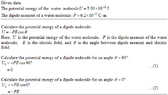
A water molecule perpendicular to an electric field has 5.00×10⁻²² J more potential energy than a water molecule aligned with the field. The dipole moment of a water molecule is 6.2×10⁻³⁰Cm.

What is the strength of the electric field?
Relevant Equations
U=-pEcos(theta)
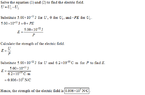
So the change in potential energy is ∆U = Uf-Ui. Final minus initial. If i solve the above problem like this I end up with a negative value. The way the person in the attached work solved the problem, is they used ∆U = Ui-Uf. How are the switching Ui and Uf? What is it I am missing?
 

Attachments

  • wrk.png
    wrk.png
    7.9 KB · Views: 276
  • wrkk.png
    wrkk.png
    6.5 KB · Views: 231
Physics news on Phys.org
What exactly do you think it means when it says "aligned"? Can that be in the reverse direction?
Which choice leads to a lower PE than when at right angles?
What angle does that correspond to?
 
haruspex said:
What exactly do you think it means when it says "aligned"? Can that be in the reverse direction?
Which choice leads to a lower PE than when at right angles?
What angle does that correspond to?

PE is a scalar quantity and so it can be +ve or -ve or 0. If ##PE_1=0 ## and ##PE_2= -5## then ##PE_1 > PE_2##. So, if ##PE = 0## it doesn't mean it's a minimum. ##PE= 0## could be a maximum.
  • Aligned means electric field is in same or opposite direction to dipole moment.
  • Yes, aligned could mean anyone of following two cases: dipole moment and electric field in same direction OR dipole moment and electric field in opposite direction.
  • PE is always lowest in equilibrium position i.e. when no net torque acts on the dipole, which will be when dipole is aligned with electric field according to above bullet point. PE will be maximum at extremes i.e. when dipole moment is perpendicular to electric field.
  • Angle of 0 or 180 degrees between dipole moment and electric field results in lowest PE. Angle of 90 degrees results in highest PE.
 
vcsharp2003 said:
PE is always lowest in equilibrium position i.e. when no net torque acts on the dipole, which will be when dipole is aligned with electric field according to above bullet point. PE will be maximum at extremes i.e. when dipole moment is perpendicular to electric field.
No, equilibrium does not necessarily correspond to minimum PE. A pencil standing on its point could theoretically be in equilibrium, though highly unstable.
Likewise, though torque is maximised for the dipole in the perpendicular position, PE is not.
 
  • Like
Likes   Reactions: vcsharp2003
haruspex said:
No, equilibrium does not necessarily correspond to minimum PE. A pencil standing on its point could theoretically be in equilibrium, though highly unstable.
Likewise, though torque is maximised for the dipole in the perpendicular position, PE is not.
I was thinking of simple harmonic motion analogy where PE is min at equilibrium position i.e. at the middle of extreme positions. So where would PE be a maximum for dipole placed in a uniform electric field? It appears that when ##\theta = 180^o## then ##PE = - | \vec P | | \vec E | \cos {180^0} = | \vec P | | \vec E |## would be maximum since PE at this position takes a +ve value.
 
Last edited:
vcsharp2003 said:
I was thinking of simple harmonic motion analogy where PE is min at equilibrium position i.e. at the middle of extreme positions. So where would PE be a maximum for dipole placed in a uniform electric field?
Suppose the external field is oriented left to right, i.e. it would push an isolated positive charge to the right. So it would push the positive side of a dipole to the right and the negative side to the left.
Consider the centre of the dipole as fixed, since there is no net force from the external field. The max PE is when each charge has furthest to go, i.e. the positive is on the left, negative on the right. That means the dipole's field is not only parallel to the applied field but acts in the same direction.
The minimum PE is the reverse position, with the two fields in opposition.
 
haruspex said:
Suppose the external field is oriented left to right, i.e. it would push an isolated positive charge to the right. So it would push the positive side of a dipole to the right and the negative side to the left.
Consider the centre of the dipole as fixed, since there is no net force from the external field. The max PE is when each charge has furthest to go, i.e. the positive is on the left, negative on the right. That means the dipole's field is not only parallel to the applied field but acts in the same direction.
The minimum PE is the reverse position, with the two fields in opposition.
I get it using the mathematical relationship of ##U = - \vec P \cdot \vec E ##, but still trying to understand how you've explained.
 
haruspex said:
Suppose the external field is oriented left to right, i.e. it would push an isolated positive charge to the right. So it would push the positive side of a dipole to the right and the negative side to the left.
Consider the centre of the dipole as fixed, since there is no net force from the external field. The max PE is when each charge has furthest to go, i.e. the positive is on the left, negative on the right. That means the dipole's field is not only parallel to the applied field but acts in the same direction.
The minimum PE is the reverse position, with the two fields in opposition.

I think I get your explanation. What you're saying is to look at the PE of system consisting of the + and - charges in the two positions shown in diagram below. We could consider that initially the two dipole charges are at center of dipole and then we separate them so each is at a distance ##a## from the center of dipole. Clearly +ve work is being by external force on each +ve and -ve charge as they are separated to their dipole positions in top dipole which means PE is increasing. In bottom dipole, -ve work is being by external force which means PE is decreasing.

IMG_20210927_153247__01.jpg
 
Last edited:
vcsharp2003 said:
I think I get your explanation. What you're saying is to look at the PE of system consisting of the + and - charges in the two positions shown in diagram below. We could consider that initially the two dipole charges are at center of dipole and then we separate them so each is at a distance ##a## from the center of dipole. Clearly +ve work is being by external force on each +ve and -ve charge as they are separated to their dipole positions in top dipole which means PE is increasing. In bottom dipole, -ve work is being by external force which means PE is decreasing.

View attachment 289767
Yes.
 
  • Like
Likes   Reactions: vcsharp2003

Similar threads

  • · Replies 5 ·
Replies
5
Views
1K
Replies
4
Views
3K
Replies
2
Views
3K
Replies
14
Views
1K
Replies
6
Views
2K
  • · Replies 2 ·
Replies
2
Views
2K
Replies
1
Views
2K
  • · Replies 2 ·
Replies
2
Views
1K
  • · Replies 1 ·
Replies
1
Views
2K
Replies
1
Views
3K