Why is the Electric Field of a Polarized Atom Different in Textbooks?

Click For Summary
SUMMARY

The discussion centers on the calculation of the electric field of a polarized atom, specifically addressing discrepancies between textbook equations and practical applications. The participants reference Coulomb's law, stating that the electric field can be calculated as ##E=\frac{1}{4 \pi \epsilon_o}\frac{-q}{r^2}## for a uniformly charged sphere. They emphasize that the electric field inside the sphere should not be overly complicated and can be simplified by treating the electron cloud as a point charge. The conversation highlights the confusion surrounding the textbook's approach to the electric field of polarized atoms.

PREREQUISITES
  • Understanding of Coulomb's Law
  • Familiarity with electric fields and polarization
  • Basic knowledge of point charges and charge distributions
  • Concept of uniformly charged spheres
NEXT STEPS
  • Study the derivation of electric fields in polarized materials
  • Learn about the behavior of electric fields inside uniformly charged spheres
  • Explore advanced topics in electrostatics, including dipole moments
  • Investigate the implications of treating electron clouds as point charges
USEFUL FOR

Physics students, educators, and researchers interested in electrostatics, particularly those focusing on electric fields and polarization phenomena.

Tony Hau
Messages
107
Reaction score
30
Homework Statement
A primitive model for an atom consists of point molecules ##(+q)## surrounded by a uniformly charged spherical cloud ##(-q)## of radius ##a## (Fig.1). Calculate the atmoic polarizability of such an atom.
Relevant Equations
##E_{dip}(r,\theta) = \frac {p}{4 \pi \epsilon_o r^{3}}(2cos(\theta)\hat {\mathbf r} + sin(\theta) \hat {\mathbf \theta}) ##
The question is like this:
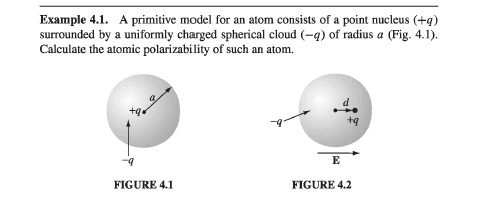
1598589507880.png


The solution is like this:
1598589542230.png

However, according to the equation for ##E_{dip}## , what I think is that it should be: $$E=\frac {1}{4 \pi \epsilon_o} \frac {qd}{d^3} \hat {\mathbf z} $$, where I take the centre of the sphere in figure 2 as the centre of the coordinate, and positive z-axis towards right.

Actually it doesn't have to be that complicated. The electric field experienced by the positive charge on the left in figure 2 can be simply calculated by the Coulomb's law ##E=\frac{1}{4 \pi \epsilon_o}\frac{-q}{r^2}##. Anyway, I don't know why the textbook gives something different.
 
Last edited:
Physics news on Phys.org
Tony Hau said:
The electric field experienced by the positive charge on the left in figure 2 can be simply calculated by the Coulomb's law ##E=\frac{1}{4 \pi \epsilon_o}\frac{-q}{r^2}##.

Really? It is a uniformly charged sphere and we are calculating the electric field inside the sphere!
 
Abhishek11235 said:
Really? It is a uniformly charged sphere and we are calculating the electric field inside the sphere!
I suppose we can treat the electron cloud as a point charge, just like what we do for centre of mass? If that's not the case, why would the author draw two points inside the sphere?
 

Similar threads

  • · Replies 5 ·
Replies
5
Views
2K
Replies
2
Views
2K
  • · Replies 4 ·
Replies
4
Views
2K
Replies
12
Views
2K
  • · Replies 13 ·
Replies
13
Views
5K
  • · Replies 6 ·
Replies
6
Views
2K
Replies
19
Views
3K
  • · Replies 0 ·
Replies
0
Views
2K
  • · Replies 1 ·
Replies
1
Views
700
Replies
3
Views
2K
