Electric/Gravitational Forces

  • Thread starter Thread starter thst1003
  • Start date Start date
  • Tags Tags
    Forces
Click For Summary

Homework Help Overview

The discussion revolves around finding the ratio of the magnitudes of the electrical and gravitational forces between a proton and an electron separated by a distance d. The subject area includes concepts from electrostatics and gravitation.

Discussion Character

  • Exploratory, Assumption checking, Problem interpretation

Approaches and Questions Raised

  • Participants discuss the equations for electrical and gravitational forces, questioning how to properly set up the ratio. There is uncertainty about the necessary equations and values to use, particularly regarding gravitational force.

Discussion Status

Participants are actively engaging with the problem, with some providing equations and others seeking clarification on how to apply them. There is a mix of interpretations regarding the setup of the ratio, but no explicit consensus has been reached.

Contextual Notes

Some participants express doubt about the familiarity with the concepts, while others reference external resources for gravitational force equations. The discussion reflects varying levels of confidence and understanding among participants.
thst1003
Messages
15
Reaction score
0
Find the ratio of the magnitudes of the electrical and the gravitational forces acting between a proton and an electron separated by an arbitrary distance d.


F= k(q)(q')/r^2 and
0f36df929ac9d711a8ba8c5658c3bfee.png


The q's are in an absolute value sign. How do I find the ratio? Is it as simply as dividing it out?
 
Last edited:
Physics news on Phys.org
thst1003 said:
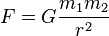
The q's are in an absolute value sign. I believe there is an additional equation similar to this one that deals with gravity that I need to use as well but I can't find it.

Although I have a lot of trouble believing that you have not encountered this already, I will just take your post at face value. Here is the equation you seek:

http://en.wikipedia.org/wiki/Newton's_law_of_universal_gravitation
 
I changed the question. I have encountered it.
 
that's a trivial problem asked on electrostatics. Yep, you divide it for a ratio.
 
What exactly do you divide? Is it Electrical force/Gravitational force using 1.6e-19 C for the electron and the electron? So it would be k(q)(q) / G(m1)(m2) ?
 
thst1003 said:
What exactly do you divide? Is it Electrical force/Gravitational force using 1.6e-19 C for the electron and the electron? So it would be k(q)(q) / G(m1)(m2) ?

In short: yes. You divide exactly what you were ASKED to divide (emphasis mine below):

thst1003 said:
Find the ratio of the magnitudes of the electrical and the gravitational forces acting between a proton and an electron separated by an arbitrary distance d.
 

Similar threads

  • · Replies 42 ·
2
Replies
42
Views
4K
  • · Replies 7 ·
Replies
7
Views
3K
  • · Replies 6 ·
Replies
6
Views
1K
  • · Replies 8 ·
Replies
8
Views
2K
  • · Replies 10 ·
Replies
10
Views
3K
Replies
1
Views
1K
  • · Replies 23 ·
Replies
23
Views
2K
  • · Replies 2 ·
Replies
2
Views
2K
  • · Replies 3 ·
Replies
3
Views
1K
Replies
1
Views
2K