Electric potential of an electron in a capacitor

Click For Summary
SUMMARY

The electric potential of an electron in a capacitor is conventionally measured from the negative plate, as discussed in Liboff's "Introductory Quantum Mechanics." The choice of reference point for measuring potential is arbitrary; however, it must remain consistent throughout calculations. When an electron moves from the negative to the positive plate, the potential energy changes, and this is reflected in the equations used. The work done in moving the charge is equal to the potential difference, regardless of the chosen reference point.

PREREQUISITES
  • Understanding of electric potential and potential energy concepts
  • Familiarity with capacitors and their operation
  • Basic knowledge of quantum mechanics principles
  • Ability to interpret mathematical equations involving charge and potential
NEXT STEPS
  • Study the concept of electric potential in capacitors using "Electromagnetism" by David J. Griffiths
  • Learn about the implications of reference points in electric potential measurements
  • Explore the relationship between work done and potential difference in electrostatics
  • Investigate the effects of charge movement in electric fields through simulations or software like PhET Interactive Simulations
USEFUL FOR

Students of physics, electrical engineers, and anyone interested in understanding the principles of electric potential and energy in capacitors.

user35711
Messages
4
Reaction score
0
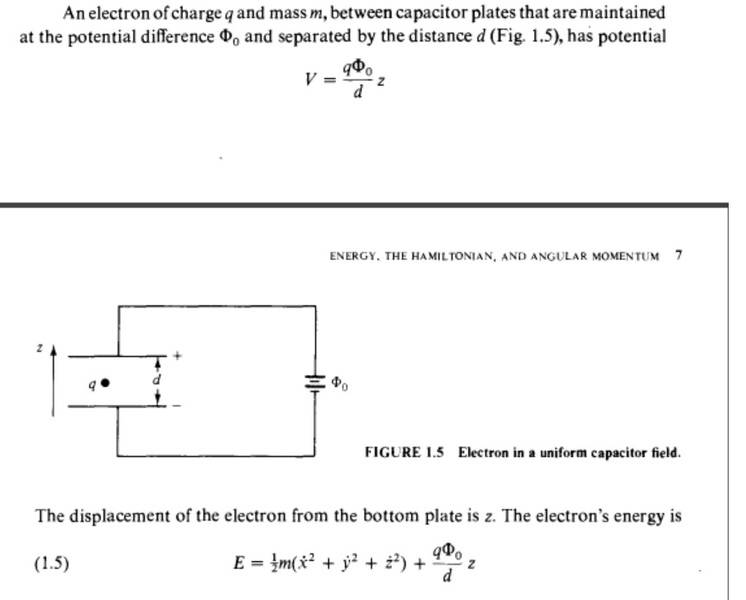
Why is the electric potential of an electron in a capacitor measured from the negative plate and not the positive plate here?
This is from Liboff Introductory quantum mechanics 1st(current is 4th) edition:
w2yTv.jpg

I don't understand why the distance z is measured from the bottom plate if the potential is of an electron which should gain Energy going to the top plate.
 

Attachments

  • w2yTv.jpg
    w2yTv.jpg
    27.6 KB · Views: 819
Physics news on Phys.org
In the equations the q is welcome to be positive or negative. When you plug in the negative charge of the electron I think you will see the equations make sense with the indicated direction of z.

There is no particular reason they had to choose z as up, and had they chosen the other direction the equations could be corrected with a minus sign. However up is a perfectly fine choice and the equations are written correctly for that choice.
 
  • Like
Likes   Reactions: sophiecentaur
Cutter Ketch said:
However up is a perfectly fine choice
Direction choice is quite arbitrary as long as you stick with it. Students are often confused by a similar thing in basic problems of acceleration under gravity - when you drop an object, do you choose distance along its downward path to be positive (the way it's actually going) or negative (because up is often positive)? The answer will be correct, whichever you choose.
 
It's not the positive or negative sign that doesn't make sense. The complimentary value of the potential is given. If you measure from the bottom, you are giving a different value for the potential energy than when you measure from the top which is the distance potential the electron can accelerate through.
 
Agreed, there will be two values of potential energy, depending which plate you choose to be zero (reference). But the work done shifting the charge from one point to another will be equal to the Potential Difference, which will give you the same answer, whichever your axes are.
Potential is not defined in terms of "accelerating" an electron - it's the work done in moving the charge from a chosen point. I'm not quite sure where you problem lies but is it something to do with the distance traveled from start position to one plate or the other? You will get two different magnitudes and two different signs for this if not starting from the mid point.
 
You're right, I meant to say the energy in joules after moving charge q, not acceleration.
 
user35711 said:
You're right, I meant to say the energy in joules after moving charge q, not acceleration.
OK - so wouldn't you expect two possible results, depending on which side the charge ends up? Is it not just that simple?
 
What I didn't understand but now think I do is that the potential energy is negative when you start with the top plate and then goes to zero as you reach the bottom plate with the coordinates chosen.
 

Similar threads

  • · Replies 7 ·
Replies
7
Views
2K
  • · Replies 16 ·
Replies
16
Views
3K
  • · Replies 2 ·
Replies
2
Views
1K
  • · Replies 10 ·
Replies
10
Views
2K
  • · Replies 3 ·
Replies
3
Views
2K
Replies
8
Views
2K
  • · Replies 2 ·
Replies
2
Views
1K
  • · Replies 6 ·
Replies
6
Views
1K
  • · Replies 22 ·
Replies
22
Views
3K
  • · Replies 7 ·
Replies
7
Views
4K