Electromagnetic mass of an electron

Click For Summary
SUMMARY

The discussion centers on the concept of electromagnetic mass of an electron, specifically addressing the electrostatic energy denoted as ##E_{em}## and its implications. Participants clarify that ##E_{em}## is the energy required to assemble a sphere of one electron charge, which relates to the electromagnetic mass of the electron at rest, defined by the equation ##m_{em} = E_{em}/c^2##. The letter "c" is confirmed to represent the speed of light, despite the electron being at rest. The conversation highlights the quantum mechanical nature of these concepts, particularly in relation to the electromagnetic field.

PREREQUISITES
  • Understanding of electromagnetic theory
  • Familiarity with the concept of mass-energy equivalence
  • Basic knowledge of quantum mechanics
  • Ability to interpret mathematical notation in physics
NEXT STEPS
  • Research the relationship between electromagnetic mass and rest mass in quantum mechanics
  • Study the implications of electrostatic energy in classical and quantum physics
  • Explore the concept of classical electron radius and its significance
  • Learn about the role of the speed of light in mass-energy equations
USEFUL FOR

Physicists, students of quantum mechanics, and anyone interested in the fundamental properties of electrons and electromagnetic theory.

PainterGuy
Messages
938
Reaction score
73
Hi,

I was reading the following Wikipedia article and couldn't make sense of few points. I'd appreciate it if you could help me with it.
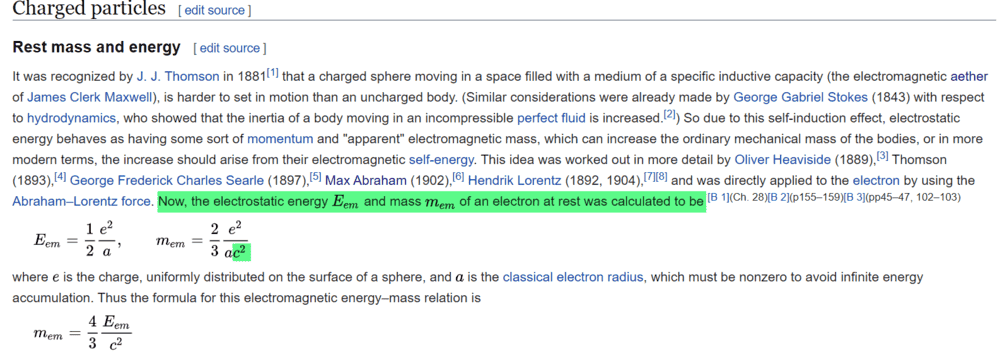
1599699951272.png

Source: https://en.wikipedia.org/wiki/Electromagnetic_mass#Rest_mass_and_energy

Question 1:
What is this "electrostatic energy ##E_{em}##"? Is it some kind of electric potential energy? But electrostatic potential energy exists between two charges.

Question 2:
I think "##m_{em}##" is electromagnetic mass of electron at rest. What would be non-electromagnetic mass electron? From the formula it looks like non-electromagnetic mass of electron would be "0".

Question 3:
I don't think the letter "c" in the stands for the speed of light since electron is at rest. It is not stated what "c" is. Could you please comment on it?

Thank you!
 
Physics news on Phys.org
I direct you to the article about classical electron radius before waving my hands rapidly at your questions.

answer1: ##E_{em}## represents the required to assemble a sphere of magnitude one electron charge (thereby overcoming the repulsion). The size of the sphere is chosen to give correct number for the mass.

answer2: from answer1 it is chosen so that ##m_{em}= E_{em}/c^2##

answer3: c is light speed

The complete answers here in fact contain ##\hbar## and are therefore quantum mechanical in nature particularly for complete description of the electromagnetic field.
 
  • Like
Likes   Reactions: PainterGuy
Thank you!

1599720224520.png


If it's electrostatic energy then shouldn't the subscript be "es" in "##E_{em}##"?
 
There are no general rules regarding subscripts. Author decides what he/she wants to use. It does not have to make sense for everyone.
 

Similar threads

  • · Replies 4 ·
Replies
4
Views
2K
  • · Replies 20 ·
Replies
20
Views
5K
  • · Replies 7 ·
Replies
7
Views
1K
  • · Replies 4 ·
Replies
4
Views
2K
  • · Replies 15 ·
Replies
15
Views
2K
  • · Replies 2 ·
Replies
2
Views
2K
  • · Replies 100 ·
4
Replies
100
Views
11K
  • · Replies 27 ·
Replies
27
Views
3K
  • · Replies 1 ·
Replies
1
Views
2K
  • · Replies 7 ·
Replies
7
Views
1K