Electromotive force when current is alternating

Click For Summary
SUMMARY

The discussion centers on the concept of electromotive force (EMF) in alternating current (AC) systems, specifically addressing the behavior of current and voltage in relation to power consumption. Participants clarify that while the EMF can be negative, the power (P=IV) remains positive when considering both current (I) and voltage (V) together. They emphasize that AC systems, including generators, deliver useful power despite the alternating nature of current flow, as demonstrated by the consistent operation of devices like light bulbs. The conversation also touches on the roles of capacitors and inductors in AC circuits, highlighting their ability to store and release energy without dissipating it over a full cycle.

PREREQUISITES
  • Understanding of electromotive force (EMF) in electrical circuits
  • Familiarity with the power equation P=IV
  • Basic knowledge of alternating current (AC) and direct current (DC)
  • Concepts of capacitors and inductors in AC circuits
NEXT STEPS
  • Research Faraday's Law of Induction and its applications in AC generation
  • Study the Lorentz Force Law and its implications for charge movement
  • Explore the behavior of capacitors and inductors in AC circuits
  • Learn about power factor and its significance in AC power systems
USEFUL FOR

Electrical engineers, physics students, and anyone interested in understanding the principles of alternating current and its practical applications in electrical systems.
mcastillo356
Gold Member
Messages
658
Reaction score
361
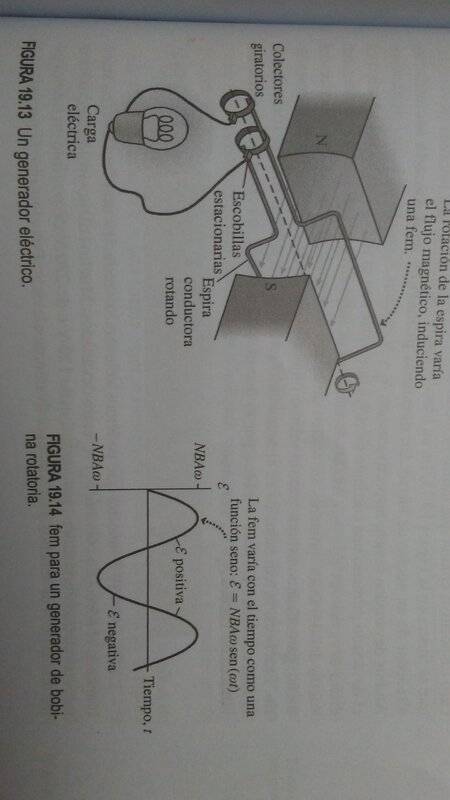
Hello, let's imagine a generator as shown in image. I just don't understand alternative current.
-\epsilon shouldn't be always positive? Otherwise, how can it provide anything?
Thanks
20200516_112748.jpg
 
Physics news on Phys.org
mcastillo356 said:
I just don't understand alternative current.
What exactly don't you understand? How it's generated or how it's useful?
 
  • Like
Likes   Reactions: mcastillo356
Sorry, I don't understand how it's useful, if sometimes is negative \epsilon, and, also, if the direction of the current changes direction; sometimes towards the consumer, and sometimes the opossite direction, towards the source
 
mcastillo356 said:
Sorry, I don't understand how it's useful,
The light bulb will doesn't care which way the current flows, it will flicker tough when the direction changes and the current is zero. Other consumers might need to convert the current first.
 
mcastillo356 said:
Sorry, I don't understand how it's useful, if sometimes is negative \epsilon, and, also, if the direction of the current changes direction; sometimes towards the consumer, and sometimes the opossite direction, towards the source

The direction in which the physical charge carriers are moving doesn't change the power dissipated. Like @A.T. mentioned, you can connect a light bulb up with either end connected to either end of the battery and it will still turn on. In each case, the charge carriers are moving in the direction of decreasing potential energy and are transferring energy to the lightbulb.
 
  • Like
Likes   Reactions: Delta2
mcastillo356 said:
Sorry, I don't understand how it's useful, if sometimes is negative \epsilon, and, also, if the direction of the current changes direction; sometimes towards the consumer, and sometimes the opossite direction, towards the source
The purpose of the electrical grid is to deliver electrical power. That power is what makes it useful.

We know that the power can be written ##P=IV## where ##I## is the current and ##V## is the voltage. If ##I## is negative and ##V## is also negative then ##P## is positive and therefore still provides useful power.

You cannot consider either the voltage or the current separately, you need to consider them together. When you do you find that the power is always positive
 
  • Like
Likes   Reactions: Delta2 and mcastillo356
Thanks, etotheipi, A.T, Dale!
 
Dale said:
You cannot consider either the voltage or the current separately, you need to consider them together. When you do you find that the power is always positive
The consumed power (defined as Dale notes) is always positive at the consumer, but negative at the power source, like the generator.
 
  • Like
Likes   Reactions: Dale
Last edited:
  • Like
Likes   Reactions: mcastillo356
  • #10
Sorry Dale, a condenser doesn't work that way. P and I are not in phase. How can I understand this?. In the case of a resistance, yes. But in the case of a condenser, P can be negative while I positive, or at the opposite🤔
 
  • #11
mcastillo356 said:
Sorry Dale, a condenser doesn't work that way.
Yes, everything works that way. ##P=IV## is a fundamental law in circuit theory and it always applies, 100% of the time, even for capacitors and inductors where ##I## and ##V## are not in phase.

For capacitors and inductors it means that during half of their cycle they are absorbing power from the circuit and during the other half of their cycle they are releasing power to the circuit. Over one full cycle their average power is 0 meaning that they do not dissipate power but just store it temporarily. The duration of the temporary storage can be used to tune circuits to specific frequencies.
 
  • Like
Likes   Reactions: Delta2, mcastillo356 and etotheipi
  • #12
Thanks Dale!. I really appreciate your help. I've understood something difficult...No, not difficult, now that I've read your post.
 
  • Like
Likes   Reactions: berkeman and Dale

Similar threads

  • · Replies 10 ·
Replies
10
Views
2K
  • · Replies 58 ·
2
Replies
58
Views
5K
  • · Replies 10 ·
Replies
10
Views
2K
  • · Replies 5 ·
Replies
5
Views
3K
  • · Replies 3 ·
Replies
3
Views
2K
  • · Replies 2 ·
Replies
2
Views
1K
  • · Replies 4 ·
Replies
4
Views
3K
  • · Replies 6 ·
Replies
6
Views
641
  • · Replies 3 ·
Replies
3
Views
2K
  • · Replies 4 ·
Replies
4
Views
1K