Electron frequency components during orbital tunneling

Click For Summary
SUMMARY

The discussion focuses on the behavior of an electron transitioning between two potential wells during orbital tunneling. It highlights that a wave packet, initially confined to a single potential well, must adapt by incorporating multiple frequency components as it approaches the second well. The electron's wave function cannot maintain a single frequency due to the need for additional frequencies to form a complete wave packet, which is constrained by the allowed energy levels of the initial well. The time evolution of this wave function is governed by the Schrödinger equation, necessitating numerical integration for accurate analysis.

PREREQUISITES
  • Understanding of quantum mechanics principles, specifically wave functions and potential wells.
  • Familiarity with the Schrödinger equation and its applications in quantum systems.
  • Knowledge of wave packet formation and frequency components in quantum mechanics.
  • Experience with numerical integration techniques for solving differential equations.
NEXT STEPS
  • Study the time-dependent Schrödinger equation for dynamic potential systems.
  • Explore numerical methods for integrating quantum mechanical equations, such as the Runge-Kutta method.
  • Investigate wave packet dynamics in quantum tunneling scenarios.
  • Learn about the implications of energy quantization in potential wells and their effects on wave functions.
USEFUL FOR

Quantum physicists, researchers in condensed matter physics, and students studying advanced quantum mechanics, particularly those interested in tunneling phenomena and wave function behavior in potential wells.

jhonnyS
Messages
2
Reaction score
0
TL;DR
what is the real time process for the wave function when an electron is living in a potential well, and an other is aproaching?
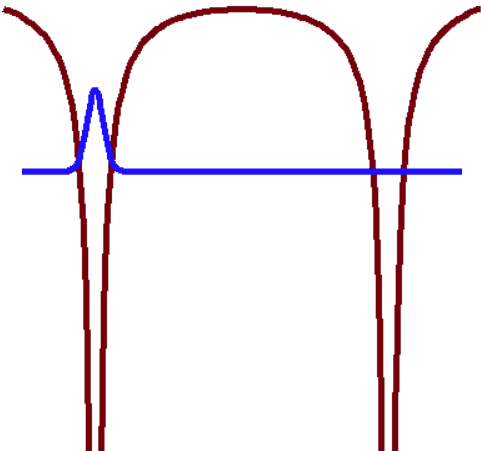
For example, we have this two potencial wells approaching, the electron is confined in one.
1582712365288.png

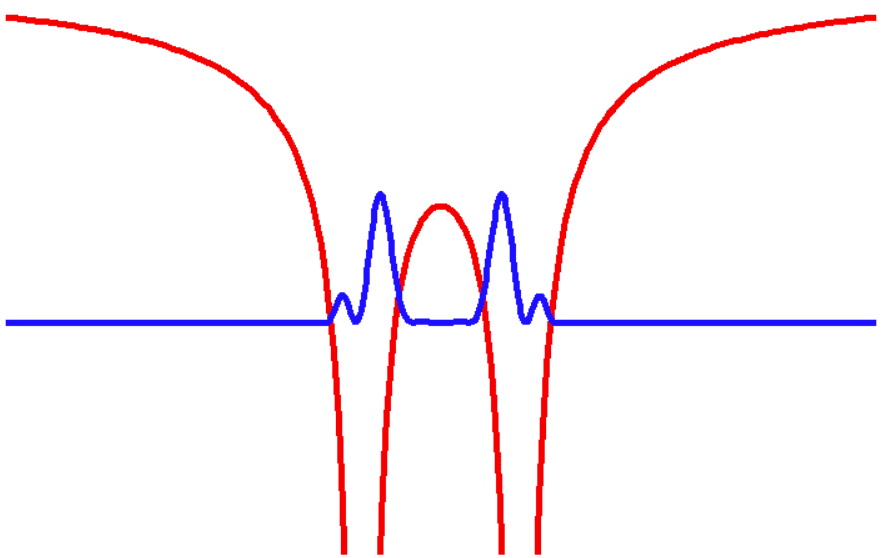
the final appearance will be like this:
1582712528582.png

THEN, if we know a wave packet is formed by many frequencies, but in a potencial well there are just few frequencies allowed, energy levels, so let's say, one frequency adapted to... the form of the potential.

In the point when the electron begins to overstep to the other potential, and the wave "don't know there is a well that will confine it later" so cannot mantain this unic frequency component because there were the posibility to extend indefinitely. NEEDs more frequencies to form a "wave packet" to contain itself BUT this frequencies, at same time, are not allowed for the part of wave function that remains confined in the initial potential well.

thank you
 
Physics news on Phys.org
jhonnyS said:
Summary:: what is the real time process for the wave function when an electron is living in a potential well, and an other is aproaching?

For example, we have this two potencial wells approaching, the electron is confined in one.
View attachment 257708
the final appearance will be like this:
View attachment 257709
THEN, if we know a wave packet is formed by many frequencies, but in a potencial well there are just few frequencies allowed, energy levels, so let's say, one frequency adapted to... the form of the potential.

In the point when the electron begins to overstep to the other potential, and the wave "don't know there is a well that will confine it later" so cannot mantain this unic frequency component because there were the posibility to extend indefinitely. NEEDs more frequencies to form a "wave packet" to contain itself BUT this frequencies, at same time, are not allowed for the part of wave function that remains confined in the initial potential well.

thank you
I'm not sure whether this answers your question, but you have a time dependent potential here. At any time where the second well becomes non negligible you no longer have purely a single well wave function.
 
The time evolution of that wave function is just described by the Schrödinger equation or equivalently the time evolution operator, you could investigate it with numerical integration.
 

Similar threads

  • · Replies 36 ·
2
Replies
36
Views
5K
  • · Replies 36 ·
2
Replies
36
Views
9K
  • · Replies 4 ·
Replies
4
Views
2K
  • · Replies 7 ·
Replies
7
Views
2K
  • · Replies 7 ·
Replies
7
Views
2K
  • · Replies 17 ·
Replies
17
Views
3K
  • · Replies 7 ·
Replies
7
Views
4K
  • · Replies 0 ·
Replies
0
Views
3K
  • · Replies 6 ·
Replies
6
Views
2K
  • · Replies 5 ·
Replies
5
Views
2K