Electron - Phonon scattering, deriving the contribution to

Click For Summary
SUMMARY

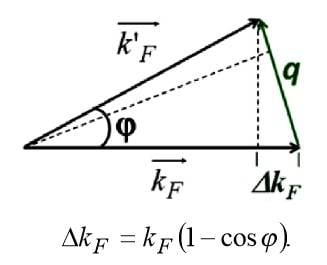
The discussion focuses on deriving the contribution of electron-phonon scattering to electron transport. Participants emphasize the importance of small approximations in the equations, specifically that ΔKF must be small for the cosine approximation to hold true. The relationship between the vectors KF and KF' is clarified, indicating that ΔKF represents a difference in magnitudes rather than a vector difference. The insights provided are crucial for understanding the mathematical modeling of electron transport phenomena.

PREREQUISITES
  • Understanding of electron-phonon interactions
  • Familiarity with vector mathematics and trigonometry
  • Knowledge of electron transport theory
  • Basic principles of quantum mechanics
NEXT STEPS
  • Study the derivation of electron-phonon scattering contributions in solid-state physics
  • Learn about the implications of small angle approximations in physics
  • Explore the mathematical modeling of electron transport phenomena
  • Investigate the role of vector magnitudes in quantum mechanics
USEFUL FOR

Physicists, materials scientists, and students studying solid-state physics who are interested in the mathematical foundations of electron transport and scattering processes.

rwooduk
Messages
757
Reaction score
59
... electron transport.

1. Homework Statement

Electron - Phonon scattering, derive the contribution to electron transport.

Homework Equations


Trig.

The Attempt at a Solution


Am I being REALLY stupid here, I can't see how the equation matches the triangle.
cUQmj9G.jpg


If you resolve KF' doesn't KF' cos theta= KF

The only thing I can think is that it's an approximation and delta KF is very small?
Thanks for any help
 
Physics news on Phys.org
rwooduk said:
... electron transport.

1. Homework Statement

Electron - Phonon scattering, derive the contribution to electron transport.

Homework Equations


Trig.

The Attempt at a Solution


Am I being REALLY stupid here, I can't see how the equation matches the triangle.

cUQmj9G.jpg


If you resolve KF' doesn't KF' cos theta= KF

The only thing I can think is that it's an approximation and delta KF is very small?
Thanks for any help
Yes, I think you're right about ΔKF needing to be small. Also, I think φ needs to be small enough so that cos(φ) ≈ 1 , while (1 - cos(φ) ) can't be ignored.

It looks to me like ΔKF is just a difference in magnitudes of the vectors and not the magnitude of the vector difference.
 
  • Like
Likes   Reactions: rwooduk
SammyS said:
Yes, I think you're right about ΔKF needing to be small. Also, I think φ needs to be small enough so that cos(φ) ≈ 1 , while (1 - cos(φ) ) can't be ignored.

It looks to me like ΔKF is just a difference in magnitudes of the vectors and not the magnitude of the vector difference.

Thanks very muvh for the reply.
 

Similar threads

Replies
13
Views
2K
  • · Replies 1 ·
Replies
1
Views
2K
  • · Replies 3 ·
Replies
3
Views
3K
Replies
1
Views
1K
  • · Replies 1 ·
Replies
1
Views
4K
  • · Replies 3 ·
Replies
3
Views
2K
  • · Replies 1 ·
Replies
1
Views
2K
  • · Replies 1 ·
Replies
1
Views
2K
  • · Replies 3 ·
Replies
3
Views
2K
  • · Replies 5 ·
Replies
5
Views
2K