Eliminating Alcohols: Why Do (A) and (B) Give Different Products?

Click For Summary

Discussion Overview

The discussion revolves around the different products formed from reactions (A) and (B) involving alcohols. Participants analyze the potential outcomes and products, including stereochemistry, in the context of a homework problem.

Discussion Character

  • Homework-related, Debate/contested

Main Points Raised

  • One participant suggests that reaction (A) can yield 1-pentene and 2-pentene, including E-Z diastereomers of 2-pentene, totaling three possible products.
  • Another participant states that reaction (B) will only produce the diastereomers E and Z of 2-pentene, resulting in two possible products.
  • The first participant expresses confusion regarding the provided answers for (A) and (B), questioning the validity of the source material.
  • Another participant comments on the reliability of books, implying that errors may exist.
  • A later reply questions whether any critical details or assumptions have been overlooked in the analysis.
  • One participant provides a cryptic response with letters (S, R, Q, P) without further clarification.

Areas of Agreement / Disagreement

Participants do not reach a consensus, as there are differing interpretations of the products formed from reactions (A) and (B), and the reliability of the source material is also contested.

Contextual Notes

There may be missing assumptions regarding the reactions, and the discussion does not clarify the definitions or conditions under which the products are formed.

Who May Find This Useful

Students studying organic chemistry, particularly those interested in reaction mechanisms and stereochemistry, may find this discussion relevant.

baldbrain
Messages
236
Reaction score
21
Homework Statement
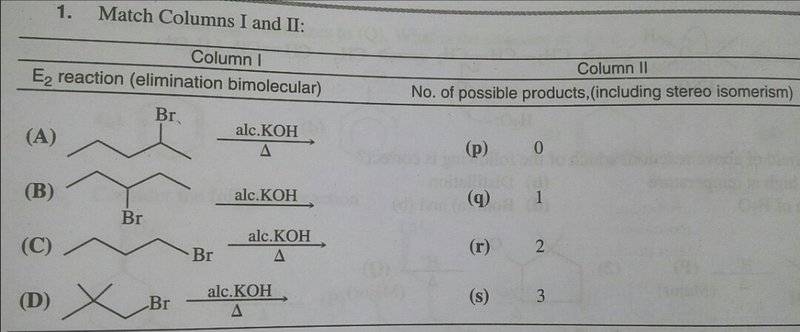
I just have a problem with (A) & (B)
IMG_20180719_173721.JPG

The attempt at a solution
Analysing all possible products;
(A) can give 1-pentene (minor) + 2-pentene (major). But you also have the E-Z diastereomers of 2-pentene. So that's total 3 possible products.
(B) will give only the diastereomers E & Z 2-pentene. So 2 possible products
Hence, (A)→(s) & (B)→(r)
But they've given (A)→(r) & (B)→(s)
How can it be?
 

Attachments

  • IMG_20180719_173721.JPG
    IMG_20180719_173721.JPG
    30 KB · Views: 1,103
Physics news on Phys.org
Books are not infallible.
 
Are you sure? No hitch? We aren't missing anything?
 
Nope. S, R, Q, P.
 
  • Like
Likes   Reactions: baldbrain

Similar threads

  • · Replies 3 ·
Replies
3
Views
4K
Replies
13
Views
3K
  • · Replies 28 ·
Replies
28
Views
6K
  • · Replies 7 ·
Replies
7
Views
3K
Replies
1
Views
2K
  • · Replies 1 ·
Replies
1
Views
4K
  • · Replies 21 ·
Replies
21
Views
2K
  • · Replies 7 ·
Replies
7
Views
883
  • · Replies 6 ·
Replies
6
Views
3K
Replies
4
Views
2K