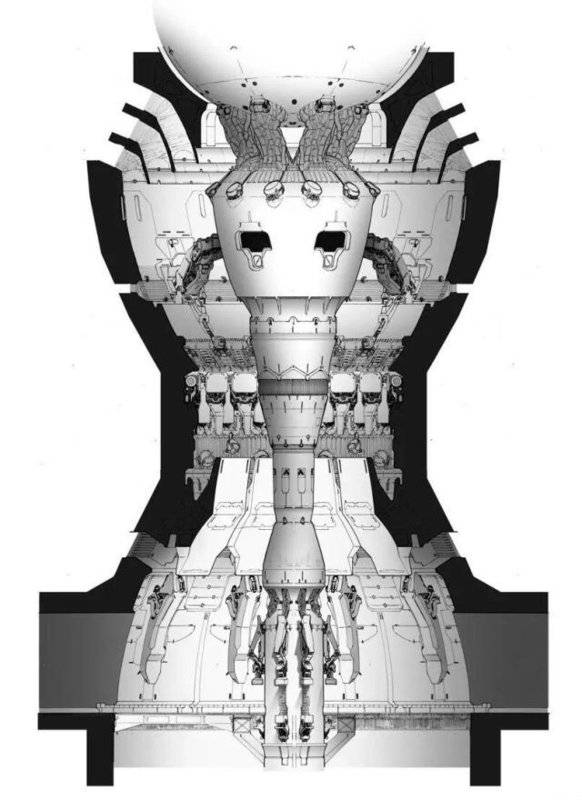
Xforce said:
Hmmm, not sure about that.
Basically, the "heavy fusion" aspect (and I'm acknowledging that this conversation is off an artists diagram so won't get too fussy about the detail) may not be a practical design feature. We know of two basic types of fusion reactions: those that preserve the number of protons and neutrons, and those that involve a conversion between protons and neutrons. The first type is the focus of our fusion-energy projects (
ITER for example) and is commonly referred to as the D-T fusion reaction, while the second starts stars burning and is commonly referred to as the H-H fusion reaction. We focus on the D-T in energy generation because the net energy release from the D-T reaction is forty times greater than the H-H reaction. (Which is not to suggest that H-H is "energy poor." Both reactions liberate a
lot of energy, esp. compared to how we normally generate the stuff!)
But the trouble with the "heavy fusion technology" aspect is that not all elements fuse usefully. Wikipedia has a very detailed - and physics heavy - overview of this at
https://en.wikipedia.org/wiki/Nuclear_fusion#Important_reactions, but essentially, only a few light elements (hydrogen, helium, and boron just barely) make the grade as practical fusion fuels. So expecting to top up the tanks with oxygen or carbon and fuse it up to power the thrusters, is very unlikely.