AdityaDev said:
I have gone through coordinate geometry by S.L.Loney and I found the same thing.
The equation of any curve passing through the points of intersection of a given curve S and line L is S+kL=0.
As a guess, this equation is some notation whose meaning is not obvious to someone without the book you cited. It is no mathematically meaningful to "add" a circle and a multiple of a line.
AdityaDev said:
This equation is correct because the resultant equation passes through the two points of intersection.
An equation doesn't pass through points -- it is not a geometric object. A given point can satisfy an equation (i.e., make the equation a true statement).
AdityaDev said:
Similarly, the equation of a circle passing through the angular points of a quadrilateral whose side equations are ##L_1,L_2,L_3,L_4## is given by
##L_1L_2+\lambda L_3L_4=0##
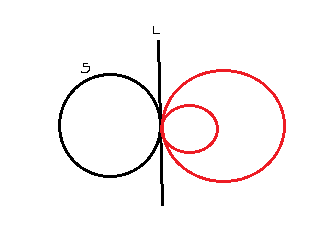
Lambda is a parameter. Its not a vertical line. Its just a rough diagram.
Again, I don't see how this makes sense, unless it is notation that is not to be taken literally. If, as you say, L
1 is an equation, then it's not something that can be used in an arithmetic expression.
Here's an example.
Let E
1 be the equation 2x + 3y = 5
Let E
2 be the equation x
2y = 1
How is E
1E
2 meaningful? We would have (2x + 3y = 5)(x
2y + 3y = 1). I have never seen any mathematics text talk about multiplying one equation by another.
AdityaDev said:
Yes. They add to zero when you substitute the point of contact of the given circle and the line. This is how the family of circles is specified. They all have to touch that point.
To get back to what you originally asked about, let me make a simplifying assumption; namely, that line L is vertical, and its equation is x = p. If C is any circle that touches the point (p, q) and whose radius is r, then its center must be at (p + r, q). The center of the circle has to be on a horizontal line that intersections the vertical line at (p, q).
The equation of the circle would be ##(x - (p + r))^2 + (y - q)^2 = r^2##. Note that if r = 0, this equation simplifies to ##(x - p)^2 + (y - q)^2 = 0##, and we get only the point (p, q). Also, if we allow r to be negative, we get circles on the other side of the vertical line. In this case, we would take the radius of the circle to be |r|.