Equation to graph a 180 degree curve comprised of a radius and an ellipse

Click For Summary

Discussion Overview

The discussion revolves around finding an equation to graph a 180-degree curve composed of a 135-degree radius and a 45-degree ellipse. Participants explore the mathematical relationships between the two curves, particularly focusing on ensuring that their curvatures match at the point where they meet. The conversation includes technical details about the equations of ellipses and curvature, as well as requests for visual representations of the curves.

Discussion Character

  • Exploratory
  • Technical explanation
  • Mathematical reasoning
  • Homework-related

Main Points Raised

  • One participant seeks an equation for a 180-degree curve made up of a radius and an ellipse, emphasizing the need for matching curvatures at their intersection.
  • Another participant suggests that the requirement for matching curvature may depend on additional conditions, such as the specific endpoint of the ellipse.
  • Equations for an ellipse and curvature are provided, including the standard form of the ellipse and the formula for curve radius.
  • Participants discuss the implications of the derivatives of the ellipse function in determining the intersection point with the circular portion.
  • There is a clarification regarding the correct form of the ellipse equation, indicating a potential error in a previous statement.
  • A participant expresses difficulty in understanding the mathematical concepts and requests a simpler explanation and visual representation of the curves.
  • Further clarification is provided regarding the relationship between the radius and the distances in the x- and y-directions from the intersection point to the center of the circular portion.

Areas of Agreement / Disagreement

The discussion contains multiple competing views regarding the requirements for the intersection of the radius and ellipse, and there is no consensus on a definitive solution or method for graphing the curves. Participants express varying levels of understanding and seek different types of explanations.

Contextual Notes

Participants mention specific values for the semi-major and semi-minor axes of the ellipse, but these values are not defined in the discussion. The relationship between the radius and the ellipse's parameters remains unresolved, and assumptions about the nature of the curves are not fully clarified.

Who May Find This Useful

This discussion may be useful for individuals interested in mathematical modeling of curves, particularly those involving ellipses and circular arcs, as well as those seeking to understand the relationships between different geometric shapes in a mathematical context.

JimEd
Messages
46
Reaction score
0
Hi All, I'm not a math guy so I am coming to you for help.

I am trying to come up with an equation to graph any 180 degree curve that is comprised of: a 135 degree radius, and a 45 degree ellipse (135 + 45 = 180). The two curves being the same curvature (slope?) where they meet.

The portion of the ellipse I want to use would be the part between line B (the vertical one) and line A (the red one), on the drawing below. The radius portion would start at A and go to the right.
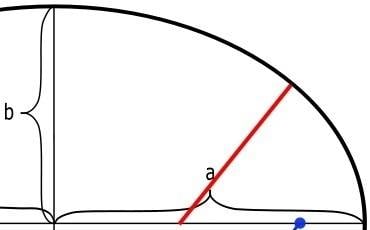
ellipse.jpg

<click image to make it larger>Given: the length of the semi-major axis of the ellipse, the length of the semi-minor axis of the ellipse, and the radius. Use any example numbers you like (but remember the curvature (slope?) of the radius and the curvature (slope?) of the ellipse have to be the same where they meet, so I believe that means the value of the radius is dependent on the values of the ellipse).

Please don't take this wrong, but I'm an older guy, and this isn't homework, so ideally I would like someone to solve it (if it is possible), and then briefly explain it to me. As opposed to someone leading me around to try to solve it for myself - which would be extremely painful for both of us!

Thanks very much.
 
Last edited:
Physics news on Phys.org
(but remember the curvature (slope?) of the radius and the curvature (slope?) of the ellipse have to be the same where they meet, so I believe that means the value of the radius is dependent on the values of the ellipse)
Only if you add more requirements. Does the end of the ellipse-part (and end of the 180°-curve) have to be some special point of the ellipse?

Some helpful equations:
An ellipse aligned with the coordinate axes can be expressed as ##\frac{x^2}{a^2}+\frac{y^2}{b^2}=1## or ##y(x)=\pm b \sqrt{1-\frac{x^2}{b^2}}##

Curve radius is given by $$R = \frac{(1+y'^2)^{\frac{3}{2}}}{y''}$$ where ' is the derivative with respect to x. The curve radius of a circle is the regular radius of the circle, of course.
45° away from the intersections of the major axes and the ellipse are points with y'=±1. This simplifies curvature to ##R=\frac{\sqrt{8}}{y''}##, but it applies to a special case of your construction only.
 
mfb said:
Does the end of the ellipse-part (and end of the 180°-curve) have to be some special point of the ellipse?

Hi mfb,

Thanks, you are right, I should have included that. I will add it, and drawing to my original question/post.

The end of the ellipse portion (at the end of the 180 degree curve) would correspond to the middle of the major axis (where the ellipse intersects line B on the drawing, above).

Thanks.
 
Last edited:
(below)
 
Last edited:
mfb said:
where ' is the derivative with respect to x.
'' is the second derivative.

If you know a and b and the 45°-part of the ellipse is like in the sketch, with the origin of the coordinate system in its center:
Derive y and solve for y'=-1 (it has a nice general solution) to find the corresponding x-value of point P where ellipse and circle meet. Use this x-value in y(x) to get the corresponding y-value for P. Use some tool of your choice to draw y(x) between the calculated x-value and x=a.

Derive y' to get y'', insert your calculated x-value and plug that in the formula for the curve radius to get the curve radius R.
The center of your circle is now ##\frac{R}{\sqrt{2}}## to the left and below P. Its center is M(c,d) and the circle equation is ##(x-c)^2 + (y-d)^2 = R^2## or ##y(x)=d+\sqrt{R^2-(x-c)^2}##. Draw this for x=c-R to point P.

##y(x)=\pm b \sqrt{1-\frac{x^2}{b^2}}##
That has an error, it should be ##y(x)=\pm b \sqrt{1-\frac{x^2}{a^2}}##
 
mfb said:
'' is the second derivative.

If you know a and b and the 45°-part of the ellipse is like in the sketch, with the origin of the coordinate system in its center:
Derive y and solve for y'=-1 (it has a nice general solution) to find the corresponding x-value of point P where ellipse and circle meet. Use this x-value in y(x) to get the corresponding y-value for P. Use some tool of your choice to draw y(x) between the calculated x-value and x=a.

Derive y' to get y'', insert your calculated x-value and plug that in the formula for the curve radius to get the curve radius R.
The center of your circle is now ##\frac{R}{\sqrt{2}}## to the left and below P. Its center is M(c,d) and the circle equation is ##(x-c)^2 + (y-d)^2 = R^2## or ##y(x)=d+\sqrt{R^2-(x-c)^2}##. Draw this for x=c-R to point P.

Thank you so much for this, it looks brilliant, but it is way over my head. I am using the online graphing calculator at https://www.desmos.com/calculator and I can't get any of these equations to show up as... anything. Is there any chance someone could make a graph of it? If so, thank you, I know it is asking a lot. I'm a little better with visual learning.

I'm probably misunderstanding you, but, from P to the center of the circular portion (as opposed to the ellipse portion) should just be R (the radius), not R / sqr 2. Correct?
 
Last edited:
The total distance is R, but it is composed of the distance in x- and y-direction, which have the same magnitude.
 
Can anyone make a drawing or a graph of this, please?

I know this is a math forum, and I do appreciate math, but I am not very good at it. That's why I am here. I don't know how to "derive" things, so I need a more basic explanation. Pretend I'm an average high school freshman and you'd probably be pretty close to my level of understanding.

I get that R / sqr 2 = the length of the x and y paths from P to M, now.

Thanks
 
Last edited:
Anyone?
 

Similar threads

  • · Replies 27 ·
Replies
27
Views
6K
  • · Replies 6 ·
Replies
6
Views
3K
  • · Replies 3 ·
Replies
3
Views
4K
  • · Replies 3 ·
Replies
3
Views
3K
  • · Replies 6 ·
Replies
6
Views
3K
  • · Replies 4 ·
Replies
4
Views
13K
  • · Replies 10 ·
Replies
10
Views
4K
  • · Replies 4 ·
Replies
4
Views
2K
  • · Replies 3 ·
Replies
3
Views
2K
  • · Replies 8 ·
Replies
8
Views
4K