DrewPear
- Messages
- 2
- Reaction score
- 2
- TL;DR
- I'm trying to determine the accuracy of a couple of equations to determine the diameter of a sphere given the frequency and the diameter and length of a sound hole and ask related questions.
I host freely for the public a web app for determining the diameter of a sphere to resonate a given frequency and sound hole diameter and length, and then download a stl file for 3D printing. I've realized it has some issues and part of it is the equations i use to determine the sphere's diameter. I offer two styles in the app using equations given to me by a physics professor in 1980's. They are...
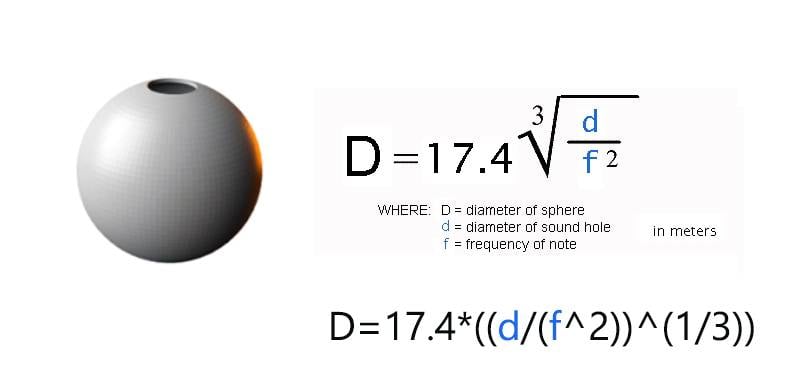
________________________________________________________________________________________________________________________________________
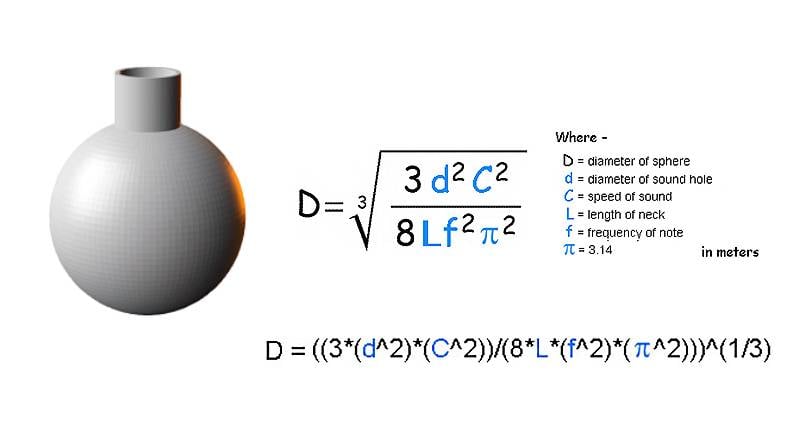 At this point, i believe i should be most interested in the accuracy of the equation next to the sphere with a neck in the second picture. I've realized that the equation for a sphere with no neck in the first picture does not consider the thickness of material used since it will in essence create a neck of some length. The expression below each equation, i'm hoping, is an accurate representation of the equation above it.
________________________________________________________________________________________________________________________________________