Equations for Various Functions ?

  • Context: Undergrad 
  • Thread starter Thread starter Jakes
  • Start date Start date
  • Tags Tags
    Functions
Click For Summary
SUMMARY

This discussion focuses on the definitions and equations of various types of functions, including constant, onto (surjective), one-to-one (injective), and many-to-one functions. A constant function is represented as f(x) = y, where y remains unchanged for all x values. An onto function requires that every element in the codomain Y has a corresponding pre-image in the domain X, while a one-to-one function ensures that distinct elements in X map to distinct elements in Y. The nuances of using variables and constants in function notation are also explored, emphasizing the importance of context and quantifiers in mathematical expressions.

PREREQUISITES
  • Understanding of basic function types: constant, onto, one-to-one, and many-to-one functions.
  • Familiarity with mathematical notation and terminology, including variables and constants.
  • Knowledge of quantifiers in mathematics, such as "for each" and "there exists."
  • Basic principles of logic, particularly universal generalization.
NEXT STEPS
  • Study the properties of surjective functions in detail.
  • Learn about injective functions and their implications in set theory.
  • Explore the concept of bijective functions and their significance in mathematics.
  • Investigate the role of quantifiers in mathematical proofs and expressions.
USEFUL FOR

Students of mathematics, educators teaching function theory, and anyone seeking to deepen their understanding of mathematical functions and their properties.

Jakes
Messages
7
Reaction score
0
I don't understand the logic behind standard equation or Expressions for various Functions.

For example:
Constant Function:
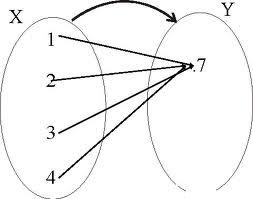
MVLJa.jpg

so from this pic you can represent constant function is f(x) = y ..when every x value gives the same y value (7 in the above case)
constant function is written as
F(x) = y
where y is constant (it will be 7 if you go by the image image above) because every value of f(x) maps to same value in f(y)
This is Understandable.

BUT

Lets say its an Onto Function or Surjective function
if function is from X to Y then every element of Y must have some pre image in A and no element in Y should be left alone
Its equation is f(x) = y ... HOW ?

Lets take One One Function or injective function
If function is from X to Y then different elements in X have different images in Y.
Its expression is f(x) = f(y) HOW ?
[URL]http://upload.wikimedia.org/wikipedia/commons/a/a5/Bijection.svg[/URL]Many One function:
(function from X to Y) If two or more different elements in X have the same image in Y
its equation or it is represented through f(x) = f(y) How ??

If the equations are wrong then please correct it
 
Last edited by a moderator:
Physics news on Phys.org
Jakes said:
BUT

Lets say its an Onto Function or Surjective function
if function is from X to Y then every element of Y must have some pre image in A and no element in Y should be left alone
Its equation is f(x) = y ... HOW ?

Whether a letter 'y' is a constant or a variable is always a tricky issue. When we have a function like f(x) = y = x + 2, the understanding is that 'y' is a variable. Precisely saying what "variables" are is a complicated matter.

The fact that letter denotes a variable is sometimes made clear by stating a "quantifier" such as "for each" or "there exists" that applies to it. For example, "For each ordered pair (x,y) in the function f, y = x + 2". Often no quantifers are written and the reader is supposed to understand that they are intended. For example, the statement "y = x + 2" might be written without the quantification "For each ordered pair (x,y)", but those quantifiers should be supplied by the reader.

Whether a letter is a constant is also a tricky matter. For example, a proof in geometry might begin "Let ABC be a triangle". This is understood to mean that the reader will pretend that ABC is a specific triangle, but not one that has any special properties. This happens when the writer wishes to use the principle of logic called "universal generalization" (see http://en.wikipedia.org/wiki/Generalization_(logic) for a technical treatment of this). To prove something is true "for each" triangle ABC, the writer says to consider a triangle ABC that is specific yet has no properties to distinguish it from any other triangle.

Likewise, when a writer says "c is a constant", he asks the reader to imagine that c is some specific number, but not one with special properties. (By contrast, a constant like \pi is a speciific number that does have special properties.)

One statement in a book may use the symbol "y" to mean a constant (although it would be more customary to use "k" or "c" in such a role.) Another statement may use "y" to represent a variable.
 
Last edited:

Similar threads

  • · Replies 7 ·
Replies
7
Views
3K
  • · Replies 5 ·
Replies
5
Views
2K
  • · Replies 2 ·
Replies
2
Views
1K
  • · Replies 1 ·
Replies
1
Views
2K
  • · Replies 6 ·
Replies
6
Views
2K
  • · Replies 7 ·
Replies
7
Views
2K
  • · Replies 3 ·
Replies
3
Views
2K
  • · Replies 3 ·
Replies
3
Views
3K
  • · Replies 9 ·
Replies
9
Views
2K
  • · Replies 7 ·
Replies
7
Views
2K