Equilibrium of a Rod Problem: Find Minimum Distance x

  • Thread starter Thread starter burnst14
  • Start date Start date
  • Tags Tags
    Equilibrium Rod
Click For Summary

Homework Help Overview

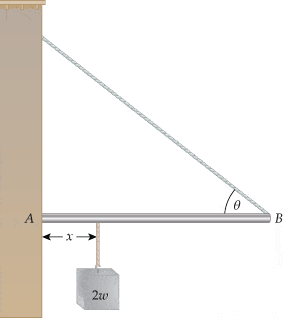
The discussion revolves around a problem involving the equilibrium of a uniform beam supported by a cable and friction. The beam's length, the angle of the cable, the coefficient of static friction, and the weight of the beam are specified. Participants are tasked with determining the minimum distance from a support point at which an additional weight can be hung without causing the beam to slip.

Discussion Character

  • Mixed

Approaches and Questions Raised

  • Participants explore the relationships between forces acting on the beam, including normal force, friction, and torques. There are attempts to set up equations for force components and moments, with some questioning the assumptions made about the forces involved.

Discussion Status

Several participants have provided equations and attempted to manipulate them to express variables in terms of others. There is ongoing exploration of how to relate the normal force to the weight of the beam and the friction force. Some participants express uncertainty about the correctness of their equations and seek clarification on algebraic manipulations.

Contextual Notes

Participants note the challenge of solving for multiple variables with limited known quantities, and there is discussion about the implications of assuming maximum friction. The problem is framed within the constraints of an online homework platform that allows multiple attempts for solutions.

burnst14
Messages
53
Reaction score
2
Problem Statement: As shown in the figure below, a uniform beam is supported by a cable at one end and the force of friction at the other end. The cable makes an angle of θ = 30°, the length of the beam is L = 1.50 m, the coefficient of static friction between the wall and the beam is μs = 0.420, and the weight of the beam is represented by w. Determine the minimum distance x from point A at which an additional weight 2w (twice the weight of the rod) can be hung without causing the rod to slip at point A.
9-p-017.gif


Relevant Equations:
Ff = μN
Ʃτ = 0
ƩF = 0

Solution Attempt:
I'm not really sure where to start. Does Fn (normal force) come from the weight of the rod multiplied by cos(30) due to the angle of the cable holding it against the wall? And once I find Fn, I multiply that by μ, giving the upward force of friction. Then, placing the rotational axis at the end of the rod that the cable is attached to (because it's not moving, I can place the axis anywehere) and set Fn equal to the weight of the object being attached multiplied by the distance from the wall. Would that work?
 
Physics news on Phys.org
You just need to go about the problem systematically.

Write down the equation for x-components of the forces.

Write down the one for y-components.

Then for moments/torques.

You are going to have a bunch of known and unknown forces in those equations. Of those, the normal force at A and friction at A will be related with the coefficient of friction.
 
  • Like
Likes   Reactions: 1 person
Okay so:

ƩFy: Ff + FBsin30-2w-w = 0
ƩFx: FN - FBcos30 = 0
Ʃτ: -w(0.75) - 2wxm + FBsin30(1.5)

Is that correct?
 
Assuming the third formula ends with " = 0 ", that looks good.
 
  • Like
Likes   Reactions: 1 person
Alright so all of that is correct, but now what? We don't have most of those variables and the only ones we can solve for are FF/FN. How do we relate w to FN? Everything has to be in terms of "w" as it stands.

What am I missing?
 
Observer that once you relate friction and the normal force, the first to equations can be solved, giving you all the forces in the system. But you still have the third one to satisfy.
 
So rewriting ƩFy we get:

μFN - 2w - w = -FBsin30 → -(μFN - 2w - w) = FBsin30

And rewriting ƩFx we get:

FN = FBsin30

We set these equal which gives:

-(μFN - 2w - w) = FN

then

-μFN + 2w + w = FN

then

(-0.420)FN + 2w + w = FN

then

What? Nothing cancels so we can't solve for anything.
 
burnst14 said:
And rewriting ƩFx we get:

FN = FBsin30

It was FBcos 30 originally.

then

(-0.420)FN + 2w + w = FN

then

What? Nothing cancels so we can't solve for anything.

How so? Assuming it is correct (which it is not), this is the same as 3w = 1.420 FN. Surely this can be solved for FN.
 
Is the answer 0.9275m?
 
  • #10
Oh yeah, so it really doesn't work then.

How so? Assuming it is correct (which it is not), this is the same as 3w = 1.420 FN. Surely this can be solved for FN.

Now I feel really dumb. How do you solve that for anything, but an answer in terms of w?

But back to the problem, I'm at a loss of what to even try. You say relate FN and μ, but I can't.

If I try setting it equal with FN rather than FB...

I get:
FBcos30 = (FBsin30 - 3w) / -μ

Does cos30/sin30 cancel somehow that I'm unaware of? That would help with one of the variables. Actually that would help everything! Waitwaitwaitwaitwait...

[FBcos30] / [FBsin30] = -3w/ -μ

substitute in for μ:

[FBcos30] / [FBsin30] = -3w/ -0.420

Cancel FB and multiply by -0.420:

-0.420(sin30/cos30) = -3w

Divide by -3:

(0.420/3)(sin30/cos30) = w

RIGHT?
 
  • #11
Gank said:
Is the answer 0.9275m?

I don't have the answers. It's a Web Assign, if you'v heard of it. Basically online physics homework that allows for 5 solution attempts.
 
  • #12
The way I did mine was:

We need to find the Fb in terms of w then we can eliminate it from the final answer as all the terms in the torques will have w. So I found 0.42Fn=Ff and that Fn=Fbcos30. From there i found Ff in terms of Fb and then put this into Fy to find Fb in terms of w. From here i substituted this into the torque equation and simplified
 
  • #13
@voko ?
 
  • #14
How many more answer attempts do you have?
 
  • #15
Is there any help available on this thread?
 
  • #16
burnst14 said:
FBcos30 = (FBsin30 - 3w) / -μ

Does cos30/sin30 cancel somehow that I'm unaware of? That would help with one of the variables. Actually that would help everything! Waitwaitwaitwaitwait...

[FBcos30] / [FBsin30] = -3w/ -μ

I think you need to brush up on your algebra skills. When you have ## a F_B = (b F_B + c)/d ##, you should have no problem doing this: $$

a F_B = (b/d) F_B + (c/d)

\\

a F_B - (b/d) F_B = c/d

\\

(a - b/d)F_B = c/d

\\

F_B = \frac {c/d} {a - b/d}

\\

F_B = \frac {c} {ad - b}
$$
 
  • #17
Burnst14 got any answers?
 
  • #18
Gank said:
The way I did mine was:

We need to find the Fb in terms of w then we can eliminate it from the final answer as all the terms in the torques will have w. So I found 0.42Fn=Ff and that Fn=Fbcos30. From there i found Ff in terms of Fb and then put this into Fy to find Fb in terms of w. From here i substituted this into the torque equation and simplified

This approach should work.
 
  • #19
Cheers Voko. Sorry for being quite brash - I get really into problem solving
 
  • #20
Gank said:
The way I did mine was:

We need to find the Fb in terms of w then we can eliminate it from the final answer as all the terms in the torques will have w. So I found 0.42Fn=Ff and that Fn=Fbcos30. From there i found Ff in terms of Fb and then put this into Fy to find Fb in terms of w. From here i substituted this into the torque equation and simplified

There is also another approach, somewhat more complex but "more correct". Note that by letting ## F_f = \mu F_n ## we assume that the friction is maxed out. But we do not really know if it is going to be maxed out at a minimum or at a maximum of ##x##.

So the more correct approach would involve not letting ## F_f = \mu F_n ## just yet, and instead solve the system of three equations in three variables ##F_B, \ F_f, \ F_n ## and one parameter ##x##. Then find the range of ##x## where ## F_f \le \mu F_n ##. You could try that.
 
  • #21
voko said:
I think you need to brush up on your algebra skills. When you have ## a F_B = (b F_B + c)/d ##, you should have no problem doing this: $$

a F_B = (b/d) F_B + (c/d)

\\

a F_B - (b/d) F_B = c/d

\\

(a - b/d)F_B = c/d

\\

F_B = \frac {c/d} {a - b/d}

\\

F_B = \frac {c} {ad - b}
$$

Yes I could do that, but in this case "c" is another variable, "w". So my solution would be in terms of w like I said. Wouldn't it?
 
  • #22
burnst14 said:
Yes I could do that, but in this case "c" is another variable, "w". So my solution would be in terms of w like I said. Wouldn't it?

Yes, you will end up with ##F_B## in terms of ##w##. Which is what you want, because the torque equation is also in terms of ##w##, so you could expect it will cancel out.
 
  • Like
Likes   Reactions: 1 person
  • #23
OOOOOOOOOOOHHHHHHHHHHHH!

Dang it. I was so focused on solving for a number that I completely forgot about the possibility of substitution and solving it as a system. Wow. Sorry. Okay.
 
  • #24
Okay I'm going to bed, I'll work on this in the morning and post what I got and let you know if I got it correct. Thanks for the patience.
 
  • #25
If absinθ = c
does (asinθ)b = c?
 
  • #26
Nevermind. I just proved it does.
 
  • #27
Alright I got it wrong. Here's what I did:

Using that algebra step, I got:

FB = 1.171w

Then I substituted that in for FB in:

burnst14 said:
Ʃτ: -w(0.75) - 2wxm + FBsin30(1.5)

Giving:

-w(0.75) - 2wxm + (1.171w)sin30(1.5) = 0

Combine like terms and multiply out:

0.13w = 2wx

Divide over:

x = 0.065m

This is wrong according to Web Assign. It seems too small, but who am I to say so. So where did I stray?
 
  • #28
I obtain ## F_B = \frac {3w} {\mu \cos \theta + \sin \theta} \approx 3.473 w ##.
 
  • Like
Likes   Reactions: 1 person
  • #29
Alright I got the right answer using your value. I'm not sure how you got it though. That seems to be new to me.

[cos30-(sin30/-μ)]FB = 3w/-μ

FB = [(-3w/-μ)/(cos30-(sin30/-μ)]

FB = (-3w/-μ)[(1/cos30)-(-μ/sin30)

FB = (3w/μ)(sin30+μcos30/sin30cos30)

FB = (3wsin30+3wμcos30)/(μsin30cos30)

Where do you go from there?
 
  • #30
Also what tool are you using to write your equations? It's much more clearly written.
 

Similar threads

  • · Replies 7 ·
Replies
7
Views
3K
Replies
2
Views
2K
  • · Replies 6 ·
Replies
6
Views
4K
  • · Replies 8 ·
Replies
8
Views
3K
  • · Replies 2 ·
Replies
2
Views
2K
  • · Replies 7 ·
Replies
7
Views
4K
  • · Replies 42 ·
2
Replies
42
Views
4K
Replies
1
Views
2K
  • · Replies 21 ·
Replies
21
Views
4K
Replies
19
Views
3K