Equipotential Apparatus on the cheap?

  • Thread starter Thread starter mishima
  • Start date Start date
  • Tags Tags
    equipotential
Click For Summary

Discussion Overview

The discussion revolves around the construction of a low-cost equipotential apparatus for educational purposes, focusing on alternatives to commercially available conductive paper. Participants explore various materials and methods to achieve the desired electrical properties for effective use in experiments.

Discussion Character

  • Exploratory
  • Technical explanation
  • Debate/contested
  • Experimental/applied

Main Points Raised

  • One participant expresses interest in creating a homemade equipotential apparatus and questions the suitability of carbon paper as a substitute for the specialized conductive paper used in commercial kits.
  • Another participant clarifies the resistance measurement of the conductive paper, noting that surface resistance is measured in Ohms without additional units.
  • Several participants suggest alternatives, including Teledeltos paper, and discuss its resistance properties compared to carbon paper.
  • One participant proposes using graphite powder or creating a conductive paint mixture as potential solutions.
  • A participant shares their prototype experience, noting issues with fluctuating readings when using carbon paper and suggesting that an analog multimeter might yield better results.
  • Concerns are raised about the affordability of Teledeltos paper for schools with limited budgets, prompting discussions about the feasibility of making it at home.
  • Participants discuss the potential for using other materials, such as coated fax paper, and the durability of homemade solutions compared to commercial products.
  • One participant reports success with a homemade conductive paint, achieving stable readings and demonstrating the effectiveness of their setup.

Areas of Agreement / Disagreement

Participants express a range of opinions on the best materials and methods for constructing the apparatus. There is no consensus on a single solution, and multiple competing views remain regarding the effectiveness and practicality of various approaches.

Contextual Notes

Participants mention limitations related to the quality and uniformity of homemade materials, as well as the potential influence of multimeter resistance on measurements. The discussion includes various assumptions about the properties of materials and their suitability for educational experiments.

mishima
Messages
576
Reaction score
43
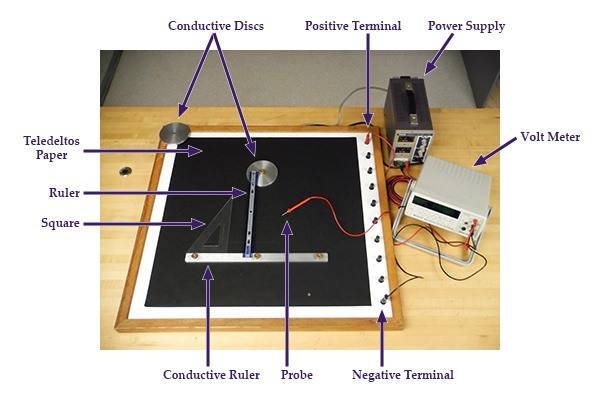
Hi, I recently stumbled across the wonderful equipotential apparatus, which allows one to create equipotentials by hand for educational purposes.
equipotential.jpg

After browsing around and finding sales prices ranging between 150 (pasco) and 500 dollars, I'd like to just make one.

It does not appear at all complicated, but I had a question about the special conductive paper used in those high dollar kits. In one video, the narrator says "semi-conducting paper" which makes me think that simple carbon paper might not be a good substitute for my home-made version. (Pasco sells 50 sheets of the semiconductive paper for $45 dollars..)

The manual for the mapper kit freely available on Pasco's website says the paper has a resistance of 5k ohms per square (cm I assume). I am looking for a cheap substitute because I already have everything else needed to make this great apparatus. Any ideas?

Mentioned Video (apparatus shown 2:30 onwards)
 
Engineering news on Phys.org
mishima said:
The manual for the mapper kit freely available on Pasco's website says the paper has a resistance of 5k ohms per square (cm I assume).
No cm. The units for surface resistance are just Ohm. If you increase the size of a square with current flow, you increase the length of the current flow but also the width where current flows. Both effects cancel and you get the same resistance - 5 kOhm.

I don't know where you can get conductive surfaces within the right resistance range, but I would expect some cheap solution to exist.
 
I googled teledeltos paper and found this site that sells 10 sheets for 14 £

http://www.betterequipped.co.uk/teledeltos-conductive-paper-prd1516-pack-of-10-sheetsp-1262
 
Hm, so Teledeltos paper is higher surface resistance than carbon paper? Is there a way to make Teledeltos paper yourself?
 
mishima said:
Hm, so Teledeltos paper is higher surface resistance than carbon paper? Is there a way to make Teledeltos paper yourself?

You haven't given any specifications for quality, uniformity, or ruggedness. Perhaps carbon paper would do. Perhaps you could just shade a piece of paper with a graphite pencil if your standards are low enough. Perhaps you could dust sticky paper with lamp black soot.

I think your best option is to contact other institutions and ask them to give you a single sheet of Teledeltos paper free.
 
Well, here is my prototype. The problem I am having with the carbon paper is that the reading fluctuates to the point of being unusable. In the pic it shows a nail head I was using, but I tried various things like small copper squares, galvanized cylinders, etc. It might be more usable with a analog multimeter. The bars are aluminum, and hardware is galvanized. The bars are tightly compressed against the carbon paper. The voltage source is an ancient laptop charger rated at 12 V and 3A. Readings of resistance on the paper with probes roughly 1 cm apart are upwards of 22 Mohms.

As far as what I'm shooting for, I would like for high school students who know nothing about vector calculus to be able to sketch equipotential maps from real fields in real space. Afterwards, they could compare their plots to theoretical constructions I prepare with Mathematica. So it can be crude and inaccurate as long as the general shapes are there. I was hoping they might be able to drag around the probe and see how the reading does not change on an equipotential. As mentioned though, its unusable due to sporadic readings.

IMG_1634.jpg
 
Your multimeter might draw too much current for a reliable measurement. Do you know its resistance?
 
My multimeter is 10 Mohm.

I've got some graphite powder, Ill try that conductive paint mixture.
 
  • #10
mishima said:
My multimeter is 10 Mohm.
Then it will influence the measurement significantly. You can use it in zero-current-mode (compare to a fixed voltage at the other lead) to find equipotential lines, but getting a sheet with better conductivity is probably easier.
 
  • #11
For zero-current-mode, do you mean putting one probe on + and the other on the paper?

Would a cheap 5-10 dollar analog multimeter have a lower resistance?
 
  • #12
I don't understand. What high school can't afford $3/sheet for teledeltos paper? How much do you think it will cost to make your own?
 
  • #13
mishima said:
For zero-current-mode, do you mean putting one probe on + and the other on the paper?

Would a cheap 5-10 dollar analog multimeter have a lower resistance?
Put the other probe to the potential where you want to measure the equipotential line. Can be externally, can be on the sheet itself.

10 MOhm is not bad for a multimeter, getting a better one is probably more expensive than buying the paper discussed above.
 
  • #14
mishima said:
My multimeter is 10 Mohm.

I've got some graphite powder, Ill try that conductive paint mixture.
The rolls of coated fax paper that preceded today's "plain paper" fax/copiers---is that a conductive coating? If so, it might be usable here even if it does have a much lower resistance.

I have none at hand, else I'd try it to see.
 
  • #15
anorlunda said:
I don't understand. What high school can't afford $3/sheet for teledeltos paper? How much do you think it will cost to make your own?

Well, we're a title 1 high school with a graduating class of about 20-30 a year. My budget is typically 600-700 dollars annually for chemistry, astronomy, physics, programming, and electronics. This year we started a new engineering program for upwards of $30,000, which was a huge deal. That was just a few months ago and I don't really want to ask my admin for more money at this point. That said, you're right that teledeltos paper really isn't unreasonable. I don't know how one would make teledeltos paper or the cost, the manufacturing process is unknown to me.

mfb said:
Put the other probe to the potential where you want to measure the equipotential line. Can be externally, can be on the sheet itself.

10 MOhm is not bad for a multimeter, getting a better one is probably more expensive than buying the paper discussed above.

I have a small regulated power supply, Ill give that a try.
 
  • #16
I'm thinking that you design the experiment so that the teledeltos paper does not get marked or destroyed. The probe has a spike on top. Move the probe to the equipotential point, and lower a piece of plain paper down to make a hole in the plain paper. Then connect the dots.

One $3 sheet of teledeltos could serve you for many years. Beg a single sheet from a nearby university.
 
  • #17
I seem to be in business. Turns out I had some conductive paint kicking around. Decided to spread it out on a piece of acrylic, and cut holes for the conductors. The readings were completely steady with one lead at 0 and the other tapping the surface. I found some of my wife's ironing beads and was able to slip the bead onto the probe and scan around the surface. When I reached the voltage I was looking for, I lifted the probe. Here is an example with brown 10 V, turquiose 7V, purple 5 V and green 3 V. The left conductor is 12.3 V and the right is 0.

IMG_1642.jpg

This is obviously more expensive than getting the teledeltos paper, but I had these things on hand and it seems very durable.
 
Last edited:
  • Like
Likes   Reactions: JBA and NascentOxygen

Similar threads

  • · Replies 5 ·
Replies
5
Views
2K
  • · Replies 6 ·
Replies
6
Views
2K
  • · Replies 30 ·
2
Replies
30
Views
6K
  • · Replies 12 ·
Replies
12
Views
4K
  • · Replies 3 ·
Replies
3
Views
2K
  • · Replies 1 ·
Replies
1
Views
3K
  • · Replies 128 ·
5
Replies
128
Views
44K
  • · Replies 1 ·
Replies
1
Views
6K
  • · Replies 4 ·
Replies
4
Views
7K
  • · Replies 3 ·
Replies
3
Views
4K