Estimating efficiency of a system

  • Thread starter Thread starter Pinon1977
  • Start date Start date
  • Tags Tags
    Efficiency System
Join the discussion
Registration is free. Ask a follow-up in this thread, or start your own.
26 replies · 5K views · last reply
Pinon1977
Messages
126
Reaction score
4
TL;DR
Trying to determine if you can estimate the efficiency of a system with a derived known efficiency as the reference starting point.
Please see the attempt sketch. Basically I have four very inefficient DC motors all commonly turning a single drive shaft at the center of the system. Currently these motors that are 2.47% efficient individually able to produce 5 newton meters of torque at 28 RPMs. So my question is this. If I replace those 2.47% efficient motors with a motor that is exactly the same but 90% efficient, can I use a multiplier of 36.4 to roughly estimate what the new torque value would be? (.5 Nm * 36.4 = 18.4 Nm)
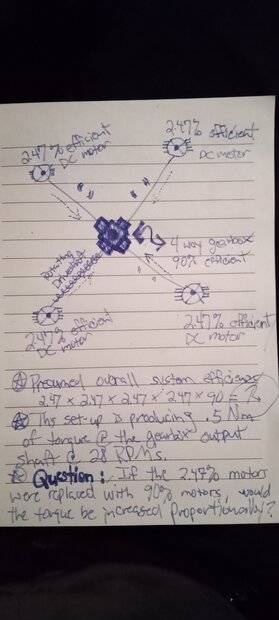
Handwritten sketch on lined paper of four DC motors, each labelled 2.47% efficient, around a central gearbox labelled 4 way gearbox 90% efficient, with a presumed overall efficiency calculation and a question below.
 
Last edited by a moderator:
Physics news on Phys.org
Pinon1977 said:
If I replace those 2.47% efficient motors with a motor that is exactly the same but 90% efficient, can I use a multiplier of 36.4 to roughly estimate what the new torque value would be?

Well, almost.

The gearbox has some losses you did not account for - for instance:
If that gear box is only rated for the original torque, the system efficiency will be Zero when the gear teeth break off! :oops:

Cheers,
Tom
 
Pinon1977 said:
Currently these motors that are 2.47% efficient
That would be awfully low. So low that it's already suspicious.
Could you please tell us how did you determined the efficiency of those DC motors?
 
  • Like
Likes   Reactions: russ_watters
Another spin on this very weird question:

Electric motors are rated based on output power and rpm, not input electrical power so if you replace these 4 motors with otherwise identical single motor at much higher efficiency it will provide 1/4 the output power that the 4 motors do combined.

You seem to be approaching this problem backwards, but it is hard to tell because we need the rest of the story we aren't getting...
 
  • Like
Likes   Reactions: sophiecentaur and Lnewqban
I'm strictly talking from an individual motor perspective..... let's just forget about the gearbox for the moment. If the existing motor is currently at 2.47% with the capability of producing .5 newton meters at 28 RPMs on a bench test, could we replace that motor with a 90% efficient motor and use a multiplier to presume what the new output to work would be?
 
Rive said:
That would be awfully low. So low that it's already suspicious.
Could you please tell us how did you determined the efficiency of those DC motors?
Sure, I used a digital torque transducer, an oscilloscope,, MATLAB, and some output data to come up with this efficiency number. Please see the attached screenshots.
 
Attachments
  • Screenshot of a partially visible data table with rows of numeric values, followed by MATLAB code computing total energy in and out as sums of power times time, and total efficiency as a percentage.
    Screenshot_20230825-172846.png
    13.9 KB · Views: 163
  • Screenshot of a MATLAB script and data table showing time, current, voltage and torque columns for 14 samples, with printed energy totals and a plotted power-over-time figure.
    Screenshot_20230825-172727.png
    16.8 KB · Views: 156
  • Phone screenshot of a dark-themed GitHub page showing a table of numeric data rows with columns of values such as 138.3981222, 0.63, 24.75, 0.4 and 28.
    Screenshot_20230825-172623.png
    10.5 KB · Views: 158
russ_watters said:
Another spin on this very weird question:

Electric motors are rated based on output power and rpm, not input electrical power so if you replace these 4 motors with otherwise identical single motor at much higher efficiency it will provide 1/4 the output power that the 4 motors do combined.

You seem to be approaching this problem backwards, but it is hard to tell because we need the rest of the story we aren't getting...
I'm strictly talking from an individual motor perspective..... let's just forget about the gearbox for the moment. If the existing motor is currently at 2.47% efficiency with the capability of producing .5 newton meters at 28 RPMs on a bench test, could we replace that motor with a 90% efficient motor and use a multiplier (36.4) to presume what the new output torque would be?

Bench test set up was as follows:

I used a digital torque transducer, an oscilloscope,, MATLAB, and some output data to come up with this efficiency number. Please see the attached screenshots.
 
Attachments
  • Screenshot of a phone browser on a GitHub page showing a dark-themed table of numeric columns, with rows of values such as 138.3981222, 0.63, 24.75 and 0.4 and row numbers down the left.
    Screenshot_20230825-172623.png
    10.5 KB · Views: 164
  • Screenshot of a MATLAB script and output showing a table of time, current, voltage and torque values, with computed energy in, energy out and efficiency of 9.77% and power-versus-time plots.
    Screenshot_20230825-172727.png
    16.8 KB · Views: 167
  • Screenshot of a MATLAB script and a table of numeric test data, with columns of values and lines computing total energy in, total energy out and total efficiency as a percentage.
    Screenshot_20230825-172846.png
    13.9 KB · Views: 163
Pinon1977 said:
I'm strictly talking from an individual motor perspective..... let's just forget about the gearbox for the moment. If the existing motor is currently at 2.47% efficiency with the capability of producing .5 newton meters at 28 RPMs on a bench test, could we replace that motor with a 90% efficient motor and use a multiplier (36.4) to presume what the new output torque would be?
Again, since motors are rated based on output, no, the output torque would not change.

Now, is this really theoretical or are you looking at real motors? What is the real point/purpose of this exercise?
 
Pinon1977 said:
the existing motor is currently at 2.47% with the capability of producing .5 newton meters at 28 RPMs on a bench test,
Rive said:
That would be awfully low. So low that it's already suspicious.
Bordering on trolling, IMO.

@Pinon1977 -- please upload a photo of the motor. Is it made from paperclips and a bar magnet?
 
I'm trying to be serious here, yet almost everyone of you guys feels that these questions are an open invitation for you guys to start your own open mic night at the comedy club. I'm trying to be serious here and I need serious consideration please.
Datasheet specification sheet for a Pololu-style PZ22GR9120R-084BBH DC planetary gear brush motor, with a small gearmotor drawing, operating conditions, electrical and mechanical characteristics tables.
 
Attachments
  • Screenshot of a phone browser showing a dark-themed table of numeric data with columns of values such as 138.3981222, 0.63, 24.75, 0.4 and 28, rows numbered down the left edge.
    Screenshot_20230825-172623.png
    10.5 KB · Views: 172
  • Screenshot of a MATLAB-style script and output: a table of time, current, voltage and torque values, followed by energy calculations and a plot of power over time.
    Screenshot_20230825-172727.png
    16.8 KB · Views: 174
Last edited by a moderator:
russ_watters said:
Again, since motors are rated based on output, no, the output torque would not change.

Now, is this really theoretical or are you looking at real motors? What is the real point/purpose of this exercise
russ_watters said:
Please see attached spec sheet for the exact motor I'm using. Yes, I am pushing it beyond its normal operating capabilities to get it to do what I needed to do. I get that. I bench test this motor across a broad spectrum of RPMs and loading characteristics. I used a digital torque transducer and matlabs to process the data. I will also attach a screenshot of that information. To answer your question, I never said it was theoretical, I said is it possible to come up with a theoretical based upon a real world known efficiency. And that particular efficiency in my case is 2.47% efficient. Horrible I know, but just go with it.


Reference: https://www.physicsforums.com/threads/estimating-efficiency-of-a-system.1055167/#post-6926192
 
Attachments
  • Datasheet specifications for a Pololu-style DC planetary gear brush motor model PZ22GR9120R-084BBH, with a 35772 MD drawing, dimension diagram, operating conditions table, electrical characteristics table and mechanical characteristics table.
    Screenshot_20230825-194022.png
    22.6 KB · Views: 179
Pinon1977 said:
And for the record, I never said it was strictly theoretical or strictly real motor data. It's both. I have a known set of established values that I've came up with using highly precise scientific instruments, and I'm wanting to know if I can presume certain facts to get in essence get a theoretical motor that is much more efficient to get the torque I need. That's all I'm trying to do. I'm trying to not have to buy six or seven different motors whenever I can maybe take an educated guess at the one that I need and have it be the right one.

And I don't know what trolling means, but I assure you it does not sound like it's a good thing. I'm doing nothing nefarious here, just trying to get you guys to give me some advice on a presumption.
 
I label the Matlab data here so you can see what I was getting from the digital torque transducer
 
Attachments
  • Phone screenshot of a table of numeric data rows with green handwritten annotations reading 'Input', 'Output' and 'Power' over the columns, shown in a browser.
    Screenshot_20230825-172623~2.png
    24.1 KB · Views: 178
berkeman said:
Bordering on trolling, IMO.

@Pinon1977 -- please upload a photo of the motor. Is it made from paperclips and a bar magnet?
 
Attachments
  • Datasheet for a PZ22GR9120R-084BBH DC planetary gear brush motor, showing a dimensioned drawing, operating conditions table, electrical characteristics table and mechanical characteristics table.
    Screenshot_20230825-194022.png
    22.6 KB · Views: 174
  • Screenshot of an Amazon product listing showing ten DC gear motors with planetary gearboxes, arranged in two rows, with visible labels such as GR912R-64 and GR912R-084BH.
    Screenshot_20230825-193941.png
    43.9 KB · Views: 153
  • Phone screenshot of a GitHub page showing a table of numeric data rows with green handwritten annotations over the rows, including the words 'wind', 'ave', 'forme' and 'pressure' written vertically.
    Screenshot_20230825-172623~2.png
    24.1 KB · Views: 198
Rive said:
That would be awfully low. So low that it's already suspicious.
Could you please tell us how did you determined the efficiency of those DC motors?
 
Attachments
  • Phone screenshot of a GitHub page showing a table of numeric columns with green handwritten annotations over it, reading 'write', 'Average', 'Power' and 'Pear'.
    Screenshot_20230825-172623~2.png
    24.1 KB · Views: 173
  • Datasheet specification sheet for a Pololu DC planetary gear brush motor, model PZ22GR9120R-084BBH, showing a motor drawing, operating conditions, electrical characteristics and mechanical characteristics tables.
    Screenshot_20230825-194022.png
    22.6 KB · Views: 143
  • Screenshot of an Amazon product listing showing ten DC gear motors with planetary gearboxes, five in the top row and five in the bottom row, with labels such as GR912R and GR912R-0 visible on the motor bodies.
    Screenshot_20230825-193941.png
    43.9 KB · Views: 193
  • Screenshot of a table of numeric data rows followed by a MATLAB-style code snippet computing total energy in, total energy out and total efficiency from power and time sums.
    Screenshot_20230825-172846.png
    13.9 KB · Views: 163
  • Screenshot of a MATLAB script and table: a data table of Time (s), Current (A), Voltage (V) and Torque columns, followed by code computing energy and total efficiency, and a plot code block.
    Screenshot_20230825-172727.png
    16.8 KB · Views: 163
Pinon1977 said:
I'm trying to be serious here, yet almost everyone of you guys feels that these questions are an open invitation for you guys to start your own open mic night at the comedy club. I'm trying to be serious here and I need serious consideration
Pinon1977 said:
And I don't know what trolling means, but I assure you it does not sound like it's a good thing. I'm doing nothing nefarious here, just trying to get you guys to give me some advice on a presumption.
Trolling means not being sincere in your posts or images. I'm not able to decode your fuzzy images that you've uploaded. Please post links to your 4% efficient electric motor datasheet.
 
  • Like
Likes   Reactions: russ_watters
Here's the full report. Please see attached. The data points that are illustrated on the second page are just the first few seconds of the test. The entire file included thousands of data points over 200 seconds.
 
Attachments
berkeman said:
Trolling means not being sincere in your posts or images. I'm not able to decode your fuzzy images that you've uploaded. Please post links to your 4% efficient electric motor datasheet.
Are you able to open up that adobe file?
 
berkeman said:
Trolling means not being sincere in your posts or images. I'm not able to decode your fuzzy images that you've uploaded. Please post links to your 4% efficient electric motor datasheet.
Did you get my response? I've given you everything that you asked for I believe.
 
Pinon1977 said:
If I replace those 2.47% efficient motors with a motor that is exactly the same but 90% efficient, can I use a multiplier of 36.4 to roughly estimate what the new torque value would be? (.5 Nm * 36.4 = 18.4 Nm)
Simple answer: Yes, if the two motors are at the same RPM. Efficiency is comparing power, not torque.

More complex answer: If the new motor is 90% efficient instead of 2.47%, I highly doubt that it "is exactly the same". But if you do find a motor with a rated 90% efficiency at the same current, voltage, and RPM then the new motor torque will necessarily be 36.4 times the torque of your motor.
 
  • Like
Likes   Reactions: russ_watters
Your motor is putting out near its rated torque according to its data sheet.
5.6kgf-cm = 0.55n-m
See:
https://www.justintools.com/unit-co...1=kilogram-force-centimeters&k2=newton-meters

Also, your motor seems to be over loaded or defective. 28RPM vs. 113RPM??
Datasheet says 113RPM @ 24V, and 5.6kgf-cm @ 0.2A
Your Test Data 28RPM @ 24V, and 0.4n-m @ 0.4A

Or perhaps your test setup has a problem.

For DC motors especially, no-load Speed is proportional to applied Voltage, Current is proportional to Load (Torque).

Cheers,
Tom
 
  • Like
Likes   Reactions: russ_watters
Pinon1977 said:
And for the record, I never said it was strictly theoretical or strictly real motor data. It's both. I have a known set of established values that I've came up with using highly precise scientific instruments, and I'm wanting to know if I can presume certain facts to get in essence get a theoretical motor that is much more efficient to get the torque I need. That's all I'm trying to do. I'm trying to not have to buy six or seven different motors whenever I can maybe take an educated guess at the one that I need and have it be the right one.
Well, the data sheet indicates much better efficiency than you measured. It may be because of how you are running or measuring it (edit: or motor fault as Tom suggests). Again, as I said, motors are rated for output power. So your best bet is to look at data sheets and find a motor that matches your requirements and buy that. You're approaching the problem backwards and I think applying constraints you don't know/guessed instead of what you do. .

I'm not sure what information you are looking at when tring to select the motor. And where are you getting this 90% efficiency number?
 
Took some time to piece things together :doh:

Pinon1977 said:
I never said it was strictly theoretical or strictly real motor data. It's both.
Yep. When I noticed you have no noise on your 'measurements' from the linked tables I could smell that there is a trick somewhere...

I won't comment on made-up data, since in this context that's about expectations and not about measuring anything. Next time please make sure you properly mark real and theoretical stuff. For theoretical purposes it's not that bad to make things up but against readers, colleagues and any audience you are expected to properly identify which is which and what is why.

IRL it's a career ruining type of issue. Mind it. Seriously.


Pinon1977 said:
I have four very inefficient DC motors
Based on the provided information - 'I am pushing it beyond its normal operating capabilities to get it to do what I needed to do.' - you have proper, high efficiency drives operated far out of normal op range.

You need to reevaluate the requirements and get a motor which can do the job while operating within spec.

Unless specified by the manufacturer there is no way to tell what happens out of normal working envelope. And adding more variables won't help that.

If you bring any new '90% efficient' motor out of spec, it'll of course won't operate at the specified efficiency. You'll be back at square one.
 
Last edited:
  • Like
  • Love
Likes   Reactions: Tom.G, berkeman and russ_watters
Rive said:
Took some time to piece things together :doh:Yep. When I noticed you have no noise on your 'measurements' from the linked tables I could smell that there is a trick somewhere...

I won't comment on made-up data, since in this context that's about expectations and not about measuring anything. Next time please make sure you properly mark real and theoretical stuff. For theoretical purposes it's not that bad to make things up but against readers, colleagues and any audience you are expected to properly identify which is which and what is why.

IRL it's a career ruining type of issue. Mind it. Seriously.


Based on the provided information - 'I am pushing it beyond its normal operating capabilities to get it to do what I needed to do.' - you have proper, high efficiency drives operated far out of normal op range.

You need to reevaluate the requirements and get a motor which can do the job while operating within spec.

Unless specified by the manufacturer there is no way to tell what happens out of normal working envelope. And adding more variables won't help that.

If you bring any new '90% efficient' motor out of spec, it'll of course won't operate at the specified efficiency. You'll be back at square one.
I am pushing this motor beyond it's normal operating range. I get it. However, this is all they gave me to work with on this preliminary design. It's a proof of concept to justify investing more money to get the proper motors paid for and installed. The proper motors for this configuration will run about a 600 or $700 a piece. I want to make sure that I'm getting the right ones and that's why I brought this whole question up to you guys. Maybe I should have given you guys the whole back story, but I didn't think that those details were important. It was really a simple question, and I got the answer that I thought I would. Loosely speaking, efficiency would have a direct impact on your output torque. And I get it I'm going about this a little backwards. I understand that as well. I already know what I need to order, I just need someone else besides myself to tell me that what I was going to order would produce what I needed
 
Rive said:
Took some time to piece things together :doh:Yep. When I noticed you have no noise on your 'measurements' from the linked tables I could smell that there is a trick somewhere...

I won't comment on made-up data, since in this context that's about expectations and not about measuring anything. Next time please make sure you properly mark real and theoretical stuff. For theoretical purposes it's not that bad to make things up but against readers, colleagues and any audience you are expected to properly identify which is which and what is why.

IRL it's a career ruining type of issue. Mind it. Seriously.


Based on the provided information - 'I am pushing it beyond its normal operating capabilities to get it to do what I needed to do.' - you have proper, high efficiency drives operated far out of normal op range.

You need to reevaluate the requirements and get a motor which can do the job while operating within spec.

Unless specified by the manufacturer there is no way to tell what happens out of normal working envelope. And adding more variables won't help that.

If you bring any new '90% efficient' motor out of spec, it'll of course won't operate at the specified efficiency. You'll be back at square one.
Also, I don't know what you were referring to in terms of trick somewhere. Consequently I don't know which chart you are referring to, but there's all kinds of noise in that chart that I posted..
jack action said:
Simple answer: Yes, if the two motors are at the same RPM. Efficiency is comparing power, not torque.

More complex answer: If the new motor is 90% efficient instead of 2.47%, I highly doubt that it "is exactly the same". But if you do find a motor with a rated 90% efficiency at the same current, voltage, and RPM then the new motor torque will necessarily be 36.4 times the torque of your motor.
Thank you Mr Jack action. This question, although it has become quite convoluted in more difficult than necessary, was supposed to be a simple question. So I was correct in loosely presuming that efficiency would mean more torque on the back end. I'm just trying to make this argument to some investors so we can get the motors that I need, not the motors that I had laying around. Thank you for your concise and prompt answer. Have a good day
 
Pinon1977 said:
....I got the answer that I thought I would. Loosely speaking, efficiency would have a direct impact on your output torque. And I get it I'm going about this a little backwards. I understand that as well. I already know what I need to order, I just need someone else besides myself to tell me that what I was going to order would produce what I needed
Evidently you heard what you wanted to hear and are likely ordering the wrong thing and wasting your investors' money. Or just our time if this isn't real. The approach you took can't possibly yield a useful motor selection. You pulled an efficiency out of thin air and then applied backwards. This is bizarre.