Estimating f on [20,50] with Midpoint Rule

  • Thread starter Thread starter tony873004
  • Start date Start date
Click For Summary
SUMMARY

The discussion focuses on estimating the average value of a continuous function f on the interval [20, 50] using the Midpoint Rule. Participants clarify the correct setup for the midpoint formula, emphasizing that delta x should be calculated as (b - a)/n, resulting in (50 - 20)/6. The midpoint sum is computed using the function values at the midpoints, leading to an average value of approximately 38.3333 after dividing by the interval length of 30. The correct application of the formula is crucial for accurate results.

PREREQUISITES
  • Understanding of the Midpoint Rule in numerical integration
  • Familiarity with calculating averages of functions
  • Basic knowledge of continuous functions and their properties
  • Ability to perform arithmetic operations with fractions and decimals
NEXT STEPS
  • Study the derivation and application of the Midpoint Rule in numerical analysis
  • Learn about other numerical integration techniques such as Trapezoidal Rule and Simpson's Rule
  • Explore the concept of Riemann sums and their relation to integrals
  • Practice calculating average values of functions over different intervals
USEFUL FOR

Students in calculus, mathematicians, and anyone interested in numerical methods for estimating integrals and averages of continuous functions.
tony873004
Science Advisor
Gold Member
Messages
1,753
Reaction score
143
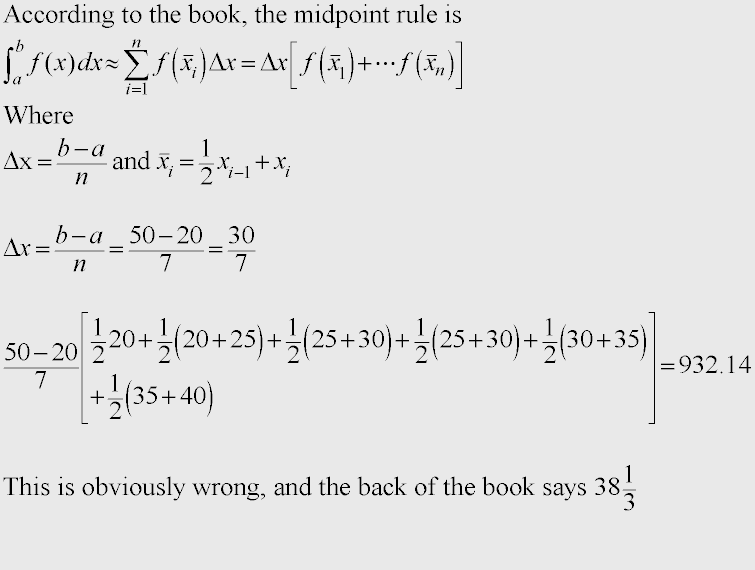
The table gives values of a continuous function. Use the Midpoint Rule to estimate the average value of f on [20, 50]

Code:
x      20  25   30   35   40   45   50  
f(x)   42  38   31   29   35   48   60
6_5_15.gif
 
Physics news on Phys.org
You were asked to find the "adverage value of the function over the interval".
Dont forget that to find this it is the intergral divided by the interval.

you also have your midpoint formula wrongly set up
delta x = (b - a)/n
so (50 - 20)/6

then you find the midpoints between the 7 f(x) values, note you used the x values in this step instead of the f(x) values

Midpoint sum = (50 -20)/60 * (.5(42 + 38) + .5(38 + 31) ...)

Now that you have the midpoint sum, or in other words the intergral of the function, divide that by the interval of 30. The anwser of 38.3333 is correct.
 
Your 1st post... Welcome!

Thanks for the explanation.

(b-a)/n is what I have, but I used 7 and you used 6. I guess that's because they're being paired up, so its only 6 pairings?

But then you use (50-20)/60 instead of (50-20)/6. Where did the 60 come from?

When I punch this into the calculator, I get
(50-20)/60 * (.5*(42+38)+.5*(38+31)+.5*(31+29)+.5*(29+35)+.5*(35+48)+.5*(48+60))
which equals 116.


Edit ***
I forgot to divide by 30. If I use (50-20)/6 instead of 60, and divide by 30 I get 38.66667, instead of 38.33333. I'm guessing the 60 was a typo? I'm still off by 1/3
 
Last edited:
Last edited:

Similar threads

Replies
3
Views
2K
Replies
3
Views
2K
  • · Replies 11 ·
Replies
11
Views
3K
  • · Replies 3 ·
Replies
3
Views
7K
  • · Replies 6 ·
Replies
6
Views
15K
Replies
11
Views
2K
  • · Replies 8 ·
Replies
8
Views
3K
  • · Replies 3 ·
Replies
3
Views
4K
  • · Replies 2 ·
Replies
2
Views
3K
  • · Replies 11 ·
Replies
11
Views
2K