Estimating oil molecule diameter

Click For Summary
SUMMARY

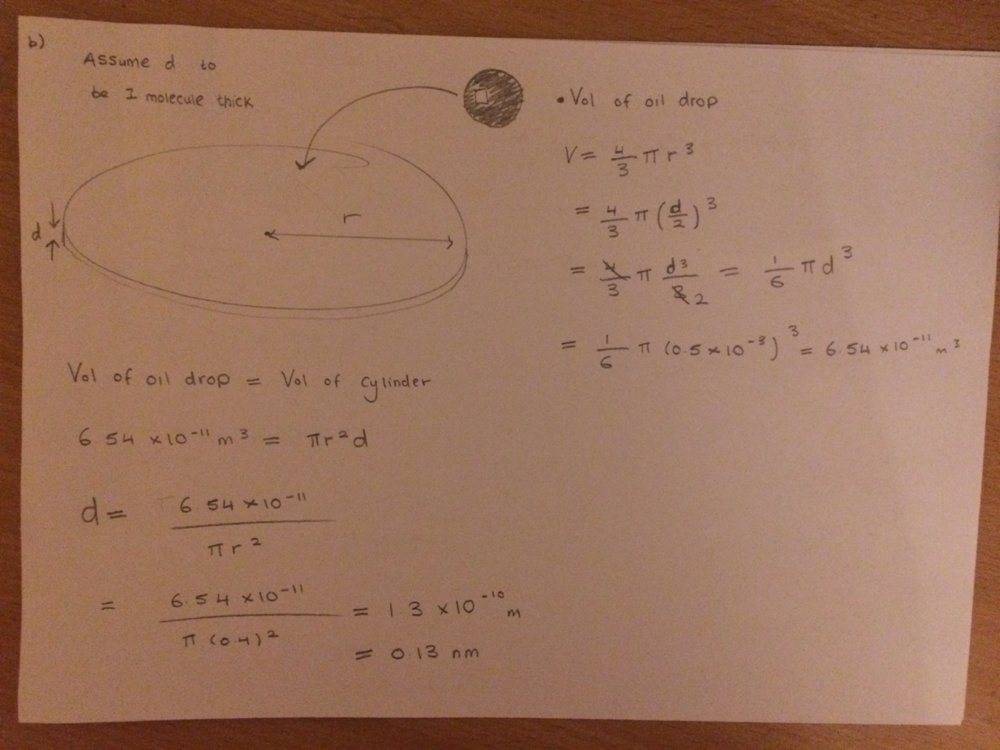
The discussion centers on estimating the diameter of an oil molecule, with a calculated value of 0.13 nanometers initially proposed. The user corrected their cylinder radius from 0.4 meters to 0.2 meters, which led to a revised thickness of 0.521 nanometers. The primary assumption made was that the cylinder's thickness equals the diameter of one molecule. The user seeks justification for this assumption, suggesting that surface tension may be a relevant factor to explore.

PREREQUISITES
  • Understanding of molecular dimensions, specifically in nanometers.
  • Familiarity with geometric calculations involving cylinders.
  • Knowledge of surface tension and its implications in molecular interactions.
  • Basic principles of dimensional analysis in scientific calculations.
NEXT STEPS
  • Research the concept of molecular diameter in organic compounds.
  • Study the effects of surface tension on molecular behavior.
  • Learn about dimensional analysis and its application in physical chemistry.
  • Investigate the relationship between molecular size and physical properties of substances.
USEFUL FOR

Chemistry students, researchers in molecular physics, and anyone involved in studying the properties of liquids and their molecular interactions.

Bolter
Messages
262
Reaction score
31
Homework Statement
Working out an estimation of molecule's diameter
Relevant Equations
V = 4/3*pi*r^3
Can anyone help me in what assumptions I can make and how to justify them for when working out diameter of the molecule in part b) of this question? You can see the method that I have used in my workings but how would I explain it in words?

I obtained the diameter to be 0.13 nano metres which seems like a sensible length for a molecules diameter?
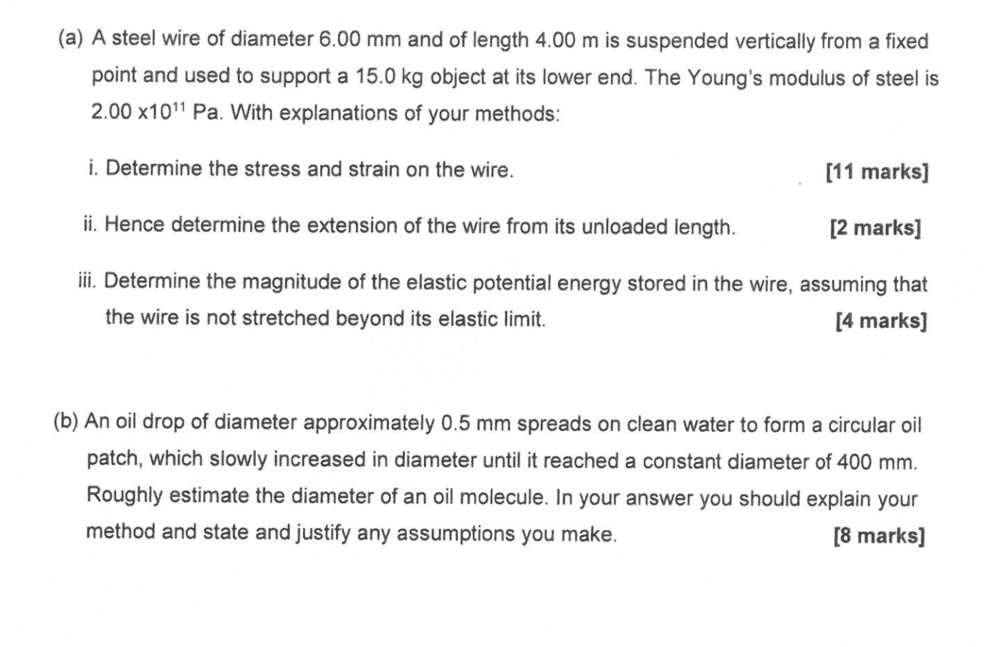
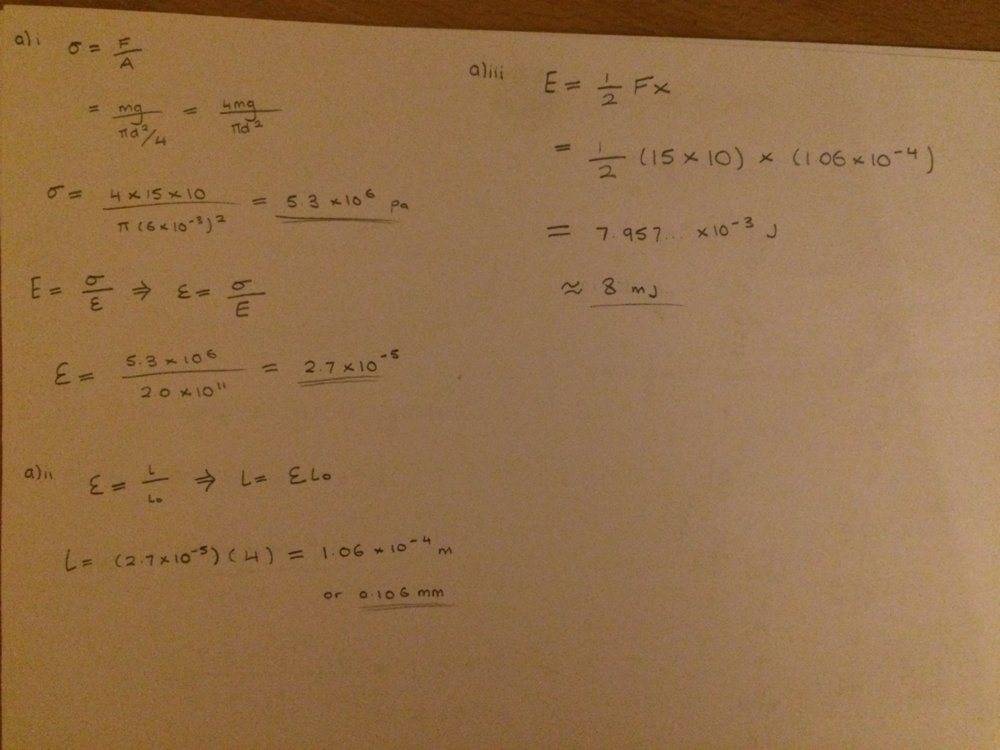
Screenshot 2019-12-21 at 21.51.25.png


IMG_3539.JPG


IMG_3540.JPG


Thanks for any help! :)
 
Physics news on Phys.org
How did you arrive at the radius of the cylinder being 0.4 (presumably meters)?

1576969893051.png
 
gneill said:
How did you arrive at the radius of the cylinder being 0.4 (presumably meters)?

View attachment 254528

I made a silly mistake and used the diameter's length in metres and not the radius length. So it should have read 0.2m instead.

I have changed from 0.4 to 0.2 and get the thickness of d to be 0.521 nano metres now

IMG_3541.JPG
 
Yes, that looks better!
 
gneill said:
Yes, that looks better!

Ok so the only assumption that I have made in this problem is that the cylinder thickness is 1 molecule's diameter thick. How do I justify such an assumption?
 
Bolter said:
Ok so the only assumption that I have made in this problem is that the cylinder thickness is 1 molecule's diameter thick. How do I justify such an assumption?
Perhaps look into surface tension.
 
gneill said:
Perhaps look into surface tension.

Possibly.
I think I'll need to look into that more myself before I make my own justification as I'm a bit hazy over that. But thank you :)
 
  • Like
Likes   Reactions: gneill

Similar threads

  • · Replies 5 ·
Replies
5
Views
23K
  • · Replies 29 ·
Replies
29
Views
2K
  • · Replies 5 ·
Replies
5
Views
2K
Replies
15
Views
3K
Replies
2
Views
2K
  • · Replies 2 ·
Replies
2
Views
2K
  • · Replies 9 ·
Replies
9
Views
4K
  • · Replies 1 ·
Replies
1
Views
4K
Replies
2
Views
2K
  • · Replies 20 ·
Replies
20
Views
3K