Estimating Pool Area Using Simpson's Rule

  • Context: Undergrad 
  • Thread starter Thread starter bns1201
  • Start date Start date
Click For Summary
SUMMARY

The discussion focuses on estimating the area of a kidney-shaped swimming pool using Simpson's Rule, a numerical method for approximating integrals. The widths of the pool at 2-meter intervals are provided as follows: a = 5.8, b = 6.6, c = 5.4, d = 5.8, e = 5.2, f = 4.8, g = 5.2. The formula applied is A = (4(4a + 2b + 4c + 2d + 4e + 2f + 4g))/6, which simplifies the calculation of the area. The final area should be rounded to the nearest square meter for accuracy.

PREREQUISITES
  • Understanding of Simpson's Rule for numerical integration
  • Basic knowledge of geometry related to area calculation
  • Familiarity with measurement units (meters)
  • Ability to perform arithmetic operations and rounding
NEXT STEPS
  • Study the derivation and applications of Simpson's Rule in calculus
  • Practice estimating areas of irregular shapes using numerical methods
  • Explore other numerical integration techniques such as Trapezoidal Rule
  • Learn how to apply Simpson's Rule in programming languages like Python or MATLAB
USEFUL FOR

Students preparing for exams in calculus, educators teaching numerical methods, and anyone interested in practical applications of integration techniques in real-world scenarios.

bns1201
Messages
22
Reaction score
0
I put this in the homework section a few days ago, but the homework was already due, and I'd like an explanation as to how to do this please. I have a feeling a similar problem will be on the exam.

The widths (in meters) of a kidney-shaped swimming pool were measured at 2 meter intervals as indicated in the figure. Use Simpson's Rule to estimate the area of the pool. Please round the answer to the nearest square meter.
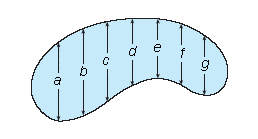
7-7-030alt.gif


a = 5.8
b = 6.6
c = 5.4
d = 5.8
e = 5.2
f = 4.8
g = 5.2


Thanks
 

Attachments

  • 7-7-030alt.gif
    7-7-030alt.gif
    1.6 KB · Views: 573
Physics news on Phys.org
I am assuming that a and g were each 2 meters from the edge.
Then Simpson's rule gives 4(4a+2b+4c+2d+4e+2f +4g)/6.
 
Last edited:

Similar threads

  • · Replies 5 ·
Replies
5
Views
23K
  • · Replies 1 ·
Replies
1
Views
3K
Replies
2
Views
6K
  • · Replies 5 ·
Replies
5
Views
2K
Replies
4
Views
21K
Replies
2
Views
1K
Replies
3
Views
2K