Estimating the Gradient of a Graph: Student's Attempt

  • Thread starter Thread starter chwala
  • Start date Start date
  • Tags Tags
    Gradient Graph
Click For Summary
SUMMARY

The discussion centers on estimating the gradient of the function \(y=2^x\) using points from a graph. The correct gradient, calculated using differentiation, is \(m \approx 1.386\) at the point (1,2). A student incorrectly estimated the gradient as \(m=2\) using the points (1,2) and (0.9,1.8), which are not on the tangent line. The consensus is that students should select points closer to the tangent line to improve accuracy, and the importance of minimizing error by choosing appropriate \(\Delta x\) values is emphasized.

PREREQUISITES
  • Understanding of calculus, specifically differentiation and tangent lines.
  • Familiarity with the exponential function \(y=2^x\).
  • Knowledge of graph interpretation and point selection for slope estimation.
  • Experience with error analysis in numerical methods.
NEXT STEPS
  • Study the concept of tangent lines and their significance in calculus.
  • Learn about error propagation in numerical estimations, particularly in slope calculations.
  • Explore the use of graphing tools like Desmos for visualizing functions and their derivatives.
  • Investigate methods for selecting optimal points for estimating gradients in non-linear functions.
USEFUL FOR

Students learning calculus, educators assessing student work, and anyone involved in teaching or understanding gradient estimation techniques.

chwala
Gold Member
Messages
2,827
Reaction score
415
Homework Statement
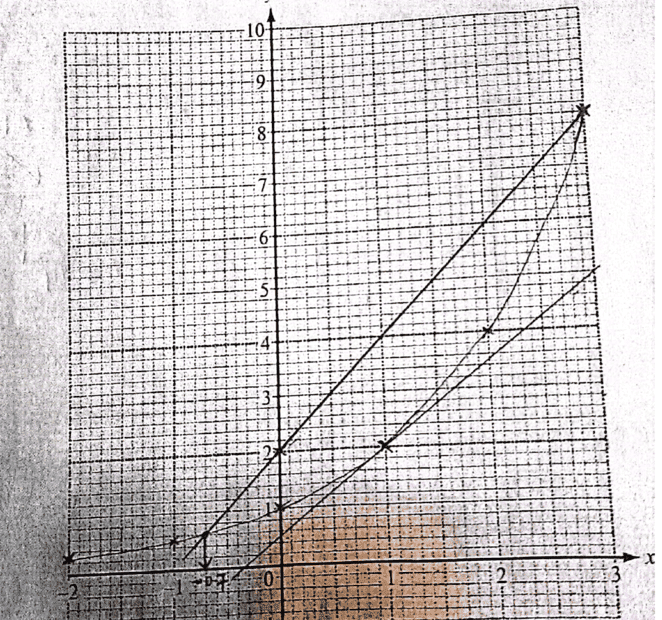
Draw the tangent to the curve at the point where ##x=1##. Use this tangent to claculate an estimate to the gradient of ##y=2^x## when ##x=1##
Relevant Equations
gradient
Ok this is a question that i am currently marking...the sketch is here;
1669462338489.png


In my mark scheme i have points ##(1,2)## and ##(3,5)## which can be easily picked from the graph to realize an estimate of ##m=1.5## where ##m## is the gradient ...of course i have given a range i.e ##1.6≥m≥1.2##

Now to my question. hmmmmm :wink:

A student picked the points ##(1,2)## and ##(0.9,1.8)## getting ##m=2## ...the difference from actual is quite big...but the points are picked from their straight line...am i missing something here...

Actual gradient using differentiation would be given by;

##\dfrac{dy}{dx}= 2^x\ln 2##

##\dfrac{dy}{dx}[x=1]= 2^1\ln 2=1.386##

Your insight welcome.
 
Last edited:
Physics news on Phys.org
Is the tangent line drawn by the student, or is it printed on the paper?

In any case, I think (0.9, 1.8) is visibly below the tangent line in the picture.
 
pasmith said:
Is the tangent line drawn by the student, or is it printed on the paper?

In any case, I think (0.9, 1.8) is visibly below the tangent line in the picture.
Drawn by the student...we would not expect the students to draw this accurately 100%. How do i deal with this? should i increase range of expected values? my thinking is; i cannot penalise the student for having picking those points from their tangent line...and the calculation as per their picked points is correct.
 
I dont think (0.9, 1.8) is on their tangent line: it's visibly below it. That should result in some loss of marks. If they'd gone with (0.9, 1.85) then they might have a better case.
 
I just checked the accurate graph on desmos...points ##(0.9,1.85)## would have been fine...
 
pasmith said:
I dont think (0.9, 1.8) is on their tangent line: it's visibly below it. That should result in some loss of marks. If they'd gone with (0.9, 1.85) then they might have a better case.
Thanks...i agree...i will emphasis the need to try and pick obvious points on the graphs to mitigate this. Cheers great weekend mate!
 
An additional comment: as a physicist, I would emphasize the large error introduced by picking such a small ##\Delta x##: any error in ##\Delta y## as read off from the graph is multiplied by 10 !

##\ ##
 
Notice in general, unless your function is itself linear to start with, the approximation is only local. But if youre just given the point (1,2), there are infinitely-many lines that go through it. The point (0.9, 1.8) defines just one of infinitely-many such lines. Not sure if this addresses your question.
 
WWGD said:
Notice in general, unless your function is itself linear to start with, the approximation is only local. But if youre just given the point (1,2), there are infinitely-many lines that go through it. The point (0.9, 1.8) defines just one of infinitely-many such lines. Not sure if this addresses your question.
Not sure ...we need points that are on the tangent line and as discussed above, it's clear that ##(0.9,1.8)## is not a point on the tangent line to the given curve ##y=2^x##.
 
  • #10
chwala said:
Not sure ...we need points that are on the tangent line and as discussed above, it's clear that ##(0.9,1.8)## is not a point on the tangent line to the given curve ##y=2^x##.
Do you mean at the point (1,2)?
 
  • #11
WWGD said:
Do you mean at the point (1,2)?
Yes.
 
  • #12
chwala said:
Yes.
Well, the points (1,2) and (0.9, 1.8) defines the line y2=2x, which contrasts with the line
y1-1=1.386(x-2).
Maybe a bound/estimate for |y1-y2| would help explain why the choice of (0.9, 1.8) was not as good. Additionally , comparing it with the choice of {(1,2),(3,5)} which would define the line y3-2=2(x-1).

Maybe we can find a generic value for
|y-y1|, for y=mx+b.
Hope I'm not too far of.
 

Similar threads

  • · Replies 5 ·
Replies
5
Views
1K
  • · Replies 1 ·
Replies
1
Views
621
  • · Replies 14 ·
Replies
14
Views
2K
  • · Replies 8 ·
Replies
8
Views
4K
  • · Replies 3 ·
Replies
3
Views
3K
  • · Replies 7 ·
Replies
7
Views
2K
Replies
3
Views
1K
  • · Replies 14 ·
Replies
14
Views
2K
  • · Replies 2 ·
Replies
2
Views
6K
  • · Replies 2 ·
Replies
2
Views
7K