Evalutaion of a real integral using the residue theorem

Click For Summary
The discussion focuses on evaluating an integral using the residue theorem, specifically for the integral involving sin(x). Participants suggest using the unit circle as the contour for evaluation, with z defined as e^(ix). The transformation of sin(x) into complex exponential form is discussed, leading to the formulation of sin^(2n)(x) in terms of z. The integral is expressed as a contour integral over the unit circle, simplifying the evaluation process. The conversation emphasizes the importance of contour choice and the application of complex analysis techniques.
asmani
Messages
104
Reaction score
0
Evaluate the following integral using the residue theorem:
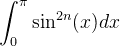
gif.latex?%5Cdpi{120}%20%5Cint_{0}^{%5Cpi%20}%5Csin^{2n}(x)%20dx.gif


Any hint?
 
Physics news on Phys.org
2i sin(x)=eix-e-ix
and
(n+1)undu=dun+1
with u=eix is
(n+1)einxdeix=dei(n+1)x
 
Sorry, I can't see how to use these facts. Can you give any further hint, please?
Besides, what contour should be chosen?

Thanks
 
Last edited:
contour is unit circle
let
z=ei x
dx=dz/(i z)
sin(x)=((z-1/z)/(2i))
sin2n(x)=((z-1/z)/(2i))2n

\int_0^\pi \sin^{2n}(x) dx=\frac{1}{2}\int_{-\pi}^\pi \sin^{2n}(x) dx=\oint_{|z|=1}\left( \frac{z-\frac{1}{z}}{2i}\right)^{2n}\frac{dz}{2i z}
 
Thanks! :smile:
 

Similar threads

  • · Replies 1 ·
Replies
1
Views
2K
  • · Replies 1 ·
Replies
1
Views
4K
  • · Replies 1 ·
Replies
1
Views
1K
  • · Replies 8 ·
Replies
8
Views
3K
  • · Replies 21 ·
Replies
21
Views
4K
  • · Replies 9 ·
Replies
9
Views
2K
  • · Replies 3 ·
Replies
3
Views
4K
  • · Replies 5 ·
Replies
5
Views
2K
  • · Replies 1 ·
Replies
1
Views
2K
  • · Replies 6 ·
Replies
6
Views
3K