Evalutaion of a real integral using the residue theorem

Click For Summary

Discussion Overview

The discussion revolves around evaluating a real integral using the residue theorem, focusing on the application of complex analysis techniques. Participants explore hints and methods related to contour integration and the properties of trigonometric functions expressed in terms of complex exponentials.

Discussion Character

  • Exploratory, Technical explanation, Mathematical reasoning

Main Points Raised

  • One participant suggests the use of the residue theorem for evaluating the integral but asks for hints.
  • Another participant presents relationships involving complex exponentials and derivatives, indicating a potential approach to the problem.
  • A third participant expresses confusion about how to apply the provided facts and inquires about the appropriate contour for integration.
  • A later reply proposes using the unit circle as the contour and provides a transformation of the integral involving sine functions expressed in terms of complex variables.

Areas of Agreement / Disagreement

Participants do not appear to reach a consensus on the approach to take, as there are varying levels of understanding and different proposed methods for evaluating the integral.

Contextual Notes

Some assumptions regarding the properties of the functions and the choice of contour remain unaddressed, and the mathematical steps leading to the final form of the integral are not fully resolved.

asmani
Messages
104
Reaction score
0
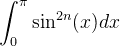
Evaluate the following integral using the residue theorem:

gif.latex?%5Cdpi{120}%20%5Cint_{0}^{%5Cpi%20}%5Csin^{2n}(x)%20dx.gif


Any hint?
 
Physics news on Phys.org
2i sin(x)=eix-e-ix
and
(n+1)undu=dun+1
with u=eix is
(n+1)einxdeix=dei(n+1)x
 
Sorry, I can't see how to use these facts. Can you give any further hint, please?
Besides, what contour should be chosen?

Thanks
 
Last edited:
contour is unit circle
let
z=ei x
dx=dz/(i z)
sin(x)=((z-1/z)/(2i))
sin2n(x)=((z-1/z)/(2i))2n

[tex]\int_0^\pi \sin^{2n}(x) dx=\frac{1}{2}\int_{-\pi}^\pi \sin^{2n}(x) dx=\oint_{|z|=1}\left( \frac{z-\frac{1}{z}}{2i}\right)^{2n}\frac{dz}{2i z}[/tex]
 
Thanks! :smile:
 

Similar threads

  • · Replies 1 ·
Replies
1
Views
2K
  • · Replies 1 ·
Replies
1
Views
4K
  • · Replies 3 ·
Replies
3
Views
2K
  • · Replies 8 ·
Replies
8
Views
3K
  • · Replies 1 ·
Replies
1
Views
1K
  • · Replies 3 ·
Replies
3
Views
4K
  • · Replies 9 ·
Replies
9
Views
3K
  • · Replies 5 ·
Replies
5
Views
2K
  • · Replies 1 ·
Replies
1
Views
3K
  • · Replies 6 ·
Replies
6
Views
3K