Evalutaion of Schrodinger's equation

  • Context: Undergrad 
  • Thread starter Thread starter student354
  • Start date Start date
  • Tags Tags
    Schrodinger's equation
Click For Summary
SUMMARY

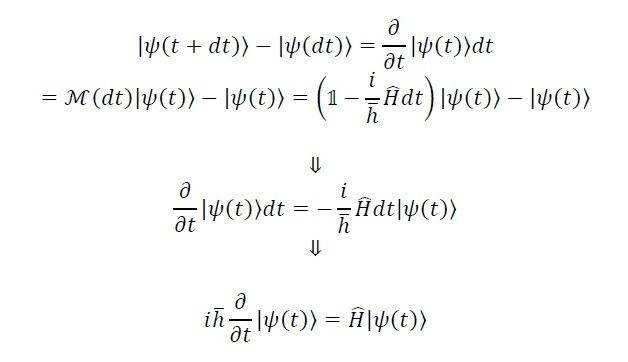
The discussion centers on the evaluation of Schrödinger's equation using Dirac notation. The operator ##M(dt)## is defined as the operator that evolves the quantum state from ##|\psi(t) \rangle## to ##|\psi(t+dt) \rangle##, with the identity operator represented as 1. The correct formulation of the equation is clarified as ##|\psi(t+dt) \rangle - |\psi(t) \rangle##, and the operator for time evolution under Hamiltonian ##H## is given by ##M(t) = e^{-iHt/\hbar}##. This formulation is essential for understanding quantum mechanics and the behavior of quantum states over time.

PREREQUISITES
  • Understanding of quantum mechanics principles
  • Familiarity with Dirac notation
  • Knowledge of Hamiltonian operators
  • Basic grasp of Taylor series expansion
NEXT STEPS
  • Study the derivation of the time evolution operator in quantum mechanics
  • Learn about the implications of the Hamiltonian operator in quantum systems
  • Explore advanced applications of Dirac notation in quantum mechanics
  • Investigate the Taylor expansion and its applications in physics
USEFUL FOR

Students of quantum mechanics, physicists working with quantum systems, and anyone interested in the mathematical foundations of quantum theory.

student354
Messages
1
Reaction score
0
hi!
i asked to evaluate the Schrödinger equation using dirac notaion.
i saw some ways but didn't understand them.
is it true?
if it does, what are M and 1 represent?
thanks!
evaluate.jpg
 
Physics news on Phys.org
The ## |\psi (t+dt) \rangle - |\psi (dt) \rangle ## in the first line should be ## |\psi (t+dt) \rangle - |\psi (t) \rangle ## (as in the second line). ## M(dt) ## is an operator that takes ## |\psi(t) \rangle ## to ## |\psi (t+dt) \rangle ##. 1 is the identity operator.

The operator that evolves a quantum state under Hamiltonian ##H## is ##M(t) = e^{-iHt/\hbar}##. For small ##dt##, keeping only the term linear in ##dt## of the the Taylor expansion of ##M(dt)## gives the right hand side of the second line.
 
  • Like
Likes   Reactions: bhobba

Similar threads

  • · Replies 3 ·
Replies
3
Views
1K
  • · Replies 18 ·
Replies
18
Views
3K
  • · Replies 24 ·
Replies
24
Views
3K
  • · Replies 17 ·
Replies
17
Views
3K
  • · Replies 3 ·
Replies
3
Views
2K
  • · Replies 1 ·
Replies
1
Views
2K
  • · Replies 11 ·
Replies
11
Views
2K
  • · Replies 143 ·
5
Replies
143
Views
12K
  • · Replies 5 ·
Replies
5
Views
1K
  • · Replies 3 ·
Replies
3
Views
2K