Clarifying the Use of Integrating Factors in Exact Differential Equations

Click For Summary
SUMMARY

This discussion clarifies the use of integrating factors in exact differential equations, specifically addressing the conditions under which integrating factors can be functions of either variable x or y. Participants confirm that while it is valid to assume an integrating factor of the form μ(x) or μ(y), it is incorrect to assume both can be used simultaneously. The example provided demonstrates that the integrating factor μ(x) can be derived as μ = c/x², where c is typically set to 1 for simplicity. The key takeaway is that integrating factors are not unique and can depend on the specific structure of the differential equation.

PREREQUISITES
  • Understanding of exact differential equations
  • Familiarity with partial derivatives
  • Knowledge of integrating factors in differential equations
  • Basic algebraic manipulation skills
NEXT STEPS
  • Study the derivation of integrating factors in exact differential equations
  • Learn how to apply the method of integrating factors to solve differential equations
  • Explore the uniqueness of integrating factors in different contexts
  • Investigate the role of constants in determining integrating factors
USEFUL FOR

Mathematics students, educators, and professionals dealing with differential equations, particularly those focusing on exact equations and integrating factors.

chwala
Gold Member
Messages
2,827
Reaction score
415
Homework Statement
Kindly see the attached....
Relevant Equations
exact differential equations
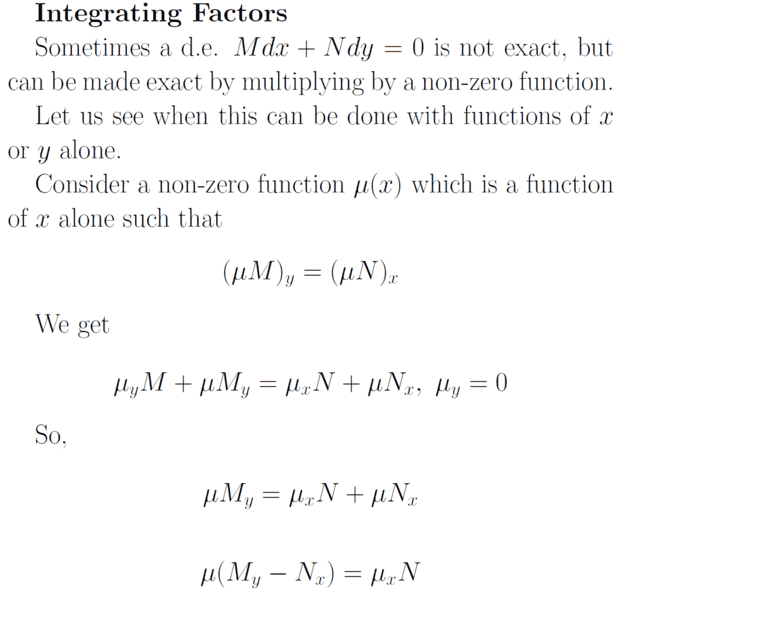
I am looking at this and i would like some clarity...
1624842125642.png
at the step where "he let" ##μ_y##=0" Could we also use the approach, ##μ_x##=0"?
so that we now have,

##μ_y##M=μ(##N_{x} -M_{y})##... and so on, is this also correct?
 
Last edited:
Physics news on Phys.org
chwala said:
Homework Statement:: Kindly see the attached...
Relevant Equations:: exact differential equations

I am looking at this and i would like some clarity...

View attachment 285140at the step where "he let" ##μ_y##=0" Could we also use the approach, ##μ_x##=0"?
Since ##\mu = \mu(x)## is a function of x alone, its partial with respect to y must be zero.
No, it's not reasonable to assume that ##\mu_x## would be zero.
 
  • Like
Likes chwala
Mark44 said:
Since ##\mu = \mu(x)## is a function of x alone, its partial with respect to y must be zero.
No, it's not reasonable to assume that ##\mu_x## would be zero.
i thought its indicated that ##μ## can be a function of ##x## or ##y## only? aaaaargh :cool: i have seen the condition...thanks Mark
 
chwala said:
at the step where "he let" ##μ_y##=0" Could we also use the approach, ##μ_x##=0"?
so that we now have,

##μ_y##M=μ(N_{x}## -M_{y})##... and so on, is this also correct?

Yeah, it's okay to try that! There might be an integrating factor ##\mu(x)##, or an integrating factor ##\tilde{\mu}(y)##, or even both. Or neither. :frown:
 
  • Like
Likes chwala
ergospherical said:
Yeah, it's okay to try that! There might be an integrating factor ##\mu(x)##, or an integrating factor ##\tilde{\mu}(y)##, or even both. Or neither. :frown:
what do you mean by "even both"? i think that's wrong. It can only be one or the other. Not Both! By neither, you are implying that we are not able to find an integrating factor, which of course may be true.
 
chwala said:
what do you mean by "even both"? i think that's wrong. It can only be one or the other. Not Both!

Let's see! Let ##\omega = y dx - x dy##. Since ##\dfrac{1}{N} \left( \dfrac{\partial M}{\partial y}- \dfrac{\partial N}{\partial x}\right) = -\dfrac{2}{x}## is a function of ##x## only, there's an integrating factor of the form ##\mu(x)##. Write\begin{align*}
\dfrac{1}{\mu} \dfrac{d\mu}{dx} &= -\dfrac{2}{x} \\

\mu &= \dfrac{c}{x^2}
\end{align*}It's simplest to take ##c=1## and then you can check it works by noticing that ##\mu \omega = d\left( - \dfrac{y}{x} \right)##.

Also, ##-\dfrac{1}{M} \left( \dfrac{\partial M}{\partial y} - \dfrac{\partial N}{\partial x}\right) = -\dfrac{2}{y}## is a function of ##y## only, so there's also an integrating factor of the form ##\tilde{\mu}(y)##. Can you work out what it is? :smile:

The take away is that integrating factors are not unique.
 
Last edited:
  • Like
Likes chwala
chwala said:
Homework Statement:: Kindly see the attached...
Relevant Equations:: exact differential equations

I am looking at this and i would like some clarity...

View attachment 285140at the step where "he let" ##μ_y##=0" Could we also use the approach, ##μ_x##=0"?
so that we now have,

##μ_y##M=μ(N_{x}## -M_{y})##... and so on, is this also correct?
this can be used too...dependent on whether we want to end up with a function of ##x## or ##y##, which is again dependent on the integrating factor being a 'function of ##x## or##y##'. In this attachment the integrating factor was given as a function of ##x##...thus no need to seek another way...
 
Generally ##\mu(x,y)## is an integrating factor if ##\mu \omega## is exact, but it's usually quite hard to solve the linear partial differential equation for ##\mu##. But there are sometimes special cases where you can find integrating factors depending on one variable only.
 
  • Like
Likes chwala
ergospherical said:
Let's see! Let ##\omega = y dx - x dy##. Since ##\dfrac{1}{N} \left( M_y - N_x\right) = -\dfrac{2}{x}## is a function of ##x## only, there's an integrating factor of the form ##\mu(x)##. Write\begin{align*}
\dfrac{1}{\mu} \dfrac{d\mu}{dx} &= -\dfrac{2}{x} \\

\mu &= \dfrac{c}{x^2}
\end{align*}It's simplest to take ##c=1## and then you can check it works by noticing that ##\mu \omega = d\left( - \dfrac{y}{x} \right)##.

Also, ##\dfrac{-1}{M} \left( M_y - N_x\right) = -\dfrac{2}{y}## is a function of ##y## only, so there's also an integrating factor of the form ##\tilde{\mu}(y)##. Can you work out what it is? :smile:

The take away is that integrating factors are not unique.

ergospherical said:
Generally ##\mu(x,y)## is an integrating factor if ##\mu \omega## is exact, but it's usually quite hard to solve the linear partial differential equation for ##\mu##. But there are sometimes special cases where you can find integrating factors depending on one variable only.
but this is a fact no dispute on this...
 
  • #10
ergospherical said:
Let's see! Let ##\omega = y dx - x dy##. Since ##\dfrac{1}{N} \left( \dfrac{\partial M}{\partial y}- \dfrac{\partial N}{\partial x}\right) = -\dfrac{2}{x}## is a function of ##x## only, there's an integrating factor of the form ##\mu(x)##. Write\begin{align*}
\dfrac{1}{\mu} \dfrac{d\mu}{dx} &= -\dfrac{2}{x} \\

\mu &= \dfrac{c}{x^2}
\end{align*}It's simplest to take ##c=1## and then you can check it works by noticing that ##\mu \omega = d\left( - \dfrac{y}{x} \right)##.

Also, ##-\dfrac{1}{M} \left( \dfrac{\partial M}{\partial y} - \dfrac{\partial N}{\partial x}\right) = -\dfrac{2}{y}## is a function of ##y## only, so there's also an integrating factor of the form ##\tilde{\mu}(y)##. Can you work out what it is? :smile:

The take away is that integrating factors are not unique.
i am trying to understand your approach...a bit confusing, this here is clear to me see attachment below:

1624846887831.png
 
  • #11
ok i see that they are expressed differently...you brought the negative outside...but in both cases we are either treating the integrating factor solely as a function of ##x## or ##y##. Not both.
 
  • #12
Looking at post ##6##, is it necessary to include the constant ##c## when determining the integrating factor when solving this kind of problems?

then letting ##c## = "to a certain value"? unless i am missing something...

i thought the integrating factor ##μ(x)## is simply equal to ##\frac {1}{x^2}##...

our brains are thinking differently:oldlaugh:...##c## the constant in your post is simply equal to ##1##...ok cheers mate :cool:
 
Last edited:

Similar threads

Replies
8
Views
4K
  • · Replies 1 ·
Replies
1
Views
1K
  • · Replies 7 ·
Replies
7
Views
2K
Replies
7
Views
2K
  • · Replies 14 ·
Replies
14
Views
2K
  • · Replies 4 ·
Replies
4
Views
2K
Replies
7
Views
2K
  • · Replies 27 ·
Replies
27
Views
2K
  • · Replies 2 ·
Replies
2
Views
2K
Replies
9
Views
2K