Exact forces (not net forces) involved in pushing a line of boxes?

  • Thread starter Thread starter InvisibleMan1
  • Start date Start date
  • Tags Tags
    Forces Line Net
Click For Summary

Homework Help Overview

The discussion revolves around the forces acting on a line of four boxes when a rightward force is applied to the leftmost box. The scenario assumes no gravity, friction, or air resistance, focusing on the exact forces involved in the interaction between the boxes as they begin to move.

Discussion Character

  • Conceptual clarification, Assumption checking

Approaches and Questions Raised

  • The original poster attempts to understand how the forces between the boxes interact when a force is applied to the first box. They explore the idea of treating the boxes as a single object versus examining the individual forces acting on each box. Some participants discuss the implications of Newton's third law in this context and question the nature of the forces involved.

Discussion Status

Participants have engaged in clarifying the forces acting on each box and have confirmed the correctness of the original poster's reasoning regarding the forces involved. There is an acknowledgment of the complexities in understanding how these forces interact, particularly when considering the absence of external factors like gravity or friction.

Contextual Notes

Participants note the constraints of the problem, specifically the assumption of no external forces other than the applied force on the leftmost box. This limitation shapes the discussion around the internal forces between the boxes.

InvisibleMan1
Messages
40
Reaction score
0
When you have a line of 4 boxes without gaps between adjacent boxes, and all of them are at rest, what exact forces are involved when a rightward force is applied to the leftmost box to cause it to move straight into the other boxes? To make this easier, let's assume no gravity, friction, or air resistance is involved.

Here is a picture of the situation:
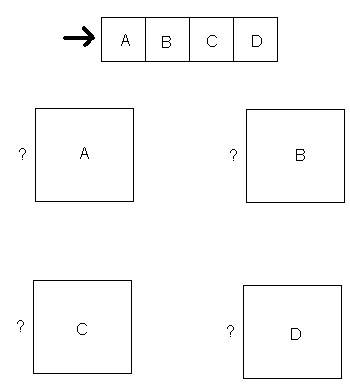
fbd_line_problem.jpg


I have been trying various ways to solve this. One thing I did was figure out how a stack of objects sitting on the ground would interact with each other (https://www.physicsforums.com/showthread.php?t=417332"). I was hoping this would clear things up, but I am still confused as to how this works. Here is what I came up with:
fbd_line_problem_solution1.jpg


To me, this looks like the force being applied to A causes D to accelerate leaving A, B, and C at rest. However, as soon as D moves, C is no longer applying F4 to it so it cannot move. I have been trying to solve this "chicken and egg" problem for a while, but I can't quite get my head around it...

Thinking of ABCD as a single object of mass A_mass + B_mass + C_mass + D_mass works of course, but since they don't actually form a single solid object, I need to somehow figure out how the individual objects are affecting each other. I was able to figure out that the net force of each object is rightward facing and has a magnitude equal to a fraction of the force pushing object A to the right. The fraction is based on the mass of the object in relation to the total mass (as I type this I'm guessing it is (mass/total_mass)*force), but I can't figure out how that net force comes about. What exact forces were involved to create that net force?
 
Last edited by a moderator:
Physics news on Phys.org
make an experiment ;]
if you push box A with force F, all four boxes will accelarate at the same rate, with acceleration given by:
a = F/(Ma+Mb+Mc+Md)
box D will not start to move away from D, unless there is something else involved besides boxes and force you apply (like some bomb between box C and D which explodes ;]).
Net force on each box will be the force, that makes this box to accelerate at a:
net_F(on D) = Md*a = Md*F/(Ma+Mb+Mc+Md)
excact forces on D when added must give net_F(on D). But there is only one force acting on D, that is force exerter by box C.
On box C there are two forces - one by box B, o ther by box D. According to Newton's third law force by box D is equal in magnitude to the force by C to D, but acting in opposite direction. Using this you can find force by box B on box C. And similarly forces on B and A.
 
Last edited:
Hmmm, well that's the result I described in my post, but it's good to know that it's actually correct. So given the mass of A, B, and C as 10 and the mass of D as 20, and a rightward force of 1N, the forces will look like this?
(For simplicity, the scale of each arrow is not taken into account)
fbd_line_problem_solution2.jpg


Are these all of the forces involved (assuming no gravity, air resistance, or friction)?

Edit: I mean all of the forces involved with A, B, C, and D. In other words, only the FBDs of A, B, C, and D. There is something applying the force to A, but I'm not interested in the FBD of that "something".
 
Last edited:
well, that force of 1 N must have come from somewhere, if you pushing box A with your hand, then box A will exert force F on your hand.
 
Sorry, I meant to ask if those are the only forces involved when considering only A, B, C, and D. There is something applying the force, but I'm only interested in the FBDs of A, B, C, and D.
 
InvisibleMan1 said:
Are these all of the forces involved (assuming no gravity, air resistance, or friction)?

Edit: I mean all of the forces involved with A, B, C, and D. In other words, only the FBDs of A, B, C, and D. There is something applying the force to A, but I'm not interested in the FBD of that "something".
Looks good to me.
 
I guess that then those are the only forces. At least only ones I could think of ;]
 
Thanks for the help.

This raises another question, but I'll create a new thread for it.
 

Similar threads

  • · Replies 4 ·
Replies
4
Views
2K
Replies
31
Views
1K
Replies
30
Views
4K
  • · Replies 9 ·
Replies
9
Views
3K
  • · Replies 16 ·
Replies
16
Views
3K
  • · Replies 5 ·
Replies
5
Views
2K
Replies
8
Views
1K
  • · Replies 21 ·
Replies
21
Views
1K
  • · Replies 11 ·
Replies
11
Views
3K
Replies
12
Views
5K