Undergrad Existence and Uniqeness of Finite Fields ....

Click For Summary
The discussion focuses on the properties of finite fields as outlined in David S. Dummit and Richard M. Foote's Abstract Algebra. It clarifies that a field of dimension n over its prime subfield has precisely p^n elements, derived from the n basis vectors each having p coefficient possibilities. Additionally, it explains that the multiplicative group of a finite field, being cyclic of order p^n - 1, implies that for any non-zero element α, α^(p^n - 1) equals 1. The characteristic of the field is confirmed to be either 0 or a prime number, not p^n - 1. The conversation emphasizes the uniqueness of linear combinations of basis vectors in defining the field's elements.
Math Amateur
Gold Member
MHB
Messages
3,920
Reaction score
48
I am reading David S. Dummit and Richard M. Foote : Abstract Algebra ...

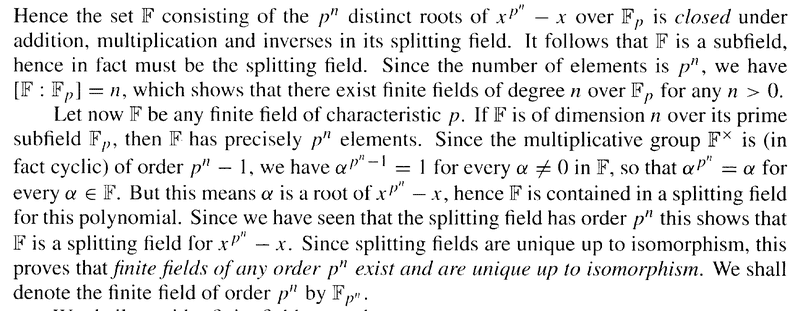
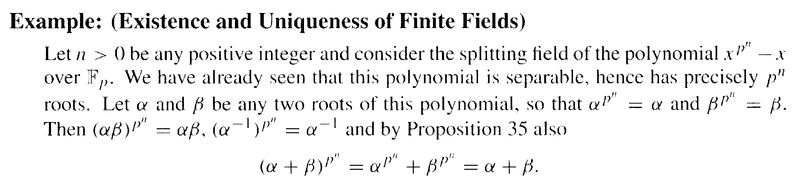
I am trying to understand the example on Finite Fields in Section 13.5 Separable and Inseparable Extensions ...The example reads as follows:
?temp_hash=7f262d4c0e613b648031240adf83746b.png

?temp_hash=7f262d4c0e613b648031240adf83746b.png


My questions are as follows:
Question 1In the above text from D&F we read the following:

" ... ... If ##\mathbb{F}## is of dimension ##n## over its prime subfield ##\mathbb{F}_p##, then ##\mathbb{F}## has precisely ##p^n## elements. ... ... "Can someone please explain why, exactly, this follows?

Question 2

In the above text from D&F we read the following:

" ... ... Since the multiplicative group ##\mathbb{F}^{ \times }## is (in fact cyclic) of order ##p^n - 1##, we have ##\alpha^{ p^n - 1 } = 1## for every ##\alpha \ne 0 in \mathbb{F}## ... ... "Can someone give me the exact reasoning concerning why ##\mathbb{F}^{ \times }## being of order ##p^n - 1## implies that ##\alpha^{ p^n - 1} = 1## for every ##\alpha \ne 0## in ##\mathbb{F}## ... ... ?(I am guessing that for some reason I cannot explain, that ##\mathbb{F}^{ \times }## being of order ##p^n - 1 ## implies that the characteristic is ##p^n - 1## ... ... but why does it mean this is the case ...? )

Hope someone can help ...

Peter
 

Attachments

  • D&F - 1 - EXAMPLE - Finite Fields - page 549-550 - PART 1 ... ....png
    D&F - 1 - EXAMPLE - Finite Fields - page 549-550 - PART 1 ... ....png
    15.9 KB · Views: 484
  • D&F - 2 - EXAMPLE - Finite Fields - page 549-550 - PART 2 ... ....png
    D&F - 2 - EXAMPLE - Finite Fields - page 549-550 - PART 2 ... ....png
    46.6 KB · Views: 488
Physics news on Phys.org
Math Amateur said:
Question 1
In the above text from D&F we read the following:
" ... ... If ##\mathbb{F}## is of dimension ##n## over its prime subfield ##\mathbb{F}_p##, then ##\mathbb{F}## has precisely ##p^n## elements. ... ... "
What does it mean "of dimension ##n##"? If you write down all possible linear combinations of basis vectors, how many possibilities do you get?
Question 2
In the above text from D&F we read the following:
" ... ... Since the multiplicative group ##\mathbb{F}^{ \times }## is (in fact cyclic) of order ##p^n - 1##, we have ##\alpha^{ p^n - 1 } = 1## for every ##\alpha \ne 0 in \mathbb{F}## ... ... "

Can someone give me the exact reasoning concerning why ##\mathbb{F}^{ \times }## being of order ##p^n - 1## implies that ##\alpha^{ p^n - 1} = 1## for every ##\alpha \ne 0## in ##\mathbb{F}## ... ... ?
If you have any finite group ##G##, say ##|G|=m## and take an element ##g \in G##, then consider the subgroup ##U:=\langle g \rangle \subseteq G##. What can be said about the order of ##U## and therewith the order of ##g##? Now with that, what do you get for ##g^m##?
(I am guessing that for some reason I cannot explain, that ##\mathbb{F}^{ \times }## being of order ##p^n - 1 ## implies that the characteristic is ##p^n - 1## ... ... but why does it mean this is the case ...? )
No. The characteristic of a field always has to be either ##0## or prime, and ##p^n-1## is only in one single case prime whereas the statement is generally valid. The characteristic is the smallest number ##n## such that ## \underbrace{1+ \ldots + 1}_{n-times} =0## or zero, if ##n## isn't finite. The order of ##\mathbb{F}^\times## is ##m=|\mathbb{F}|-|\{0\}|=p^n-1## not the characteristic.
 
Last edited:
  • Like
Likes Math Amateur
fresh_42 said:
What does it mean "of dimension ##n##"? If you write down all possible linear combinations of basis vectors, how many possibilities do you get?

If you have any finite group ##G##, say ##|G|=m## and take an element ##g \in G##, then consider the subgroup ##U:=\langle g \rangle \subseteq G##. What can be said about the order of ##U## and therewith the order of ##g##? Now with that, what do you get for ##g^m##?

No. The characteristic of a field always has to be either ##0## or prime, and ##p^n-1## is only in one single case prime whereas the statement is generally valid. The characteristic is the smallest number ##n## such that ## \underbrace{1+ \ldots + 1}_{n-times} =0## or zero, if ##n## isn't finite. The order of ##\mathbb{F}^\times## is ##m=|\mathbb{F}|-|\{0\}|=p^n-1## not the characteristic.
Hi fresh_42 ... ... thanks for the help ...

Regarding Question 1, you write the following"

"What does it mean "of dimension n" role="presentation">n"? If you write down all possible linear combinations of basis vectors, how many possibilities do you get?"

Well, dimension ##n## means there are ##n## basis vectors, and each linear combination of the basis vectors has ##n## coefficients with ##p## possibilities for each ... ... so we get a total of ##p^n## unique elements in the field ##\mathbb{F}## ... ... Is that the correct analysis/reasoning?

Still thinking about Question 2 ...

Peter
 
  • Like
Likes fresh_42
Math Amateur said:
Hi fresh_42 ... ... thanks for the help ...

Regarding Question 1, you write the following"

"What does it mean "of dimension n" role="presentation">n"? If you write down all possible linear combinations of basis vectors, how many possibilities do you get?"

Well, dimension ##n## means there are ##n## basis vectors, and each linear combination of the basis vectors has ##n## coefficients with ##p## possibilities for each ... ... so we get a total of ##p^n## unique elements in the field ##\mathbb{F}## ... ... Is that the correct analysis/reasoning?

Still thinking about Question 2 ...

Peter
Yes. And they are all different, because ##\alpha_1 b_1 + \ldots + \alpha_n b_n = \beta_1 b_1 + \ldots + \beta_n b_n## means, that each ##\alpha_i=\beta_i## if ##\{ b_1,\ldots ,b_n\}## is a basis. So there cannot be two different combinations resulting in the same vector, i.e. all ##p^n## combinations are different elements.
 
  • Like
Likes Math Amateur
I am studying the mathematical formalism behind non-commutative geometry approach to quantum gravity. I was reading about Hopf algebras and their Drinfeld twist with a specific example of the Moyal-Weyl twist defined as F=exp(-iλ/2θ^(μν)∂_μ⊗∂_ν) where λ is a constant parametar and θ antisymmetric constant tensor. {∂_μ} is the basis of the tangent vector space over the underlying spacetime Now, from my understanding the enveloping algebra which appears in the definition of the Hopf algebra...

Similar threads

Replies
2
Views
2K
  • · Replies 21 ·
Replies
21
Views
1K
  • · Replies 1 ·
Replies
1
Views
2K
  • · Replies 6 ·
Replies
6
Views
3K
  • · Replies 2 ·
Replies
2
Views
2K
  • · Replies 15 ·
Replies
15
Views
1K
  • · Replies 5 ·
Replies
5
Views
942
  • · Replies 26 ·
Replies
26
Views
860
  • · Replies 4 ·
Replies
4
Views
2K
  • · Replies 3 ·
Replies
3
Views
2K