MHB Expanding to power series, and finding the Laurent Series

Click For Summary
The discussion centers on expanding logarithmic functions into power series and finding Laurent series. Participants express confusion over the process, particularly regarding the expansion of logarithms and the necessary manipulations, such as converting logarithms to exponential forms. Key points include the derivation of the series expansion for ln(1+s) through integration of the geometric series and the application of specific substitutions to simplify the expressions. Clarifications on the definitions and manipulations involved in these expansions are sought, leading to a deeper understanding of series. Overall, the conversation highlights the challenges and insights gained in mastering series expansions in complex analysis.
nacho-man
Messages
166
Reaction score
0
Please refer to attached image.

Hi,
I'm a bit lost here with the first question. Unfortunately the online lecture covering this material isn't available due to their having been made some technical difficulties, and I find our textbook difficult to comprehend!
My lecture notes are pretty ambiguous in relation to these two questions.

Firstly, how exactly does one expand a log to a power series? Is there some trick required here, like converting the given logs to it's equivalent exponential, and then using the polar form?
 

Attachments
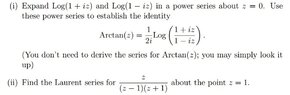
  • problem 3.jpg
    problem 3.jpg
    29.5 KB · Views: 132
Last edited:
Physics news on Phys.org
nacho said:
Please refer to attached image.

Hi,
I'm a bit lost here with the first question. Unfortunately the online lecture covering this material isn't available due to their having been made some technical difficulties, and I find our textbook difficult to comprehend!
My lecture notes are pretty ambiguous in relation to these two questions.

Firstly, how exactly does one expand a log to a power series? Is there some trick required here, like converting the given logs to it's equivalent exponential, and then using the polar form?

(i) Is...

$\displaystyle \ln (1 + s) = - \sum_{n=1}^{\infty} (-1)^{n} \frac{s^{n}}{n}\ (1)$

$\displaystyle \ln (1 - s) = - \sum_{n=1}^{\infty} \frac{s^{n}}{n}\ (2)$

... and setting $\displaystyle s = i\ z$ You obtain... $\displaystyle \ln (1 + i\ z) = - \sum_{n=1}^{\infty} (-1)^{n} \frac{(i\ z)^{n}}{n}\ (3)$

$\displaystyle \ln (1 - i\ z) = - \sum_{n=1}^{\infty} \frac{(i\ z)^{n}}{n}\ (4)$

From (3) and (4)... $\displaystyle \ln (1 + i\ z) - \ln (1-i\ z) = \sum_{n=1}^{\infty} \{1- (-1)^{n}\}\ \frac{(i\ z)^{n}}{n} = 2\ i\ \sum_{n=1}^{\infty} (-1)^{n-1}\ \frac{z^{2n-1}}{2n-1} = 2\ i\ \tan^{-1} z\ (5)$

Kind regards$\chi$ $\sigma$
 
nacho said:
Please refer to attached image.

Hi,
I'm a bit lost here with the first question. Unfortunately the online lecture covering this material isn't available due to their having been made some technical difficulties, and I find our textbook difficult to comprehend!
My lecture notes are pretty ambiguous in relation to these two questions.

Firstly, how exactly does one expand a log to a power series? Is there some trick required here, like converting the given logs to it's equivalent exponential, and then using the polar form?

(ii) For semplicity we set $\displaystyle s = z - 1$ so that the function becomes... $\displaystyle f(s) = \frac{1}{s}\ \frac{1 + s}{2 + s} = \frac{1}{2}\ \frac{1}{s}\ \frac{1 + s}{1 + \frac{s}{2}} = \frac{1}{2}\ \frac{1}{s}\ (1 + s)\ (1 - \frac{s}{2} + \frac{s^{2}}{4} - \frac{s^{3}}{8} + ...)= \frac{1}{2}\ (\frac{1}{s} + \frac{1}{2} - \frac{s}{4} + \frac{s^{2}}{8} - ...)\ (1)$

Kind regards

$\chi$ $\sigma$
 
thanks for the response both of you.

curiously, for

i) when you said

$\displaystyle \ln (1 + s) = - \sum_{n=1}^{\infty} (-1)^{n} \frac{s^{n}}{n}\ (1)$

Is that simply the definition for a power series of natural logs, or did you do some quick manipulation otherwise?

Thank you very much, the rest of it makes perfect sense, I was just getting stuck on how to start it.

I'm having a look at ii) now again
 
nacho said:
thanks for the response both of you.

curiously, for

i) when you said

$\displaystyle \ln (1 + s) = - \sum_{n=1}^{\infty} (-1)^{n} \frac{s^{n}}{n}\ (1)$

Is that simply the definition for a power series of natural logs, or did you do some quick manipulation otherwise?

Thank you very much, the rest of it makes perfect sense, I was just getting stuck on how to start it.

I'm having a look at ii) now again

The series expansion of $\ln (1 + x)$ derives from the well know expansion...

$\displaystyle \frac{1}{1+x} = \sum_{n=0}^{\infty} (-1)^{n}\ x^{n}\ (1)$

... and integrating (1) 'term by term' ...

$\displaystyle \int \frac{d x}{1+x} = \ln (1+x) = - \sum_{n=1}^{\infty} (-1)^{n} \frac{x^{n}}{n}\ (2)$

Kind regards

$\chi$ $\sigma$
 
chisigma said:
The series expansion of $\ln (1 + x)$ derives from the well know expansion...

$\displaystyle \frac{1}{1+x} = \sum_{n=0}^{\infty} (-1)^{n}\ x^{n}\ (1)$

... and integrating (1) 'term by term' ...

$\displaystyle \int \frac{d x}{1+x} = \ln (1+x) = - \sum_{n=1}^{\infty} (-1)^{n} \frac{x^{n}}{n}\ (2)$

Kind regards

$\chi$ $\sigma$

oh wow, this has changed my perspective of series completely!

thanks for that, i'll keep it in mind
 
We all know the definition of n-dimensional topological manifold uses open sets and homeomorphisms onto the image as open set in ##\mathbb R^n##. It should be possible to reformulate the definition of n-dimensional topological manifold using closed sets on the manifold's topology and on ##\mathbb R^n## ? I'm positive for this. Perhaps the definition of smooth manifold would be problematic, though.

Similar threads

  • · Replies 1 ·
Replies
1
Views
2K
  • · Replies 3 ·
Replies
3
Views
2K
Replies
1
Views
2K
  • · Replies 5 ·
Replies
5
Views
2K
  • · Replies 2 ·
Replies
2
Views
3K
  • · Replies 1 ·
Replies
1
Views
5K
  • · Replies 5 ·
Replies
5
Views
2K
Replies
8
Views
2K
Replies
29
Views
2K
  • · Replies 7 ·
Replies
7
Views
3K