Expectation Value Notation in Griffiths QM Textbook Third Edition

Join the discussion
Registration is free. Ask a follow-up in this thread, or start your own.
4 replies · 2K views
Icycub
Messages
12
Reaction score
1
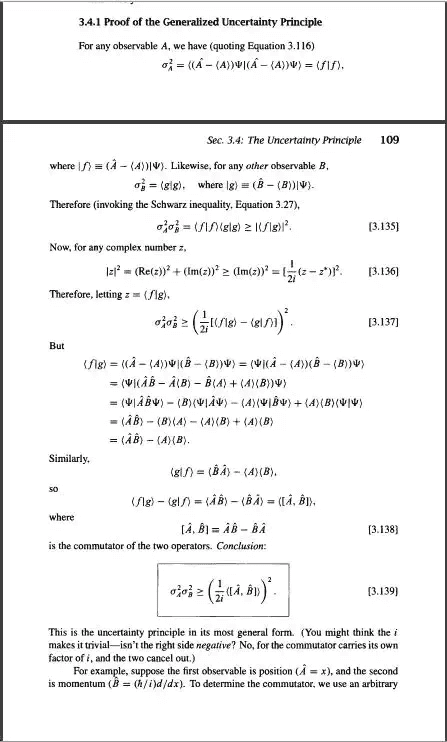
In the 3rd edition of the Introduction to Quantum Mechanics textbook by Griffiths, he normally does the notation of the expectation value as <x> for example. But, in Chapter 3 when he derives the uncertainity principle, he keeps the operator notation in the expectation value. See the pasted page. I don't understand why he suddenly keeps the operator notation for the expectation value and for just one of the expectation values in the group below. Is there a physical reasoning for this or was it just author preference?
1603740187943.png
 
Physics news on Phys.org
Icycub said:
But, in Chapter 3 when he derives the uncertainity principle, he keeps the operator notation in the expectation value. See the pasted page. I don't understand why he suddenly keeps the operator notation for the expectation value and for just one of the expectation values in the group below.
I think he is quite consistent in his notation here. What would you propose ?
 
BvU said:
I think he is quite consistent in his notation here. What would you propose ?
Yes, he roughly follows the same notation except for the <A^B^>. He doesn't explain why he does that, I'm assuming it's just preference.
 
Icycub said:
Yes, he roughly follows the same notation except for the <A^B^>. He doesn't explain why he does that, I'm assuming it's just preference.
Technically, if we have an observable ##A##, represented by operator ##\hat A## and the system in state ##\psi##, then: ##\langle A \rangle## is the expected value of measurements of ##A## (for a system in state ##\psi##); and, ##\langle \hat A \rangle = \langle \psi |\hat A|\psi \rangle##.

And, of course, we have: ##\langle A \rangle = \langle \hat A \rangle##.
 
  • Like
Likes   Reactions: BvU
Yes, that's common practice of physicists' sloppy notation. If you are pedantic, the expectation values are of course expectation values of observables, not operators, but the operators are of course used to describe observables in quantum mechanics. The correct notation is
$$\langle A \rangle=\langle \psi|\hat{A} \psi \rangle,$$
where ##|\psi \rangle \langle \psi|## describing the state the particle is prepared in when measuring the observable ##A##, which is represented by the self-adjoint operator ##\hat{A}##.
 
  • Like
Likes   Reactions: etotheipi and BvU