Explanation of the Diagram of the Rashba Effect

Click For Summary

Discussion Overview

The discussion revolves around the interpretation of a diagram related to the Rashba effect and Rashba spin-orbit coupling. Participants are exploring the meaning of the arrows in the diagram, the relationship between momentum and spin, and the implications of different representations of the effect.

Discussion Character

  • Exploratory
  • Technical explanation
  • Debate/contested

Main Points Raised

  • One participant expresses confusion regarding the arrows in the Rashba effect diagram, questioning their meaning and how to interpret them.
  • Another participant explains that the ##k_x## vs. ##k_y## plot represents a slice through the ##E(\mathbf{k})## vs. ##\mathbf{k}## plot, indicating that spins become momentum-dependent and that the inner and outer rings have opposite spins.
  • A different participant introduces a contrasting diagram from Harvard, suggesting it makes more sense and potentially contradicts the original diagram.
  • Another participant argues that there is no contradiction between the diagrams, noting that they are essentially the same but with different colored arrows.
  • One participant critiques the original diagram's representation of the two horizontally displaced parabolas, proposing a specific sequence of spin states that illustrates how an electron might hop between lattice sites while undergoing spin-orbit interaction.

Areas of Agreement / Disagreement

Participants express differing interpretations of the diagrams and their implications, indicating that multiple competing views remain without a consensus on the correct interpretation.

Contextual Notes

Some participants highlight potential confusion arising from different representations of the Rashba effect, and there are unresolved questions regarding the specific meanings of the arrows and the implications of the diagrams.

JanSpintronics
Messages
31
Reaction score
2
Hello,

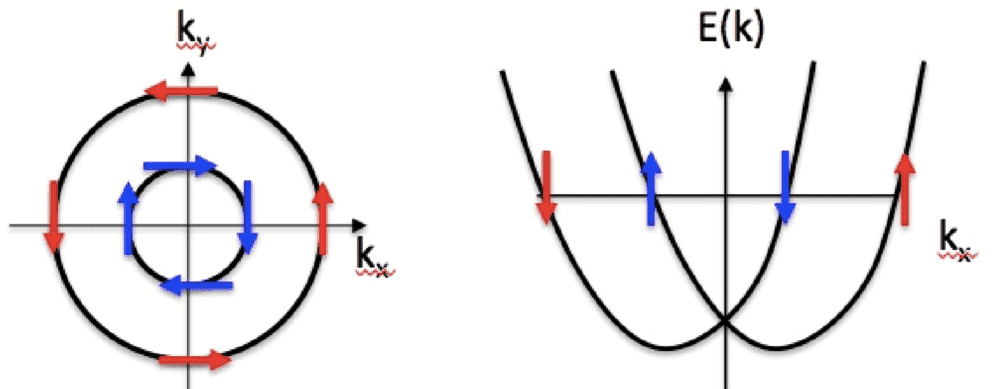
I find something about the Rashba Spin Orbit coupling but I am not sure how to understand it. Hope you can help me. Consider the following picture of the Rashba effect i found:
Rashba.png


Well i don't really know what's about the arrows here. They should showing the spin direction i guess but i don't see there meaning.
Can somebody help how to interprete this diagram??
 
Physics news on Phys.org
The ##k_x## vs. ##k_y## plot is just a slice through the ##E(\mathbf{k})## vs. ##\mathbf{k}## plot at constant ##|\mathbf{k}|##. Basically, imagine rotating the right-hand diagram about the ##E(k)## axis and slicing through ##E = 0##. The arrows simply show that the spins become momentum-dependent. The inner ring has opposite spins from the outer ring, but the spin projections are going to depend on where along those rings you are in momentum space.
 
At the risk of casting more confusion on the topic, I found this picture, https://www.physics.harvard.edu/node/549, which seems to contradict your picture. Harvard's picture make more sense to me:-)
 
I don't see the contradiction. b and e are literally the same pictures as OP. Only the arrows are different colors.
 
The issue I have with the OP's diagram is with the right hand picture of the two horizontally displaced parabolas. Each parabola has spin up or spin down. Call the right most parabola blue with it's electron in the down state, then the left parabola has its red electron in spin up state. So starting from the right hand side of the diagram I would expect blue (down), then red (up), then blue (down) and finally red (up). I think that this would demonstrate that the electron (or hole) hops from one lattice site to a neighboring site in a two stage process. Since we are considering surface states, it suffers a spin orbit interaction, from the bulk, with its surface neighbor causing it to hop, then flips its spin because the z component of momentum is suppressed.
 

Similar threads

  • · Replies 1 ·
Replies
1
Views
3K
  • · Replies 3 ·
Replies
3
Views
2K
  • · Replies 0 ·
Replies
0
Views
900
  • · Replies 1 ·
Replies
1
Views
3K
  • · Replies 6 ·
Replies
6
Views
3K
  • · Replies 1 ·
Replies
1
Views
1K
  • · Replies 0 ·
Replies
0
Views
3K
  • · Replies 0 ·
Replies
0
Views
3K
  • · Replies 4 ·
Replies
4
Views
3K
Replies
0
Views
2K