Explicit form of time evolution operator

Click For Summary

Discussion Overview

The discussion revolves around the explicit form of the time evolution operator in quantum mechanics, particularly focusing on the conditions under which it can be expressed as an exponential function of the Hamiltonian. Participants explore the implications of Hamiltonians that do not commute at different times and the use of various mathematical representations, including the Dyson series and Magnus expansion.

Discussion Character

  • Technical explanation
  • Debate/contested
  • Mathematical reasoning

Main Points Raised

  • One participant states that the time evolution operator can be expressed in exponential form only if the Hamiltonians at different times commute, referencing Sakurai's text.
  • Another participant suggests testing the case of piecewise constant Hamiltonians to explore the implications of non-commuting operators.
  • It is mentioned that there are alternative representations to the Dyson series, such as the Magnus expansion.
  • A participant asserts that the product of exponentials cannot be simplified to a single exponential unless the operators commute.
  • One participant argues that while a single exponential form is possible, it cannot be expressed as the exponential of an integral over H(t) when the Hamiltonians do not commute.
  • Another participant provides the formal expression for the time evolution operator with time ordering and connects it to a power series expansion, emphasizing its unitary nature.
  • Several participants agree that integrating Hamiltonians at different times complicates the use of the exponential form unless they commute, leading to the necessity of the time-ordering operator.

Areas of Agreement / Disagreement

Participants generally agree on the challenges posed by non-commuting Hamiltonians and the need for time ordering, but there are differing views on the specific forms and representations of the time evolution operator.

Contextual Notes

Participants reference various mathematical formulations and their implications, but the discussion does not resolve the complexities surrounding the integration of non-commuting Hamiltonians or the equivalence of different series representations.

bluesunday
Messages
8
Reaction score
0
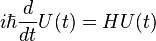
The time evolution operaton may be written formally as:

ddbf6e70688646a736bab03d869de7ca.png


This is an actual solution to:

2d3d85612b27b4ab3ba471c138b71cd1.png


only in the case that [H(t1),H(t2)]=0 (that is: the hamiltonian commutes in different instants of time) Of course, this includes the case of a time independent hamiltonian.

If this is not the case, the actual U(t) may be obtained with the Dyson series.

This is what is stated in Sakurai, for example. But I don't really understand WHY you cannot use the exponential form of U(t) in case the Hamiltonian doesn't commute at different times. I guess it may have something to do with its integrability, but I don't know.

Any hints?
 
Last edited:
Physics news on Phys.org
Well, you may try it out. Assume that you have H(t)=H_1 for 0<t<t_1 and H(t)=H_2 for t_1< t<t_2. For t>t_2, the time evoltion operator will be a product of two exponentials of the form you gave. Can you write it as a single exponential of an integral if H_1 and H_2 don't commute?
 
Btw. there are other representations than the Dyson series, e.g. the Magnus expansion.
 
No, of course you can't because the product of exponentials of two operators can't be written as the exponential of the sum unless the operators commute!

Thank you!
 
DrDu said:
Well, you may try it out. Assume that you have H(t)=H_1 for 0<t<t_1 and H(t)=H_2 for t_1< t<t_2. For t>t_2, the time evolution operator will be a product of two exponentials of the form you gave. Can you write it as a single exponential of an integral if H_1 and H_2 don't commute?

Yes, since it is a unitary operator, and any unitary operator can be written as the exponential of i times a self-adjoint operator. There are even explicit formulas for
the rsult, but they are in terms of infinite series, and not very useful.
 
Of course you can write it as a single exponential, but certainly not as the exponential of an integral over H(t).
 
The time evolution operator for Hamiltonians which are not constant in time is

U(t,t_0) = \mathcal{T}\exp\left(-\frac{i}{\hbar}\int_{t_0}^t dt&#039; H(t&#039;)\right)

where \mathcal{T} is the time ordering symbol. This exponential is just a short-way of writing the following power series:

U(t,t_0) = 1 + \sum_{n=1}^{\infty} \frac{1}{n!}\left(-\frac{i}{\hbar}\right)^n} \int dt_1\cdtos dt_n \mathcal{T}\left[H(t_1)\cdots H(t_n)\right]

This series is what's actually the time evolution operator. You can look it up in e.g. the books by Rammer, Mahan or Fetter and Walecka.

Again, the proof relies on the fact that this power series is a unitary solution to the Schrödinger equation.
 
I think DrDu is right, when you integrate you are sort of adding hamiltonians at different t's, and then the exponential form doesn't hold anymore unless they all commute.
 
bluesunday said:
I think DrDu is right, when you integrate you are sort of adding hamiltonians at different t's, and then the exponential form doesn't hold anymore unless they all commute.

...which is why the time-ordering operator is introduced. It takes care of that problem.
 
  • #10
Right xepma :) Thanks to all of you!
 
  • #11
xempa, yes, you can write it with time ordering, but this is nothing else than the Dyson series bluesunday mentioned in the first post.
 

Similar threads

  • · Replies 12 ·
Replies
12
Views
2K
  • · Replies 1 ·
Replies
1
Views
1K
  • · Replies 1 ·
Replies
1
Views
1K
  • · Replies 1 ·
Replies
1
Views
2K
  • · Replies 1 ·
Replies
1
Views
1K
  • · Replies 3 ·
Replies
3
Views
2K
  • · Replies 24 ·
Replies
24
Views
4K
  • · Replies 2 ·
Replies
2
Views
1K
  • · Replies 6 ·
Replies
6
Views
8K
  • · Replies 33 ·
2
Replies
33
Views
4K