Exponentially damped dipole - line broadening

Click For Summary

Discussion Overview

The discussion centers around the behavior of an exponentially damped dipole moment in the context of electromagnetic (EM) wave emission, particularly near the transition frequency. Participants explore the relationship between the dipole moment and the electric field, referencing classical physics principles in their explanations.

Discussion Character

  • Technical explanation
  • Conceptual clarification

Main Points Raised

  • One participant presents the equation for the dipole moment and questions the expectation that the electric field is proportional to the time derivative of the dipole moment.
  • Another participant asserts that changes in the dipole moment, which arise from charge accelerations, lead to the emission of EM waves, suggesting that the electric field can be expressed as proportional to the derivative of the dipole moment.
  • A repeated request for clarification on the term "classical treatment" indicates a desire for deeper understanding of the underlying principles.
  • A further explanation is provided that relates the behavior of a time-varying dipole moment to classical physics, likening it to an antenna that emits EM waves, thus framing the discussion within classical treatment of atomic behavior.

Areas of Agreement / Disagreement

Participants appear to agree on the basic premise that changes in the dipole moment relate to EM wave emission, but there is ongoing clarification regarding the classical treatment and its implications. The discussion does not reach a consensus on the specifics of the classical treatment or its application to atomic behavior.

Contextual Notes

The discussion includes assumptions about the relationship between dipole moments and EM wave emission that may depend on classical physics definitions. The term "classical treatment" remains somewhat ambiguous and is not fully resolved within the conversation.

unscientific
Messages
1,728
Reaction score
13
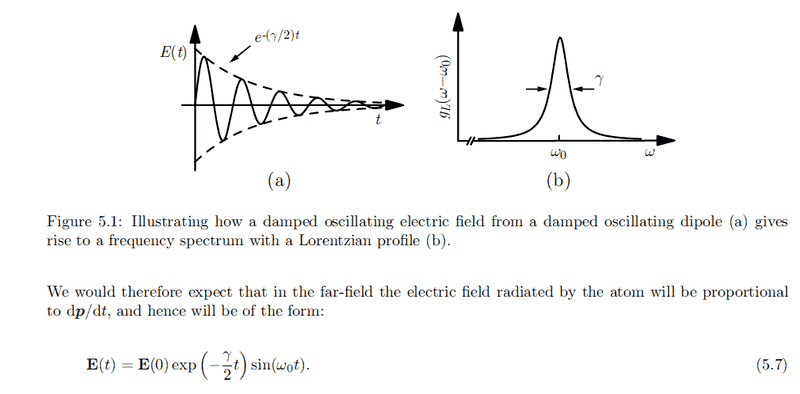
For an EM wave close to the transition frequency ##\omega_{21}##, we assume the dipole moment to be exponentially damped and oscillating:

p(t) = p(0) e^{-\frac{\gamma}{2}t} cos(\omega_0 t)

Why do we expect the electric field to be proportional to ##\dot p##?

Taken from my lecturer notes on laser and atomic physics:
laser1.png
 
Physics news on Phys.org
If a dipole moment changes(it is created by charge accelerations), it emit EM wave in classic treatment. Therefore we can get E(t) proportional to dp/dt.
 
abbas_majidi said:
If a dipole moment changes(it is created by charge accelerations), it emit EM wave in classic treatment. Therefore we can get E(t) proportional to dp/dt.
Please explain the "classical treatment".
 
unscientific said:
Please explain the "classical treatment".
In classical physics accelerated charges can emit EM waves, it is used in making antenna. A dipole changes with time is a antenna and its behavior is explained by classical physics compleatly. Therefore if you use ' electric field to be proportional to ##\dot p##', you consider atoms like antenna or in other words you use classical treatment of atoms.
 

Similar threads

  • · Replies 1 ·
Replies
1
Views
2K
  • · Replies 10 ·
Replies
10
Views
3K
  • · Replies 1 ·
Replies
1
Views
2K
  • · Replies 8 ·
Replies
8
Views
4K
  • · Replies 0 ·
Replies
0
Views
2K
  • · Replies 13 ·
Replies
13
Views
5K
Replies
9
Views
2K
Replies
3
Views
1K
  • · Replies 5 ·
Replies
5
Views
3K
  • · Replies 7 ·
Replies
7
Views
3K