External-excitation Van de Graaff polarities

Click For Summary
SUMMARY

The discussion centers on the polarities of the excitation supply and terminal in external-excitation Van de Graaff (VDG) generators. It is established that applying the positive electrode to the lower pulley will attract electrons from the belt, resulting in a positively charged belt and a positive terminal at the top. Conversely, using the negative electrode will yield a negatively charged terminal. The operation of the conductive pulley and the charged bar remains ambiguous, with suggestions that they may enhance induction or facilitate operation without the external excitation supply.

PREREQUISITES
  • Understanding of Van de Graaff generator principles
  • Knowledge of electrostatic induction
  • Familiarity with high-voltage power supplies (5,000-10,000V)
  • Basic concepts of charge transfer and electron deficiency
NEXT STEPS
  • Research the principles of electrostatic induction in VDGs
  • Explore the role of conductive pulleys in high-voltage applications
  • Study the effects of charge distribution in external-excitation VDGs
  • Investigate historical context and advancements in Van de Graaff technology
USEFUL FOR

Electronics enthusiasts, physics students, and engineers interested in high-voltage systems and electrostatics will benefit from this discussion.

eigenmax
Messages
58
Reaction score
12
My question regards the polarities of the excitation supply and terminal in an external-excitation VDG.
As you all probably know, external excitation VDGs use a voltage supply (usually 5,000-10,000V) to influence the charge on the lower pulley, instead of just relying on frictional contact to remove electrons from the belt.
My question is, if I place the positive of my supply at the lower pulley, will the positive electrode of the supply draw electrons to it from the belt (as a positive object is an electron deficient one), thereby making a electron-deficient belt and a positive top terminal?
If I use the negative electrode will I have a negative terminal?
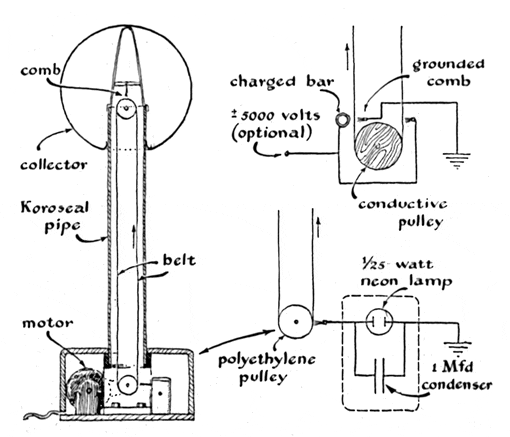
1957-05-04.gif


There is a little diagram of the excitation supply at the top right.
 

Attachments

  • 1957-05-04.gif
    1957-05-04.gif
    38.6 KB · Views: 2,312
Engineering news on Phys.org
The section of belt passing the 'excitation supply unit' will become charged by Induction. (the opposite charges are taken to ground via the comb) At the top, there is no path to ground so the charges on the belt will get transferred directly to the outer surface of the sphere by mutual repulsion
I'm not sure of the function of the rest of the lower unit, namely the conductive pulley and the apparent common the other side of the charged bar. Perhaps the induction is better with those extra parts. Or perhaps it's for operation without the external excitation supply.
 
The article I was reading was in The Amateur Scientist, a book written 1960 as a compilation of all the Amateur Scientist columns from the Scientific American throughout the 50s. It describes the operation of standard (self-exciting) VDGs, but this is all it has on the external excitation. I'm also not sure what the charged bar is for.
 

Similar threads

Replies
5
Views
2K
  • · Replies 20 ·
Replies
20
Views
4K
  • · Replies 3 ·
Replies
3
Views
3K
  • · Replies 2 ·
Replies
2
Views
4K
  • · Replies 8 ·
Replies
8
Views
6K
  • · Replies 2 ·
Replies
2
Views
3K
  • · Replies 1 ·
Replies
1
Views
2K
  • · Replies 1 ·
Replies
1
Views
2K
Replies
1
Views
2K
  • · Replies 2 ·
Replies
2
Views
3K