Why Are Gravity Effects Neglected in Stokes Flow Analysis?

Click For Summary
SUMMARY

In Stokes flow analysis, gravity effects are often neglected due to the assumption of low Reynolds number (Re→0), allowing the material derivative of velocity (Dv/Dt) to equal zero. The gravitational force per unit mass, represented as \mathbf{g} = -\nabla\left(-\int\mathbf{g} \cdot d\mathbf{x}\right), can be incorporated into the pressure term, leading to the concept of "modified pressure." This approach simplifies the mathematical treatment of fluid dynamics without altering the fundamental equations.

PREREQUISITES
  • Understanding of Stokes flow and low Reynolds number fluid dynamics.
  • Familiarity with the concept of material derivatives in fluid mechanics.
  • Knowledge of pressure terms in fluid equations, specifically modified pressure.
  • Basic grasp of vector calculus and gradient operations.
NEXT STEPS
  • Study the implications of low Reynolds number on fluid behavior in Stokes flow.
  • Research the derivation and applications of modified pressure in fluid dynamics.
  • Explore the mathematical treatment of gravitational effects in incompressible flow.
  • Learn about the role of density assumptions in fluid mechanics, particularly in Stokes flow.
USEFUL FOR

Fluid dynamics researchers, mechanical engineers, and students studying advanced fluid mechanics concepts, particularly those focusing on Stokes flow and pressure dynamics.
Est120
Messages
54
Reaction score
3
Homework Statement
find the appropiate Navier-Stokes equation in the low Re number limit
Relevant Equations
Navier Stokes equations
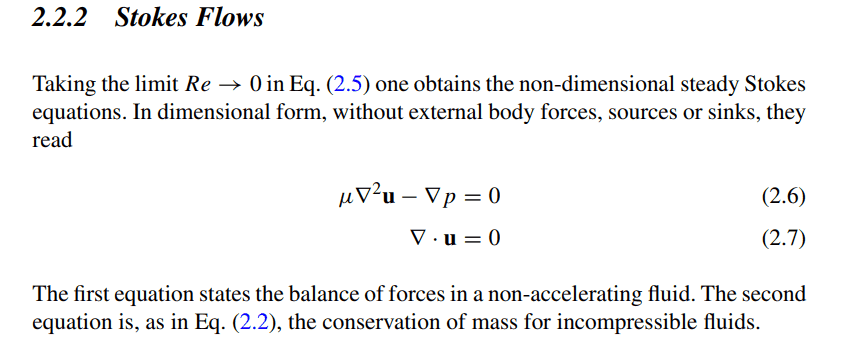
in the limit as Re→0 , we can neglect the material derivate of v ( Dv/Dt =0 ) but why in books they always make the gravity effects equal to 0?
i can't understand and no one really explains this stuff
1610820716854.png
 
Physics news on Phys.org
The density is being treated as constant, so the gravational force per unit mass is \mathbf{g} = -\nabla\left(-\int\mathbf{g} \cdot d\mathbf{x}\right).

You can therefore absorb it into the pressure term. It makes no difference to the mathematics if you work with p or p' = p - \int\mathbf{g} \cdot d\mathbf{x}.
 
pasmith said:
The density is being treated as constant, so the gravational force per unit mass is \mathbf{g} = -\nabla\left(-\int\mathbf{g} \cdot d\mathbf{x}\right).

You can therefore absorb it into the pressure term. It makes no difference to the mathematics if you work with p or p' = p - \int\mathbf{g} \cdot d\mathbf{x}.
yeah, that's the so called "modified pressure" right? i hardly managed to get that but still almost no source of information talks about that...
 

Similar threads

  • · Replies 0 ·
Replies
0
Views
2K
  • · Replies 9 ·
Replies
9
Views
2K
Replies
9
Views
3K
  • · Replies 18 ·
Replies
18
Views
2K
  • · Replies 1 ·
Replies
1
Views
1K
  • · Replies 1 ·
Replies
1
Views
2K
Replies
2
Views
3K
  • · Replies 3 ·
Replies
3
Views
2K
  • · Replies 2 ·
Replies
2
Views
2K
  • · Replies 18 ·
Replies
18
Views
6K