Factors affecting compression spring oscillations

Click For Summary
SUMMARY

The discussion focuses on reducing oscillations in compression springs used in machine design applications. Key factors include the spring constant, preload force, and the damping coefficient, which are critical for controlling the amplitude of oscillation. Participants suggest that merely altering the spring design may not suffice; instead, incorporating a rubber bumper or transitioning to a hydraulic shock absorber can effectively mitigate bouncing. The harmonic oscillator and damped oscillator equations are essential for understanding these dynamics.

PREREQUISITES
  • Understanding of harmonic and damped oscillators
  • Knowledge of spring constant and preload force
  • Familiarity with damping coefficients in mechanical systems
  • Basic principles of shock absorbers and their applications
NEXT STEPS
  • Research the equations governing harmonic and damped oscillators
  • Explore the design and application of rubber bumpers in mechanical systems
  • Investigate hydraulic shock absorbers and their integration with springs
  • Study the effects of varying spring constants and preload on oscillation frequency
USEFUL FOR

Mechanical engineers, product designers, and anyone involved in optimizing spring dynamics in machinery.

Travis T
Messages
18
Reaction score
2
TL;DR
Factor affecting compression spring oscillating effect
Hi all,

I'm studying the compression spring design issue that occurred in a machine design application.

As illustrated below, spring is bouncing or oscillating after impact to a stopping surface (1 -> 2 -> 3 -> 4) and eventually stop after few bounces.
Ideal case for this application is to eliminate the bouncing effect (1 -> 4).

Assuming only enable changes in spring design, my question is:

What properties should I look into for reducing the bouncing effect? eg. deduct spring constant, reduce preload spring force, increase spring force?
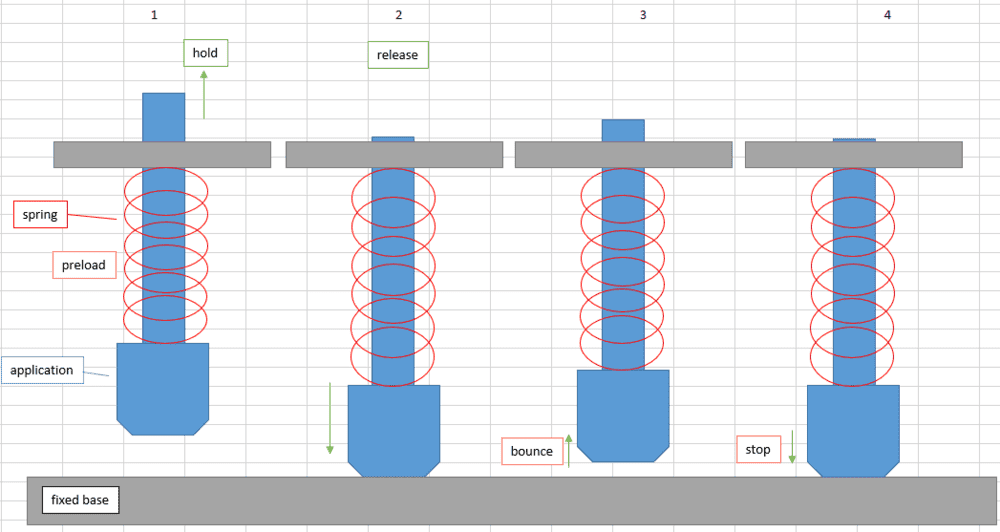
1613466135720.png
 
Engineering news on Phys.org
Do you know the equation for the harmonic oscillator?

https://en.wikipedia.org/wiki/Harmonic_oscillator

Are you asking about reducing the amplitude of the oscillation, or do you want to stop the oscillating motion as fast as possible? If you want to know when the oscillation stops, then you have to consider the damped oscillator, and look into the damping coefficient of the spring.
 
  • Like
Likes   Reactions: Travis T
bigfooted said:
Do you know the equation for the harmonic oscillator?

https://en.wikipedia.org/wiki/Harmonic_oscillator

Are you asking about reducing the amplitude of the oscillation, or do you want to stop the oscillating motion as fast as possible? If you want to know when the oscillation stops, then you have to consider the damped oscillator, and look into the damping coefficient of the spring.

Thanks for reply. Will read through the harmonic oscillator.
Would prefer reducing the amplitude of the oscillation.
 
I would suggest experimentation as the easier approach.
If there is a specification about the force of first impact and subsequent pressing force against the surface, there is no much room to play with sping K and pre-load.
A friction or viscous dampener may be your solution.
 
Changing the spring constant and/or amount of preload will change the frequency of bouncing, but will not prevent it from bouncing. Your constraint of only changing the spring will not work. Two possibilities:

1) Add a rubber bumper to the end of the bouncing thing. This link gives a good idea of what rubber bumpers look like, and the different designs available: https://www.mcmaster.com/bumpers.

2) Change the spring/pusher assembly to a hydraulic shock absorber. Industrial hydraulic shock absorbers have springs as part of the assembly, plus you can add an additional spring if needed. Here is a link to the catalog of a good source of shock absorbers: https://www.acecontrols.com/media/acedownloads/ACE_Main Catalog-2018-US-imperial.pdf. They are not the only manufacturers of shock absorbers, but I have had good experience with them.
 
  • Like
Likes   Reactions: Travis T and Lnewqban

Similar threads

  • · Replies 5 ·
Replies
5
Views
4K
  • · Replies 11 ·
Replies
11
Views
2K
  • · Replies 6 ·
Replies
6
Views
3K
  • · Replies 5 ·
Replies
5
Views
3K
  • · Replies 6 ·
Replies
6
Views
11K
Replies
17
Views
5K
  • · Replies 1 ·
Replies
1
Views
1K
  • · Replies 8 ·
Replies
8
Views
918
Replies
13
Views
4K
  • · Replies 2 ·
Replies
2
Views
8K