Factors affecting compression spring oscillations

Click For Summary

Discussion Overview

The discussion revolves around the design considerations for compression springs in a machine application, specifically focusing on factors that affect the oscillation and bouncing behavior of the spring after impact with a stopping surface. Participants explore various properties and modifications to reduce the bouncing effect, examining both theoretical and practical approaches.

Discussion Character

  • Exploratory
  • Technical explanation
  • Debate/contested
  • Experimental/applied

Main Points Raised

  • One participant inquires about which properties of the spring design could be adjusted to reduce the bouncing effect, suggesting changes to the spring constant, preload force, or spring force.
  • Another participant references the harmonic oscillator equation and questions whether the goal is to reduce oscillation amplitude or to stop the motion quickly, introducing the concept of a damped oscillator and the importance of the damping coefficient.
  • A suggestion is made to conduct experiments, noting that constraints on the spring design limit the ability to modify spring constant and preload significantly.
  • One participant argues that while changing the spring constant and preload affects the frequency of bouncing, it does not eliminate the bouncing itself, proposing alternative solutions such as adding a rubber bumper or using a hydraulic shock absorber.

Areas of Agreement / Disagreement

Participants express differing views on the effectiveness of modifying spring properties alone to eliminate bouncing. Some suggest that additional components or methods may be necessary, indicating a lack of consensus on the best approach.

Contextual Notes

Participants have not reached a consensus on the most effective method to reduce the bouncing effect, and there are unresolved considerations regarding the specific parameters of the spring and the impact forces involved.

Travis T
Messages
18
Reaction score
2
TL;DR
Factor affecting compression spring oscillating effect
Hi all,

I'm studying the compression spring design issue that occurred in a machine design application.

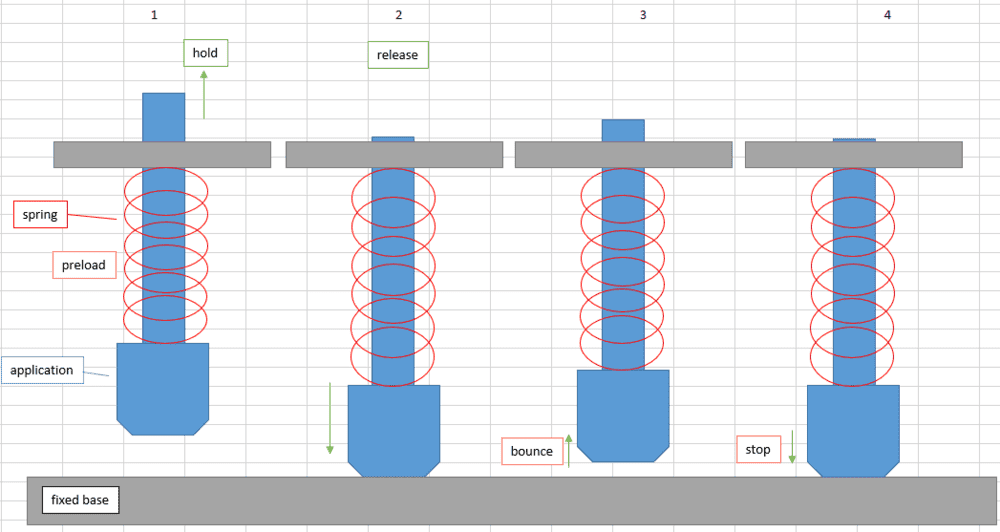
As illustrated below, spring is bouncing or oscillating after impact to a stopping surface (1 -> 2 -> 3 -> 4) and eventually stop after few bounces.
Ideal case for this application is to eliminate the bouncing effect (1 -> 4).

Assuming only enable changes in spring design, my question is:

What properties should I look into for reducing the bouncing effect? eg. deduct spring constant, reduce preload spring force, increase spring force?
1613466135720.png
 
Engineering news on Phys.org
Do you know the equation for the harmonic oscillator?

https://en.wikipedia.org/wiki/Harmonic_oscillator

Are you asking about reducing the amplitude of the oscillation, or do you want to stop the oscillating motion as fast as possible? If you want to know when the oscillation stops, then you have to consider the damped oscillator, and look into the damping coefficient of the spring.
 
  • Like
Likes   Reactions: Travis T
bigfooted said:
Do you know the equation for the harmonic oscillator?

https://en.wikipedia.org/wiki/Harmonic_oscillator

Are you asking about reducing the amplitude of the oscillation, or do you want to stop the oscillating motion as fast as possible? If you want to know when the oscillation stops, then you have to consider the damped oscillator, and look into the damping coefficient of the spring.

Thanks for reply. Will read through the harmonic oscillator.
Would prefer reducing the amplitude of the oscillation.
 
I would suggest experimentation as the easier approach.
If there is a specification about the force of first impact and subsequent pressing force against the surface, there is no much room to play with sping K and pre-load.
A friction or viscous dampener may be your solution.
 
Changing the spring constant and/or amount of preload will change the frequency of bouncing, but will not prevent it from bouncing. Your constraint of only changing the spring will not work. Two possibilities:

1) Add a rubber bumper to the end of the bouncing thing. This link gives a good idea of what rubber bumpers look like, and the different designs available: https://www.mcmaster.com/bumpers.

2) Change the spring/pusher assembly to a hydraulic shock absorber. Industrial hydraulic shock absorbers have springs as part of the assembly, plus you can add an additional spring if needed. Here is a link to the catalog of a good source of shock absorbers: https://www.acecontrols.com/media/acedownloads/ACE_Main Catalog-2018-US-imperial.pdf. They are not the only manufacturers of shock absorbers, but I have had good experience with them.
 
  • Like
Likes   Reactions: Travis T and Lnewqban

Similar threads

  • · Replies 5 ·
Replies
5
Views
4K
  • · Replies 11 ·
Replies
11
Views
2K
  • · Replies 6 ·
Replies
6
Views
4K
  • · Replies 5 ·
Replies
5
Views
3K
  • · Replies 6 ·
Replies
6
Views
11K
Replies
17
Views
6K
  • · Replies 1 ·
Replies
1
Views
1K
  • · Replies 9 ·
Replies
9
Views
2K
Replies
13
Views
4K
  • · Replies 2 ·
Replies
2
Views
8K